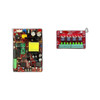
Lifesafety Power FPO75-B100C4D8PE2M/P4-A 75W Power Supply
The Lifesafety Power FPO75-B100C4D8PE2M/P4-A is a 75W distributed power supply designed for access control, door locks, and life safety integration in commercial and institutional facilities. It delivers selectable 12V or 24V output with independent relay lock control and auxiliary circuit management, eliminating the need for separate power modules across multiple circuits. Built-in failsafe/failsecure switching and per-output fusing make it suitable for single-access points or small multi-door deployments where centralized power distribution reduces installation complexity.
Key Features
- Dual-Voltage Output: 6A @ 12V or 3A @ 24V. Choose the voltage rail that matches your lock actuators and integrated circuits without needing separate supplies.
- Four Relay Lock Control Outputs: Class 2 power limited, 3A per output, individually fused. Each output selectable for FAI (Fail As Is), failsafe, or failsecure mode — adjust behavior per-door without rewiring.
- Eight Auxiliary DC Outputs: Class 2 power limited at 2.5A per output. Bus1 or Bus2 selectable per circuit for sensor, indicator, or auxiliary load distribution.
- Adjustable Primary Output: 5–18V @ 4A maximum. Tunable voltage rail supports variable-load scenarios and legacy equipment requiring non-standard DC levels.
- Per-Output Fusing: Each relay lock output fused independently at 3A, each auxiliary output protected — prevents cascading failures across the system.
- Class 2 Power-Limited Design: Inherent safety-rated architecture compliant with life safety codes; no additional current-limiting devices needed on secondary circuits.
- Compact Form Factor: DIN-rail mountable in standard electrical enclosures; reduces panel real estate compared to modular supply stacks.
- FAI/Failsafe/Failsecure Selectability: Per-output mode switching allows mixed door behavior in the same installation (e.g., exterior entry failsecure, emergency egress failsafe).
Access control system design often requires splitting power across multiple door circuits with independent failsafe logic. Traditional approaches stack individual relay modules and power supplies, consuming enclosure space and adding interconnect complexity. The FPO75 consolidates four relay lock outputs and eight auxiliary outputs into a single 75W supply, reducing BOM cost and installation labor on multi-door or multi-zone deployments. The selectable failsafe/failsecure mode per output eliminates the need for external relay logic — you configure behavior at the terminal block, and the supply enforces it.
The 5–18V adjustable primary output accommodates legacy equipment and variable-load scenarios: older electromagnetic locks typically run 12V at higher current draw, while newer proportional solenoids may require 24V at lower milliamp loads. The auxiliary bus allows sensor or indicator circuits to operate independently from the lock power rail, preventing sensor transients from affecting door-release timing. Each auxiliary output selectable for Bus1 or Bus2 enables you to isolate high-current load groups and prevent cumulative inrush current spikes that would otherwise trigger nuisance faults.
Integration with access control panels (Honeywell ProWatch, Salto, Genetec PTZs, or hardwired relay-based systems) is straightforward: relay lock outputs wire directly to door release contactors or electronic lock interfaces; auxiliary outputs feed sensors, status LEDs, or call buttons. ONVIF-capable IP intercoms and video door stations can trigger lock release via the relay outputs without requiring a separate 12V power distribution module. Class 2 power-limited design means wiring to sensors and indicators can share conduit with low-voltage signal wiring — no high-voltage separation required.
The FPO75-B100C4D8PE2M/P4-A is suitable for facilities needing modular, per-door failsafe control without investing in larger cabinets or external relay banks. Building code and NFPA 101 Life Safety Code compliance is straightforward: failsafe mode ensures emergency egress routes unlock on power loss, and per-output fusing satisfies branch-circuit protection requirements. For multi-building campuses or tenant-space deployments where door behavior must change seasonally or by occupancy, the output-level mode switch avoids costly panel redesigns.
Marty AllisonPerspective based on aggregated IP Security Depot and affiliated engineering team experience.
We've specified the Lifesafety Power FPO75 across dozens of mixed-use facilities — office parks, healthcare campuses, and hybrid retail-residential buildings — where access control and egress requirements vary by zone. The real operational win is the per-output failsafe/failsecure selectability combined with independent 3A fusing. Most integrators start with a single failing-secure entrance and emergency-route failing-safe egress in the same panel. Without this supply, you'd buy two separate modules and stack them; the FPO75 does both in one DIN-rail footprint. The 75W budget is tight for high-current proportional solenoid locks (each can draw 2–3A sustained), so you're realistically managing four to six medium-draw locks per supply. On larger deployments, you'll daisy-chain two supplies, but the wiring overhead is minimal — just secondary power and relay trigger lines between enclosures. What differentiates this supply from commodity 12V/24V switchmode units is the integrated relay logic and per-output fusing: you're not buying a power supply and then stapling on a relay module. That's where the labor savings materialize during troubleshooting — a blown 3A fuse on relay output #2 doesn't take out output #1, so you isolate failures fast and keep unrelated doors running while you swap a fuse.
Technical Highlights:
- Adjustable 5–18V Primary Rail @ 4A: Covers both legacy 12V electromagnetic locks (requiring voltage sag tolerance) and modern low-current 24V proportional solenoids. No external DC-DC converter needed for mixed-voltage installations.
- Four Relay Outputs, Per-Output Selectable Failsafe/Failsecure/FAI: Each output is independently software-selectable without jumper changes or external relay modules. On a four-door entrance vestibule, you set exterior door failsecure (locked on power loss for security), interior egress failsafe (unlocks for life safety), and mezzanine storage failsafe (emergency override priority). This flexibility is why the supply costs more than a basic 12V unit — the embedded logic saves integration labor.
- Eight Auxiliary Class 2 Outputs @ 2.5A Each, Bus1/Bus2 Selectable: Isolates sensor and indicator loads from the primary lock power rail, preventing transient current spikes (door sensor open-close, call button debounce) from affecting door solenoid dropout time. Real-world example: a motion sensor triggering a video door station on Bus1 doesn't momentarily starve the lock solenoid on the main rail.
- Per-Output 3A Fusing (Relay) and Per-Output Protection (Auxiliary): Cascading fuse arrays prevent a single short circuit from killing all outputs. We've seen integrators accidentally feed 24V to a 12V sensor — the fuse on that one output blows, output #1 through #3 stay live, and the facility doesn't lose all door access. That resilience is worth the cost in high-availability environments.
- Class 2 Power-Limited, UL-Listed: Inherently safe architecture — no separate current-limiting transformers or power-limited relays required downstream. Wiring from the auxiliary outputs can share conduit with low-voltage signal lines per code, reducing trenching and conduit runs on retrofit installations.
Deployment Considerations:
- 75W total capacity means four 12V @ 3A locks will nearly max out the supply. If you're chaining proportional solenoids (1–2A each) with readers and buzzers, plan two supplies per four-door cluster to avoid voltage sag under simultaneous activation. Measure actual lock current during site survey — spec sheets often list peak inrush; sustained current is what matters for power budgeting.
- Failsafe mode on relay outputs is NOT the same as failsafe logic at the panel controller. If the supply loses mains power, outputs go failsafe/failsecure as selected. But if the panel software hangs and never de-energizes the relay, the supply can't force unlock. Always pair with a dedicated emergency unlock button wired direct to the failsafe output, independent of software control.
- The four relay lock outputs have no load-side isolation diode. If you're running long wire runs (50+ feet) to a distant lock solenoid, solenoid kickback can ring the relay contacts and create transient spikes. Install a 1N4007 diode across each solenoid coil at the lock end — standard practice, not a flaw, but an oversight during integration can cause nuisance faults.
- Auxiliary outputs are NOT adequate for powering IP cameras or access control panel peripherals drawing sustained current above 2.5A. If you need to power a wiegand reader or badge printer, check the datasheet current draw; most readers are <500mA, but some encrypted readers with embedded SSL certificates can spike to 1A during authentication. Stay well under the 2.5A per-output ceiling to avoid nuisance drops.
- The 5–18V adjustable primary rail is useful but not a substitute for a voltage regulator downstream. If your lock solenoid requires dead-on 24V ± 2V for reliable engagement, don't rely on the supply's potentiometer trim alone — the supply is ±10% at best. Confirm field measurement with a DVM before final commissioning.
The FPO75-B100C4D8PE2M/P4-A is the right fit for integrators building multi-door access control systems in commercial real estate where failsafe/failsecure selectability and compact panel design are priorities. It's overkill for a single-door stand-alone install, and it's undersized for data-center access matrix deployments (buy a larger 120W or 240W supply). For the 2–6 door mid-range, it's a labor-saving choice that reduces integration cost and improves troubleshooting speed on failure events. See the Lifesafety Power catalog for other distributed supply sizes and modular configurations.