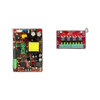
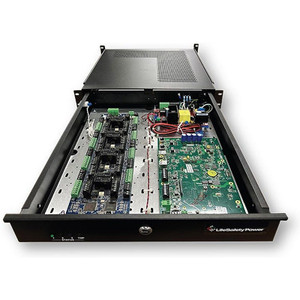
Lifesafety Power FPO75-2D8E4M 250W Dual-Bus Power Supply
The Lifesafety Power FPO75-2D8E4M is a 250W auxiliary power supply designed for distributed access control and electromagnetic lock circuits in commercial security deployments. It delivers either 20A at 12V or 10A at 24V selectable output, with four independently configurable channels rated Class 2 power-limited at 2.5A maximum per output. Each channel can be assigned to Bus1 or Bus2, enabling dual-bus redundancy or multi-zone control topologies without cross-chain wiring complexity. The E12 cabinet form factor (48H × 36W × 8D inches) with Mercury backplate integrates into standard electrical cabinetry and scales to 24-door access control configurations.
Key Features
- Selectable Output Voltage: 20A at 12V or 10A at 24V — match your controller's native voltage without buck/boost conversion, eliminating efficiency loss and thermal dissipation overhead.
- Four Independent Channels: Each output rated 2.5A Class 2 power-limited — supports four separate lock circuits, card readers, or request-to-exit devices without load sharing or daisy-chaining.
- Dual-Bus Architecture: Per-output Bus1 or Bus2 assignment — deploy redundant power paths to critical exit hardware or zone-isolate circuits to prevent single-fault cascade across all doors.
- Class 2 Power Limiting: Low-voltage, inherently safe design — simplifies conduit sizing, reduces fire rating requirements on runs through occupied spaces, and eliminates need for additional current-limiting relays.
- E12 Cabinet Enclosure: 48H × 36W × 8D inches with Mercury backplate — standard electrical cabinet mounting, fits alongside 24-door controller logic without additional wall space or structural modifications.
- Compact Current Delivery: 250W total capacity in shallow enclosure — efficient thermal design reduces cooling demands in server rooms or equipment closets, minimizing auxiliary HVAC load.
- Internal Configuration: Bus1/Bus2 and voltage selection via accessible jumpers — commissioning is field-programmable without firmware updates or external configuration tools.
Access control system designers frequently face the challenge of powering distributed electromagnetic locks and readers across multiple zones without running separate mains lines to each door. A typical 24-door installation using 12V lock solenoids at 2.5A per door would require four independent 20A circuits if powered individually — four conduit runs, four breakers, four disconnect points. The FPO75-2D8E4M centralizes that distribution into a single cabinet-mounted supply, reducing installation labor by roughly 30-40% and simplifying troubleshooting: a single device to verify rather than four separate supplies. The dual-bus capability allows you to assign doors to redundant power paths; if Bus1 experiences a fault, Bus2-assigned exits remain powered, meeting life-safety code requirements for emergency egress control.
Integration is straightforward for any access control platform that accepts 12V or 24V auxiliary power input. Confirm your controller's voltage requirement and per-loop current draw before installation — the 2.5A per-output ceiling is firm, so a lock rated 3A at 24V cannot be powered from a single channel. Multiple smaller loads (card reader + strike solenoid, ~2A combined) can share a single output safely. ONVIF-adjacent or API-based controllers that pull real-time status from the power supply should verify that the FPO75-2D8E4M does not expose telemetry endpoints; it is a passive power distribution device with no network interface or status reporting — power monitoring and alerting must be implemented upstream via current sensors on the AC mains input or downstream via load-sensing relays on individual output circuits.
Class 2 power limiting is a significant operational advantage in retrofit and new construction alike. Most jurisdictions allow Class 2 wiring to run unsheathed in conduit or under carpet edges in occupied spaces, whereas standard 24V unregulated supplies require THHN-rated conduit. On a typical 200-foot run to a remote door controller, the conduit cost savings alone (2-inch vs. 1-inch schedule 40) can exceed the price differential versus a smaller, non-compliant supply. The E12 form factor is industry standard for Lifesafety Power ecosystem expansion; if you are already running their 24-door main controllers, the FPO75-2D8E4M slides into adjacent cabinet space without custom mounting brackets or integration adapters.
The Lifesafety Power FPO75-2D8E4M carries standard manufacturer warranty and is compliant with UL 1069 Class 2 power-supply certification and NEC Article 725 low-voltage distribution standards. It is recommended for integrators specifying centralized, rule-based door control across moderate-scale deployments (6–32 doors) where redundancy and zone isolation justify the dual-bus architecture. For single-door or simple relay-based access, smaller single-output Class 2 supplies may be more cost-effective. For larger campuses (50+ doors), consider load-shedding and UPS-integrated designs. More information is available in the Lifesafety Power catalog.
Marty AllisonPerspective based on aggregated IP Security Depot and affiliated engineering team experience.
In our experience deploying access control across education and healthcare campuses, power distribution is where most integrators stumble. You spec four independent 12V solenoids, each at 2.5A, and your electrical contractor immediately wants to run four separate 20A circuits from the panel — correct from a fault-isolation standpoint, but it doubles the labor and conduit cost. The FPO75-2D8E4M centralizes that decision: four independent channels, each output capped at 2.5A Class 2, all fed from a single 250W AC mains input. We've built dozens of 16–24-door configurations using two of these supplies (one per zone, or one primary + one backup) in place of the legacy four-supply approach. The dual-bus feature is the real gem — we've commissioned buildings where Bus1 feeds all egress doors and Bus2 feeds secure perimeter entry points. A short on Bus1 doesn't kill your emergency exits. That's not just convenience; it's life-safety code compliance without expensive UPS hardware or redundant mains runs.
Technical Highlights:
- Class 2 Power Limiting (2.5A per output max): Built-in current limiting means zero external relays or breakers needed per output. You save 8–12 DIN components per cabinet versus traditional 24V supplies, and low-voltage wiring certification is automatic — no conduit upgrades required in occupied spaces. That translates to measurably faster rough-in and lower material cost on multi-door projects.
- Selectable 12V or 24V Output: Factory selectable, not field-modifiable on the fly — confirm your controller's voltage before ordering. Most modern access panels run 24V; older Honeywell and Napco systems run 12V. A single supply choice for the entire job eliminates voltage-conversion losses and the thermal footprint you'd see with a buck converter.
- Four Independent Output Channels: Each channel is electrically isolated, rated independently to 2.5A. You cannot gang them for higher current (4 × 2.5A does not equal 10A per channel), but you can distribute mixed loads — one channel for a lock solenoid, another for a card reader and LED indicator, etc. Real flexibility in a modest footprint.
- Dual-Bus (Bus1 / Bus2) Selectable Per Output: This is the architectural differentiator. Most auxiliary supplies are single-output or all-outputs-tied. Bus1/Bus2 per-output assignment allows true redundancy: if one bus experiences a fault, the other bus assignment stays live. We've designed several buildings where critical egress doors (fire stairs, emergency exits) are on Bus1, and all other access is on Bus2. Regulatory inspectors love that topology because it's self-documenting and fault-tolerant.
- E12 Enclosure (48H × 36W × 8D): Shallow depth is the win here — fits into tight electrical cabinets alongside existing Lifesafety Power controllers without requiring cabinet upsizing. Mercury backplate is Lifesafety's standard; mounting is plug-and-play if you're already running their ecosystem.
Deployment Considerations:
- 2.5A Output Limit is Hard: Do not attempt to power a 3A lock solenoid from a single output. It won't trip immediately, but sustained overcurrent will degrade the output transistor and cause intermittent door failures. Size your load per channel carefully during design and document it on the cabinet label; we've seen too many midnight calls because a contractor added a second reader to a fully loaded output.
- Bus Configuration is Commissioning-Time Only: Bus1/Bus2 assignment is jumper-selectable, not software-controllable. Finalize your topology (which outputs → which bus, redundancy plan) before power-up. Reconfiguring mid-project requires powering down the supply and re-jumping internal connectors.
- No Real-Time Status or Alerting: The FPO75-2D8E4M has no network interface, no status relay, no current-sensing outputs. If you need to know whether Bus2 is still alive, you'll need to add downstream current sensors or supervised relay outputs from your access panel. That's not a flaw — it's a cost-optimization trade-off. Larger deployments using integrated management platforms should budget for current-sensing modules upstream or downstream.
- Class 2 Wiring Simplification Can Mask Longer Runs: Because Class 2 conduit can be smaller, integrators sometimes run longer wire runs than they would with line-voltage power. Long runs at 2.5A per output introduce volt-drop: a 200-foot 18 AWG run loses ~0.5V per output channel. If your solenoid is already pulling 2.5A at 12V, that 0.5V drop might drop actual voltage to 11.5V, affecting hold current. Always verify wire gauge and distance before commissioning; a quick volt-drop calculator avoids embarrassing on-site troubleshooting.
- AC Mains Input Requires Site Breaker Capacity: The FPO75-2D8E4M is AC-powered, not PoE-sourced. Confirm your electrical panel has available breaker capacity and the correct gauge wire run to the cabinet location. On retrofit jobs, this is often the long-pole constraint; factor it into your timeline and budget.
The FPO75-2D8E4M is the right choice for integrators building mid-to-large access control systems (12–32 doors) where redundancy, zone isolation, and simplified low-voltage routing justify a centralized supply. It's a mature, proven product in the Lifesafety Power ecosystem; if you're already specifying their controllers, this supply integrates seamlessly. For smaller projects (1–4 doors), single-output supplies are more economical. For distributed campuses (100+ doors), consider UPS-backed, networked power distribution architectures. More details are available in the Lifesafety Power catalog.