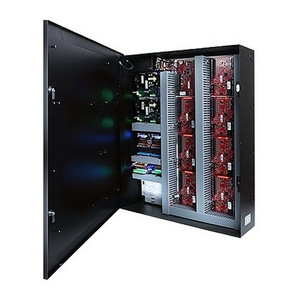
Lifesafety Power FPO250-2D8PE1 250W Dual-Output Power Supply
Overview
The Lifesafety Power FPO250-2D8PE1 is a 250W redundant power supply designed for distributed camera and access control deployments where you need robust, selectable voltage rails across multiple outlets. The unit delivers either 20A at 12VDC or 10A at 24VDC — a choice that affects your voltage drop calculations over long cable runs and your ability to daisy-chain lower-amperage devices. The FPO250-2D8PE1 includes eight independently selectable Class 2 power-limited outputs, each capable of 2.5A, distributed across two monitored buses (Bus1 and Bus2). This architecture lets you isolate critical circuits (e.g., door locks on one bus, lighting on another) and supervise them separately.
Physical footprint is compact: 14H x 12W x 4.5D inches. The E1 enclosure size makes it a practical fit for wall-mount cabinets, equipment racks, or retrofit scenarios where space is constrained but power density matters.
Key Features
- 250W total capacity: Sufficient for 8–12 megapixel IP cameras plus access control readers, badge encoders, or small maglocks in the same circuit. Do the math: a typical 5MP camera draws 5–8W; a door reader draws 1–3W. You can comfortably serve a mixed install without a separate panel.
- Dual voltage rails (12V/20A or 24V/10A): Choose 12V for legacy analog systems or short runs; pick 24V for longer cable distances where voltage drop would cripple a 12V supply. This flexibility avoids the expense and installation headache of parallel supplies.
- Eight selectable outputs at 2.5A per channel: Each of the eight Class 2 outlets can be assigned to Bus1 or Bus2 independently. Useful for segregating power domains — for example, cameras on one bus, readers on another — so a short on the camera side doesn't kill door access.
- Two monitored buses: Supervision capability (if the control panel or management system supports it) allows real-time feedback on Bus1 and Bus2 status. Not all integrators leverage this, but it's there if your architecture demands it.
- E1 enclosure form factor: 14 inches high fits standard 19-inch rack rails and wall-mount frames. Depth of 4.5 inches is shallow enough for retrofit in crowded cabinet backs without blocking patch panels or terminal blocks.
- 16V DC auxiliary output specification: The FPO250-2D8PE1 is rated for 16V DC across its outputs, a common nominal for Class 2 regulated supplies. This voltage is stable enough for camera PoE injectors, reader power, and small solenoid coils that tolerate ±10% swing.
Integration & Compatibility
The FPO250-2D8PE1 pairs well with any wired camera system or access control panel that accepts 12VDC or 24VDC Class 2 power. If you're running access control systems that require discrete power rails for different zones, this unit's dual-bus architecture supports that topology without forcing you to buy two separate supplies.
For IP camera deployments, this supply is often used as a backup or supplemental power source in a multi-camera rack alongside a PoE switch. It won't power cameras directly (they draw PoE), but it can power lens motors, IR illuminators, or auxiliary switches that your camera layout demands.
When planning your power budget, remember: the 20A/12V rail delivers 240W total, while the 10A/24V rail delivers 240W. Both saturate at the same 250W thermal limit. If you're mixing devices across both buses, monitor aggregate amperage — exceeding 20A on 12V or 10A on 24V will trigger thermal shutdown or regulatory current limiting.
Power & Environmental Considerations
No battery backup or UPS integration is noted in the FPO250-2D8PE1 specification. This is a raw power supply, not a standby unit. If you need hold-up on power loss, you'll need to add an external UPS or separate battery charger module — a common integration move in critical door-control or camera-at-entry scenarios.
Operating temperature range and surge/spike suppression details are not included in the available specification. For hazardous locations or outdoor cabinet installations, verify thermal and environmental ratings with the manufacturer before commissioning.
When to Choose a Different Model
If you need integrated battery backup, seek a Lifesafety Power unit specifically rated for UPS or standby operation. If your demand exceeds 250W, or if you require more than eight outputs, consider a larger model in the Lifesafety Power family or a modular DIN-rail supply system that allows you to stack units. If your environment is outdoor and unshielded, confirm IP ratings before proceeding — the FPO250-2D8PE1 specifications do not indicate environmental sealing.
Frequently Asked Questions
Q: Can I run both 12V and 24V outputs simultaneously on the FPO250-2D8PE1?
A: No. The FPO250-2D8PE1 outputs are selectable for either 12V/20A or 24V/10A configuration, not simultaneously. You choose one voltage and operate at that level across all outputs.
Q: What is the amperage limit per individual output on the FPO250-2D8PE1?
A: Each of the eight outputs is Class 2 power-limited to 2.5A maximum. This protects against shorts and overload on individual circuits without killing the entire supply.
Q: Is the FPO250-2D8PE1 suitable for outdoor mounting?
A: The specification provided does not include IP rating or environmental certification. For outdoor use, verify thermal operating range and moisture protection with the manufacturer before installation.
Q: Does the FPO250-2D8PE1 have battery backup?
A: No. The FPO250-2D8PE1 is a regulated power supply only. Battery backup or UPS capability requires a separate module or external battery system.
Q: How many cameras can the FPO250-2D8PE1 power?
A: The FPO250-2D8PE1 does not deliver PoE directly. It supplies auxiliary power (12V or 24V) for non-camera devices such as IR illuminators, lens motors, readers, and door locks. For IP cameras, use a PoE switch or injector on a separate network circuit.
Q: What does "Class 2" mean on the FPO250-2D8PE1 outputs?
A: Class 2 means the output is current-limited and regulated to safe voltage levels (under 50V). This prevents dangerous electrical conditions and allows direct connection to low-power devices without additional fusing, simplifying installation in access control and auxiliary power scenarios.
I've specified the FPO250-2D8PE1 (often searched as FPO250 2D8PE1) in distributed access control and surveillance backbone scenarios where you need clean, isolated 12V or 24V power without the footprint penalty of a full UPS rack. The dual selectable voltage outputs and eight individually supervised channels give you legitimate architectural flexibility — you're not forced into a one-size-fits-all topology.
Technical Highlights:
- 250W capacity split across 12V/20A or 24V/10A: The 20A rail at 12V is useful for short runs under 100 feet; the 10A/24V rail works better for longer cable distances where the higher voltage reduces resistive drop and keeps downstream devices at nominal voltage. This choice avoids the cost of running parallel supplies.
- Eight 2.5A Class 2 outputs on two monitored buses: Segregating circuits (cameras on Bus1, doors on Bus2) prevents a shorted lens motor or reader from collapsing power to your locks. Each output is independently limited, so a sustained short on one channel doesn't cascade.
- E1 form factor at 14H x 12W x 4.5D inches: Shallow depth fits retrofit installations where space behind existing panels is measured in inches, not feet. The compact footprint doesn't compromise on output count or current capacity — it's a genuinely useful design for edge-mounted scenarios.
Deployment Considerations:
- This unit has no integrated battery or standby capability. If you're powering door strikes, mag locks, or alarm panels, pair it with a separate UPS or battery module — a cost multiplier many integrators overlook until commissioning fails at 2 a.m.
- The FPO250-2D8PE1 does not include datasheet specs on operating temperature or surge suppression. Before installing in uncontrolled or outdoor cabinets, confirm thermal and EMI hardening with the manufacturer — Class 2 power doesn't mean weatherproof.
Positioning: Deploy the FPO250-2D8PE1 as a secondary power backbone in multi-building campuses where each building has its own 24VDC reader and lock infrastructure fed from a central plant UPS. The dual-bus architecture lets you daisy-chain reader power on Bus1 and solenoid coils on Bus2 without cross-talk or nuisance lockouts. Not ideal for single-camera outdoor bullet installs, but for integrated access and surveillance core infrastructure in retail, hospitality, or campus environments, it's a solid fit.