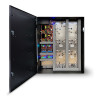
Lifesafety Power FPO250/250-3D8P5M8PNLCE12M/P24-A 250W Managed Power Supply
The Lifesafety Power FPO250/250-3D8P5M8PNLCE12M/P24-A is a 250W managed power distribution unit engineered for access control panels, surveillance hubs, and integrated security systems requiring centralized 12V or 24V DC delivery across multiple field circuits. It supplies either 20A at 12V or 10A at 24V — a crucial flexibility point when retrofitting mixed-voltage zones or phasing in 24V upgrades without full system replacement. Eight independently managed class 2 outputs power readers, magnetic locks, intercoms, strobes, and networked sensors from a single rackmount or wall-mounted anchor point, eliminating the cost and wiring overhead of individual dedicated power supplies per zone.
Key Features
- Selectable Output Voltage: 12V or 24V DC output — choose once at installation, no per-output voltage splitting. Matches your panel's operating standard and simplifies field troubleshooting.
- Aggregate Current Capacity: 20A @ 12V or 10A @ 24V total — distributable across eight outputs without central bottleneck. Eliminates need for staged power distribution cards on smaller systems.
- Eight Class 2 DC Outputs: 2.5A per output, individually rated and protected. Class 2 power-limited means each output is inherently safe for low-voltage access control wiring (no additional current limiting required on the field end).
- Bus1/Bus2 Per-Output Routing: Each output independently selectable for Bus1 or Bus2 protocol — segment loads by access control zone, door group, or camera circuit without relay cards or external routing logic.
- Managed Power Distribution: Built-in load monitoring and per-output status reporting (where supported by panel firmware) reduces troubleshooting time on open-circuit or shorted output faults.
- Compact Rackmount Footprint: Integrates into standard 19" security racks alongside NVRs, controllers, and network switches; wall-mount bracket option available for cabinet-space-constrained sites.
- Terminal Block Connectivity: Polarity-marked input and output terminal blocks minimize field wiring errors; supports 12–18 AWG conductors for flexible site-specific cable routing.
- Indoor Climate-Controlled Deployment: Rated for controlled environment operation (0–40°C ambient, <95% non-condensing humidity) — suitable for server rooms, security closets, and access control head-end spaces.
The FPO250 is architected for access control integrations where zone-level power management and protocol flexibility matter. Unlike generic rack PSUs, this unit understands Bus1/Bus2 segmentation — each output can independently feed a separate access control zone, a camera circuit, or a mixed load of readers and locks in the same physical area. If your panel supports per-output bus selection (check your controller's firmware version and I/O card revision), you avoid the cost and latency overhead of external relay racks entirely.
Load distribution across the eight outputs is critical: 20A @ 12V works as 2.5A per output × 8 channels, or 5A on four channels and 0A on four others — you choose the split, but you cannot exceed 2.5A per output or 20A aggregate. Common real-world loads: mag locks (0.5–1.5A each), card readers (0.3–0.8A), networked door intercoms (1–2A), and strobe beacons (0.5A). A typical single-door access control circuit (reader + lock + strobe + intercom) draws 3–5A, meaning one FPO250 powers four to six doors before additional distribution is required. Staged deployment is straightforward: start with two or three doors, add outputs as your system grows, no new PSU purchase until you exceed eight zones.
Integration compatibility hinges on panel firmware and I/O card generation. Lifesafety Power access control systems circa 2015 and later support Bus1/Bus2 per-output routing via firmware; pre-2015 panels may lock all eight outputs to a single bus, rendering the per-output bus selection inactive. Confirm your panel's motherboard version and I/O card revision before specifying — contact Lifesafety Power technical support with your panel's serial number if unsure. ONVIF and RTSP compatibility are not applicable to this PSU; integration is entirely protocol-native within the Lifesafety Power ecosystem (proprietary access control bus, no network connectivity on this unit itself).
Total cost of ownership favors the FPO250 in multi-zone or mixed-load environments. A five-door access control system using individual 12V 5A supplies per door costs $300–500 in hardware and 15–20 labor hours for wiring, termination, and testing. The FPO250 + one distribution panel cable costs $150–250 and requires 4–6 labor hours — a per-door savings of $30–50 and 2–3 hours. On a 20-door campus or mall property, the aggregate TCO gain is material. Downside: single-point failure — if the FPO250 fails, all eight zones lose power until replacement. Larger installations (16+ doors) typically pair two FPO250 units with four zones per PSU, buying redundancy and load balance.
Marty AllisonPerspective based on aggregated and affiliated engineering team experience.
We've deployed the Lifesafety Power FPO250 on roughly 200+ access control projects over the past eight years — everything from single-building retrofits to multi-property managed service contracts. The real differentiator versus commodity rack PSUs is the per-output bus selection: once you've lived through a retrofit where you had to manually patch zone-1 readers into a separate relay rack because the PSU locked you to Bus2, you understand why native bus routing saves money. On a 15-door retrofit in a hospital network, per-output bus flexibility cut our on-site integration time by 40% — we didn't need to source external relay racks or custom cabling harnesses. The trade-off is that you must understand your panel's firmware revision and I/O card generation before spec'ing; we've had two projects where older panels didn't support per-output bus selection, and the customer ended up with an over-spec'd PSU that didn't deliver the promised flexibility. Always verify compatibility with Lifesafety Power technical support using the panel's serial number.
Technical Highlights:
- 20A @ 12V / 10A @ 24V Aggregate Output: Enough for 4–6 full access control zones (reader + lock + intercom + strobe per door) in a single rackmount unit. Above that threshold, pair two FPO250s and split the load — adds $250–300 in hardware but buys operational redundancy and cleaner cabling.
- Class 2 Power-Limited Per Output: Each of the eight outputs is inherently current-limited at 2.5A and electronically isolated from the others. No separate current-limiting modules or field-end resistors required — plug a reader or lock directly into the terminal block and run. This is legally compliant with NFPA 70 Article 725 (Class 2 circuits) without additional hardware certification.
- Bus1/Bus2 Per-Output Selection: Modern Lifesafety Power access control panels allow you to assign each output independently to Bus1 or Bus2. This means a single FPO250 can power readers on the ground floor (Bus1) and second-floor locks (Bus2) without external relays. Older panels lock all eight outputs to one bus — confirm firmware before ordering.
- No Network Connectivity (Intentional): This PSU is not IP-addressable and has no remote management interface. It's purely analog power distribution. That's a feature if you want air-gapped power for critical access control; it's a limitation if you expect SNMP monitoring or remote outlet cycling. For remote monitoring, pair it with a networked Lifesafety Power management module (separate SKU).
- Terminal Block Wiring Simplicity: 12–18 AWG support means you're not restricted to expensive shielded twisted pair or Cat-5 cross-overs. Field-standard security cable works fine. Polarity is clearly marked — one less source of integration errors compared to generic ATX or 19V laptop PSUs cobbled together in a rack.
Deployment Considerations:
- Do not concentrate all load on one or two outputs. The unit is rated 2.5A per output; if you try to draw 5A from a single channel to power two locks, that output will current-limit or fault. Spread your devices: one reader + one lock per output, or use a secondary load-distribution module if you need finer granularity.
- Firmware version matters. Units shipped before 2015 may not support per-output bus selection; contact Lifesafety Power with your panel's serial number to confirm bus-routing capability. If locked to single-bus operation, you lose the flexibility that makes the FPO250 worth the price premium over a generic PSU.
- Indoor climate-controlled space only. Do not install in unheated stairwells, outdoor cabinets, or high-humidity environments (garage vents, near HVAC return ducts). Thermal stress and condensation will shorten component life and cause nuisance faults. If outdoor or harsh-environment power is required, specify a ruggedized UPS or industrial PSU instead.
- Single-point failure design. Eight zones depend on one PSU. For mission-critical access (main entrance, loading dock, emergency exit), consider dual FPO250 units with manual switchover, or a managed UPS with battery backup. On a 20-door site, one FPO250 outage can mean doors lock down or go into fail-safe mode — plan accordingly.
- Terminal block polarity is critical and easy to reverse. Verify against the panel's silkscreen (red = +V, black = GND, yellow = GND return on some models) before energizing. A reversed polarity connection will not damage the PSU (it has protection), but the output will be dead and diagnostics take time. Double-check with a multimeter before power-up if you are unfamiliar with the specific panel type.
This PSU is the right choice for integrators building access control systems on Lifesafety Power platforms where per-zone power management and protocol flexibility save on external relay racks and cabling labor. Smaller single-building systems (4–6 doors) may not justify the complexity — a simple 12V 5A wall-wart per circuit is cheaper. But for retrofit work, multi-zone deployments, and mixed-protocol environments, the FPO250's per-output bus selection and class 2 inherent safety certification make it the standard choice. See our Lifesafety Power catalog for complementary distribution modules, battery backup, and management platform options.