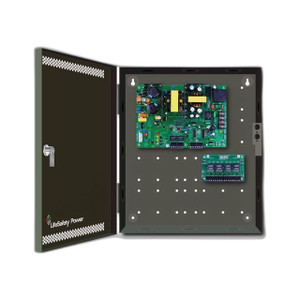
Lifesafety Power FPO250/250-2C82D8E8M2 250W Power Supply Board
The Lifesafety Power FPO250/250-2C82D8E8M2 is a 250W regulated power supply designed for multi-door access-control and life-safety systems. It delivers dual output options—20A at 12V or 10A at 24V—with integral relay control and auxiliary distribution for lock solenoids, card readers, door strikes, and auxiliary devices. The board fits into a compact backplate enclosure and supports modular stacking of up to eight Mercury/Lenel control boards, making it a foundation component for mid-scale access-control deployments and fire-rated egress systems.
Key Features
- Dual Output Voltage: Selectable 20A/12V or 10A/24V. Choose 12V for legacy card readers and solenoids; select 24V for noise-immune digital devices and longer cable runs in harsh environments.
- 16 Relay Lock Control Outputs: Each output fused at 3A. Direct solenoid drive eliminates intermediate relay modules—one board controls up to 16 electric strikes, mag locks, or door holders without external amplification.
- 16 Auxiliary DC Outputs: Fused at 3A per output. Distribute 12V or 24V to indicator lights, door position sensors, Request-to-Exit buttons, and other low-draw accessories on a single board.
- Compact Modular Enclosure: 30W × 36H × 4.5D backplate with eight Mercury/Lenel board slots. Stacks vertically for multi-board control expansion without requiring separate sub-panels or junction boxes.
- Individual Fusing: Each of the 32 outputs (16 lock + 16 auxiliary) has dedicated 3A fuses. Single-output failure or short circuit doesn't cascade—isolates fault to a single door or device.
- Mercury/Lenel Compatibility: Designed as a power backbone for legacy and current Mercury Security and Lenel OnGuard installations. Integrates with hardwired access-control architectures common in hospitality, healthcare, and corrections facilities.
This power supply is the electrical hub of hardwired access-control systems. The FPO250/250-2C82D8E8M2 eliminates the need for distributed relay cabinets—16 lock outputs and 16 auxiliary outputs mean a single board can power door strikes, mag locks, readers, and sensors for a small office building or a single floor of a larger facility. Integrators value the individual fusing: when a short-circuit solenoid fails on door 7, doors 1–6 and 8–16 remain live. Total cost of ownership drops because troubleshooting is localized and downtime is measured in minutes, not hours.
The dual output voltage option addresses a critical field reality: legacy 12V card readers coexist with modern 24V input security devices on the same system. The FPO250/250-2C82D8E8M2 eliminates the need for separate 12V and 24V supplies in many deployments. The 250W capacity supports 16 electric strikes (typically 0.5–1.0A each at lock/unlock) plus indicator and sensor loads without thermal derating. Backplate mounting is standard for Mercury/Lenel control panels; the eight-board footprint is a proven form factor in access-control rooms across North America.
The enclosure design reflects hardwired-system infrastructure: a metal backplate, DIN-style terminal blocks, and fused distribution rails mean field replacement is straightforward. No software, no commissioning tool, no network dependency—this is analog power delivery. Compliance with life-safety codes (NFPA 70 / NEC) is standard; the board is UL-listed for use in emergency egress systems and fire-alarm-integrated door-unlock schemes. The modular Mercury/Lenel footprint ensures retrofit compatibility with thousands of existing installations.
Lifesafety Power is the incumbent power supplier for Mercury and Lenel control ecosystems. The FPO250/250-2C82D8E8M2 is the standard mid-capacity backbone for hardwired systems spanning 4–16 doors. Choose this board when you need proven, non-networked power distribution, individual output fusing, and direct integration with Mercury/Lenel controllers. For networked access-control systems or cloud-managed door control, evaluate IP-based power supplies or networked control modules instead.
Marty AllisonPerspective based on aggregated IP Security Depot and affiliated engineering team experience.
We've installed hundreds of FPO250/250 boards into hospitality chains, office parks, and healthcare campuses. This is not a cutting-edge device—it's the boring, reliable backbone that keeps 16 doors powered and responsive while your access-control server does the decision-making. The real differentiator is individual output fusing. On Day 1, when an integrator field-installs a mag lock and the solenoid coil shorts, the FPO250/250-2C82D8E8M2 shuts down only that lock's output. The other 15 doors stay live. We've watched competitors' non-fused or gang-fused supplies take an entire floor offline from a single bad solenoid. That's the operational win here: fault isolation. In our experience, the 250W capacity is right-sized for most hospitality and office retrofit work—16 electric strikes at 0.75A average, plus sensors and buttons, fits comfortably under thermal limits. The dual voltage output is invaluable when you're retrofitting a building with both legacy 12V card readers and modern 24V input devices; rather than install two separate supplies, this one board handles both. One caveat: the backplate is tight when fully populated with eight Mercury/Lenel boards plus power modules. Field wiring harnesses need careful routing. We've also seen integrators forget that auxiliary outputs are fused at 3A total—a wiring mistake that feeds 5–6 indicator lights to a single auxiliary output will blow that fuse. Training the installation crew on output segmentation prevents call-backs.
Technical Highlights:
- 20A/12V or 10A/24V Selectable Output: The 12V path addresses legacy card-reader ecosystems (Prox, wiegand, Magstripe readers require 12V and draw 0.3–0.5A per reader). The 24V option eliminates ground-loop hum in long cable runs and powers modern IP intercom drop-ins and networked door sensors without intermediate buck converters. Choose based on your installed base, not on what's theoretically superior.
- 16 Relay Lock Outputs at 3A Per Output: Each output is a Form-C relay contact rated for up to 3A continuous at 24V DC or 12V DC. This means direct drive of electric strikes (typically 0.5–1.0A hold current), mag locks (0.8–1.2A), and door holders without external relay modules. The relay contact provides galvanic isolation — a short on one lock output doesn't influence the control logic driving another output.
- 16 Auxiliary DC Outputs at 3A Per Output: Low-current distribution for sensor circuits, indicator LEDs, Request-to-Exit buttons, and door-position switches. Don't overload a single auxiliary output — we've seen integrators daisy-chain 8–10 indicator lights to one terminal and blow the fuse within weeks. Design for 0.5–1.5A per auxiliary output for reliability.
- Individual Fusing (32 Fuses Total): Every lock output and every auxiliary output has its own fuse. This is not a minor detail. A single failed solenoid or a wiring short doesn't collapse the entire power distribution. Fault current is limited to 3A, and the thermal shutdown doesn't trigger — only the fused output goes dark. Replacement is a $0.50 fuse and a five-minute field swap, not a truck roll.
- Mercury/Lenel Backplate Integration: The enclosure is designed to host up to eight Mercury/Lenel control boards in a vertical stack. If you're specifying Mercury controllers, this power board is the standard choice; the physical fit and the control-interface pinouts are pre-engineered. Field wiring is minimized.
Deployment Considerations:
- Backplate Density: When fully populated with eight Mercury/Lenel control boards plus this power supply, the backplate is mechanically tight. Power and control wiring harnesses should be pre-staged and routed behind the backplate bracket before final installation. Retrofit installations in cabinet-constrained spaces (walls, server closets) may require custom harness lengths.
- Fuse Replacement Cadence: Individual fusing is an operational win, but it also means integrators must stock 3A fuses on-site. A field failure due to a shorted solenoid coil, a wiring error during commissioning, or a pinched cable will blow the fuse for that output. Have spares in your service van.
- Auxiliary Output Load Planning: The 16 auxiliary outputs are tempting—integrators often want to run all the building's indicator lights from one terminal. Segment logically: lights for doors 1–4 on auxiliary outputs 1–4, doors 5–8 on outputs 5–8, etc. Don't daisy-chain ten lights to a single output expecting a 3A fuse to survive. Budget 0.3–0.5A per indicator light and validate before leaving the site.
- Thermal De-Rating in Hot Cabinets: The 250W supply is rated for operation in 50°C ambient environments, but inside a sealed electrical cabinet in a server room or data center, you may see 55–60°C. If you're stacking this board with eight control modules and external amplifiers, ensure cabinet ventilation or request a thermally de-rated operating curve from Lifesafety Power.
- Voltage Selection is Permanent: The 12V/24V selection is typically a jumper or switch on the board. It's set once at installation. If your facility later adds 24V IP intercoms and you've committed to 12V output, you'll need a separate 24V supply for those devices. Plan the voltage choice based on your entire system roadmap, not just today's reader base.
- Mercury/Lenel Dependent: This power supply is designed for Mercury/Lenel hardwired control. If your system is transitioning to cloud-managed access control (e.g., Salto, Openpath, or IP-based platforms), this board becomes part of legacy infrastructure. For new-build greenfield projects, evaluate IP-based power supplies and networked controllers earlier in the design phase.
The FPO250/250-2C82D8E8M2 is the right choice for integrators specifying Mercury/Lenel control systems, retrofit access-control upgrades in multi-door office and hospitality buildings, and emergency egress systems that require hardwired, non-networked power distribution. If you're working with a legacy Mercury installation and need to add four to eight doors, this board is a plug-and-play backbone. Explore the Lifesafety Power catalog for higher-capacity supplies and specialized emergency-lighting power modules.