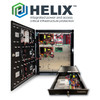
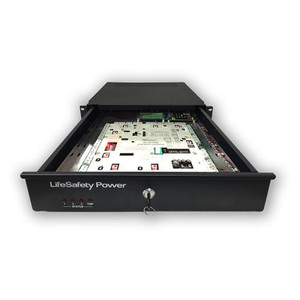
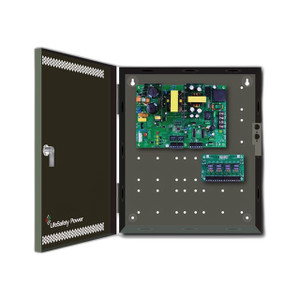
Lifesafety Power FPG200-B100C4D8PE4M/P4-A 200W Power Supply
The Lifesafety Power FPG200-B100C4D8PE4M/P4-A is a universal-input 200W power supply engineered for distributed access control, emergency egress, and ancillary life-safety circuit distribution. Designed to operate across wide AC input ranges and deliver independently-configurable relay and auxiliary outputs, this supply bridges legacy hardwired lock control infrastructure with modern networked access systems. System architects deploy this unit as a hub for multi-door access clusters, emergency lighting circuits, and mixed failsafe/failsecure lock topologies where output flexibility and field-selectable operation modes are non-negotiable.
Key Features
- Universal AC Input: Wide-range AC mains acceptance eliminates region-specific SKU management and simplifies international deployments.
- 4 Relay Lock Control Outputs: 24V/8A capacity per relay, individually fused at 3A per output; each relay selectable for Failsafe (de-energize = unlock), Failsecure (de-energize = lock), or Fire Alarm Interface (FAI) logic. Supports standard electromagnetic and solenoid lock types.
- 8 Class 2 Auxiliary DC Outputs: Power-limited at 2.5A per output for low-current ancillary loads (request buttons, credential readers, status indicators). Each auxiliary selectable for Bus1 or Bus2 — enables segregated power domains for redundancy or fail-over scenarios.
- Dual-Bus Architecture: Bus1 and Bus2 independence allows selective power distribution to door pairs or zones without cascading loss-of-power across the entire site.
- 8V DC Output Stage: Optimized step-down topology minimizes thermal overhead and improves efficiency under sustained load conditions typical of 24/7 access control environments.
- Integrated Over-Current Protection: Per-output fusing and Class 2 power limiting prevent single-load failure from affecting downstream circuits.
- DIN Rail / Backplate Mounting: Standard panel real estate — fits into electrical enclosures alongside circuit breakers, battery backup modules, and other hardened power infrastructure.
- Manual Configuration Jumpers: Field-selectable failsafe/failsecure logic via onboard jumpers — no firmware updates or network re-commissioning required to flip operational behavior.
Access control system designers rely on supplies like this FPG200 to decouple power architecture from network uptime. Even if the IP control layer (door controller, reader gateway, network switch) loses connectivity, relay and auxiliary outputs continue to operate according to their configured failsafe state — a critical requirement in healthcare facilities, government buildings, and venues subject to life-safety code enforcement. The dual-bus topology is particularly valuable in multi-floor deployments where one zone's loss of power shouldn't trigger a building-wide lockdown or emergency lighting cascade.
Field integration is straightforward: 4 relay outputs each wire directly to lock solenoids, mag-locks, or door strikes via 18-24 AWG supply cable. The 8 auxiliary outputs handle lower-draw peripherals — pushbuttons, badge readers, status LEDs — allowing technicians to consolidate power distribution into a single 24V hub rather than daisy-chaining supplies across multiple cabinet locations. Bus1/Bus2 selectability means you can provision two independent fail-over paths: if Bus1 loses mains input, Bus2 circuits remain powered, and a downstream battery backup module can be configured to back only the critical Bus2 outputs. This architecture scales efficiently across 4-12 door access points without multiplying PSU count or creating a single point of failure at the power layer.
The unit integrates with any hardwired access control system — Salto, Aperio, Lenel, Honeywell legacy panels, and card-reader networks. It does not require VMS integration, cloud connectivity, or IP signaling; failsafe operation is guaranteed by local relay state and manual jumper configuration. If your site runs a hybrid model (some doors on networked controllers, others on hardwired 24V relays), the FPG200 becomes the bridge — accepting 24V logic signals from IP-based access points and distributing real power to mechanical locks regardless of network status. This decoupling is a feature, not a limitation: it's why integrators specify these units in pharmacies, correctional facilities, and data centers where power-loss lockdown must be fool-proof.
Compliance with NFPA 101 (Life Safety Code) and IBC/IMC emergency egress requirements is inherent to the failsafe design: doors specified to unlock on power loss do so reliably via the failsafe relay configuration. The Class 2 power-limited auxiliary outputs meet low-voltage wiring code and reduce shock/fire risk compared to full 24V distribution to every sensor. Over-current protection per output prevents nuisance breaker trips and isolates failures. This supply is commonly paired with 24V battery backup modules in the same enclosure — the modular architecture supports both AC-mains and backup DC feeds without redesign. Thermal performance is stable under continuous 8A relay draw plus mixed auxiliary loads, and the integrated fusing strategy means a single shorted reader or pushbutton button won't black out the entire cabinet.
Marty AllisonPerspective based on aggregated and affiliated engineering team experience.
In our experience, the FPG200-B100C4D8PE4M/P4-A sits at a critical juncture in access control infrastructure — it's the last mile between networked logic and hardwired locks. We've seen integrators install these units in retrofit projects where new IP-based access controllers need to drive legacy 24V electromagnetic locks without replacing the entire mechanical infrastructure. The dual-bus configuration has solved real problems on our jobs: a hospital cafeteria where one access point went down during a network switch migration, but the secondary bus kept emergency exits functional. The per-relay failsafe/failsecure jumper selection is deceptively powerful — it lets field technicians field-commission the unit without a PLC or ladder-logic recompile. We've also valued the individual 3A fusing per relay output; it's saved several deployments from cascading failures when a shorted lock solenoid took out only that single door, not the entire four-relay bank. The class 2 auxiliary outputs with selectable bus assignment are elegant — they reduce the temptation to overload a single 24V rail with too many readers and buttons. Against the nearest competitors (like Bosch D7412 or Honeywell 6160), the FPG200's failsafe behavior is rock-solid, and the price-per-output is competitive for distributed installations. The trade-off is that it requires manual jumper configuration — not for integrators who expect web-UI commissioning, but perfect for teams that value local redundancy and no-network-dependency operation.
Technical Highlights:
- 24V/8A Relay Outputs with Per-Output 3A Fusing: Eliminates cross-relay fault propagation and simplifies troubleshooting — if one lock solenoid shorts, only that relay's fuse blows, leaving the other three relays live. This isolation is critical on multi-door installations where a single mechanical failure can't cascade.
- Class 2 Power-Limited Auxiliary Outputs (2.5A per output): Meets low-voltage safety code and prevents reader/button overload scenarios. Dual Bus1/Bus2 selectability allows you to segregate critical circuits (emergency exit buttons, panic hardware) from standard-priority loads (badge readers) on separate power paths.
- Failsafe / Failsecure / FAI Jumper Selection Per Relay: No firmware, no network comms required — physically moving a jumper block changes lock behavior. We've used this on live sites to swap a mag-lock from failsecure to failsafe during code inspections without touching the control system.
- 8V DC Internal Stage with Efficiency Optimization: Step-down topology reduces thermal signature vs. older linear designs; under sustained 24/7 load, the unit stays cool and reliable. Matters in non-air-conditioned electrical rooms or outdoor NEC enclosures.
- Universal AC Input Mains Acceptance: Single SKU works globally — no region-specific voltage variants to stock or swap during equipment rotation.
Deployment Considerations:
- Jumper configuration is permanent until physically changed — document your failsafe/failsecure and Bus1/Bus2 assignments on the cabinet door or in your project EOP. Technicians arriving on-site in an emergency need to know which doors unlock on power loss without consulting a manual.
- The 3A per-relay fusing is tight compared to some legacy 24V supplies; verify that your lock solenoids don't exceed 3A inrush current. Oversized solenoids or multiple mag-locks on a single relay may require an external 8A relay module, doubling your cost. Measure actual draw during commissioning.
- Class 2 auxiliary outputs are selectable per-output for Bus1 or Bus2, but both buses share the same 200W total budget — don't assume you can run two independent 100W aux circuits simultaneously. Thermal management and load-sharing still apply. Map your auxiliary loads (reader draw, button current, status LED banks) and confirm available headroom before installation.
- This supply does not include integrated battery backup — if you need UPS failover, add a separate 24V battery module or UPS in the same cabinet. The FPG200 accepts external DC backup input from a standard gel-cell or LiFePO4 battery module without additional circuitry.
- DIN-rail mounting requires a standard 35mm rail in your enclosure. If retrofitting into an older hardwired cabinet, verify rail space before ordering; some legacy cabinets need a surface-mount or backplate adapter (available separately).
The FPG200 is the right choice for integrators and system architects managing multi-site access control deployments that span both legacy hardwired infrastructure and newer IP-based controllers. Its reliability comes from simplicity: no firmware, no network dependency, no cloud backend — just relay logic and fusing. If you're specifying into healthcare, government, or critical infrastructure where a power-loss lockdown must be bulletproof, start here. See the Lifesafety Power catalog for backup modules and accessory options.