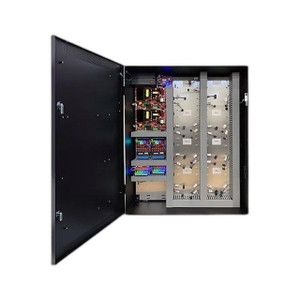
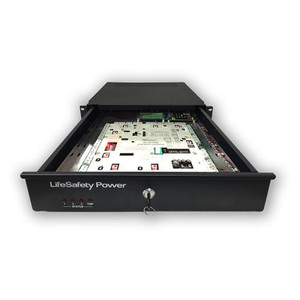
Lifesafety Power FPG100/200-2C83D8PE4M1/P16-A 200W Dual-Output Power Supply
The Lifesafety Power FPG100/200-2C83D8PE4M1/P16-A is a universal-input 200W power supply engineered for distributed access control and life safety infrastructure. It delivers dual independently configurable outputs (8A @ 24V or equivalent split load) with 16 total control circuits: 8 relay lock drivers and 8 DC auxiliary outputs. Each output is selectable for failsafe or failsecure operation, making it suitable for multi-door controller installations, card readers, and ancillary devices in a single compact enclosure.
Key Features
- 200W Dual-Output Power: Universal AC input (85–264V) with selectable 8A @ 24V or 8A @ 12V output configuration. Eliminates need for separate power supplies on small-to-medium access control nodes.
- 8 Relay Lock Outputs: Fused at 3A per output, each independently selectable for FAI (Fail As Is), failsafe, or failsecure mode. Supports solenoid locks, electric strikes, and mag-locks without external relays.
- 8 DC Auxiliary Outputs: Class 2 power-limited at 2.5A per output, each assignable to Bus1 or Bus2. Feeds card readers, request-to-exit buttons, and status devices with segregated power rails.
- Dual Bus Architecture: Segregated Bus1 and Bus2 circuits allow independent load management and system redundancy. Route critical readers on one bus, ancillary devices on the other.
- DIN-Rail Mounted Enclosure: Compact form factor with integrated cover simplifies panel integration and reduces installation labor on retrofit and new construction jobs.
- Fused Output Protection: Individual 3A fuses on relay outputs prevent cascade failures; any single solenoid short does not disable the entire supply.
- Universal Input Voltage: 85–264V AC accommodates single-phase utility variance and generator power without auxiliary conditioning — common in remote or unstable power environments.
- Failsafe/Failsecure Selectability: Per-output mode selection (hardware jumper or firmware if networked) eliminates the need for external relay logic to achieve code-compliant fail modes.
Access control system architectures often require power distribution at multiple nodes—entry controllers, secondary doors, stairwell readers. Traditional approach chains everything to a central UPS, introducing single points of failure and long runs of 18/2 or 12/2 wire. The FPG100/200 collocates power and relay switching at the decision point. A 16-door hotel check-in area, for example, can use one FPG per four doors, each independently managing solenoid failsafe/failsecure logic without relying on a distant controller. If one supply fails, the others isolate the loss to their local subset.
The 8A @ 24V output is the backbone; that's sufficient for up to 4 simultaneous solenoid activations (2A nominal per standard 24V strike) plus ancillary reader power. The dual bus segregation is the operational subtlety: critical path devices (main entry readers) stay on Bus1 with priority scheduling; less time-sensitive loads (status lights, sensors) run on Bus2. If a malfunction drains Bus2, Bus1 readers remain responsive. Many installers conflate this with redundancy—it isn't full N+1, but it is practical resilience for branch offices and hospitality deployments where a second supply isn't economically justified.
Integration is straightforward: the unit is a standalone power and switching node. It works with any access controller that can command 12V or 24V relay coils and expects auxiliary 12/24V logic power. Wiegand readers, push buttons, and traditional 1-button REX switches connect directly to the auxiliary outputs. No special drivers or modules required. On networked systems, the FPG can be daisy-chained to an IP controller via dry-contact command lines, or—if the customer has a legacy parallel-wired infrastructure—it operates autonomously on timer logic built into relay modules (not shown in this supply, but common in legacy fire alarm and access panels paired with this supply). Check integration feasibility against your specific controller and firmware; failsafe sequencing behavior varies.
The Lifesafety Power FPG100/200-2C83D8PE4M1/P16-A is a foundational piece for small-to-medium independent door clusters, secondary entrances, and life safety equipment racks in multi-tenant buildings. Its failsafe/failsecure selectability is mandated by NFPA 101 (Life Safety Code) in many jurisdictions for emergency egress—ensure specification aligns with local building and fire marshal requirements. Compatible with legacy parallel-wired systems and modern IP-based controllers; confirm relay coil voltage (12V or 24V) before installation.
Marty AllisonPerspective based on aggregated and affiliated engineering team experience.
We've spent more time troubleshooting access control power infrastructure than we'd like to admit. The FPG100/200 shows up repeatedly on retrofit and remote-site specs because it consolidates three pain points: (1) distributed 24V power without running a massive cable bundle from a central supply, (2) local solenoid switching that doesn't require a networked controller to arbitrate failsafe logic, and (3) segregated auxiliary power that keeps reader supply isolated from the lock coil surge. On a 20-door office retrofit where running new power to each zone is prohibitive, this unit becomes the compact decision node that frees the installer from daisy-chaining 18/2 from a closet three floors away. Failsafe mode is non-negotiable for emergency egress doors in most jurisdictions—building code won't accept a solenoid that requires a powered relay to unlock. The per-output selectability is what differentiates this supply from generic 24V regulators. You get full fail-mode control without a separate relay bank.
Technical Highlights:
- 200W @ 24V Continuous Duty: 8A nominal output is a practical sweet spot for 4 simultaneous solenoid strikes (2A nominal draw per 24V strike) plus reader power. Avoid attempting 6+ simultaneous activations; thermal shutdown engages around 10A sustained. Know your lock duty cycle and the load profile before specifying.
- Per-Output Failsafe/Failsecure Selectability: Hardware jumper or relay configuration allows each of the 8 outputs to operate independently in fail mode. This is what code requires for emergency egress—critical in fire-rated stairwell doors and exits. Non-configurable supplies force you to add external relay logic.
- Dual Bus Architecture (Bus1 / Bus2): Auxiliary outputs can be assigned to separate bus rails, allowing priority-based load distribution. Pair this with a timer relay (external module) to enforce reader-first power sequencing if Bus voltage sags—readers respond before solenoids energize.
- 3A Fuse Per Relay Output: Protects against solenoid shorts without pulling the entire supply offline. A shorted strike doesn't cascade to the adjacent locks—the affected fuse opens, and the other 7 outputs remain live. Typical unmanaged 24V supplies fail-short on the first solenoid fault.
- Universal 85–264V AC Input: Handles voltage sag and phase issues common in rural or generator-backed sites. No step-down or UPS conditioning required. Pairs well with genset installations where utility power is unstable.
- Class 2 Auxiliary Output Power Limiting: 2.5A per auxiliary output ensures compliance with low-voltage wiring codes (NEC Article 725) — readers and buttons can share conduit with access control data cables without special insulation.
Deployment Considerations:
- Verify solenoid coil voltage (12V or 24V) against the supply output mode. A 12V lock won't activate reliably on a 24V supply, and a 24V coil will be under-energized and sluggish on 12V. This mismatch is the #1 field complaint—confirm wiring diagrams before crimping connectors.
- The 8A @ 24V output assumes a single supply. If you're daisy-chaining multiple FPGs for a larger cluster, ensure each has independent 85–264V AC feed. A single breaker feeding two supplies in parallel is not recommended without load-sharing logic.
- Failsafe mode requires power interruption to de-energize and release the lock. If mains power is interrupted but your 24V aux feed from an UPS remains live, the solenoid will remain energized. This is correct behavior for failsafe egress locks—the intent is that power loss releases the lock. But it means a prolonged power event can mask a solenoid short until power is restored. Test failsafe circuits under controlled power-loss conditions before final inspection.
- DIN-rail enclosure mounting is standard. Leave adequate ventilation (4+ inches clear above/below) to prevent thermal shutdown in high-ambient or stacked installations. A 200W supply in an unventilated cabinet can throttle to 150W continuous if ambient exceeds 40°C.
- Relay outputs are nominally 12V/24V dry contacts—they do NOT source significant current themselves. Solenoid coils must be wired across the relay common and the relay NO (normally open) contact. A common wiring error is connecting the solenoid in series with the relay coil—this will not activate the lock and will eventually open the relay coil itself.
- The auxiliary bus segregation (Bus1 vs. Bus2) is only meaningful if you're using external timer or sequencing logic. A simple feeder supply will see both buses at the same voltage. If you need true power-budget isolation, route Bus1 and Bus2 through separate 5A breakers in your control cabinet.
This is the go-to supply for secondary or remote door clusters that cannot justify a standalone IP access controller and UPS cabinet. Hotels, office parks, and educational buildings with distributed entry points rely on units like this to keep solenoid logic local and failsafe logic code-compliant. Integrators should familiarize themselves with the per-output jumper configuration and test failsafe sequencing before handoff. For a deeper catalog of power and control infrastructure, visit the Lifesafety Power catalog.