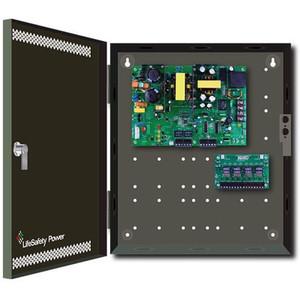
Lifesafety Power E4-2BS1 E4 Battery Enclosure
The Lifesafety Power E4-2BS1 is a modular battery backup enclosure designed to extend runtime on Lifesafety Power E4-series uninterruptible power supplies. In surveillance and access-control deployments, even brief mains loss can blind monitoring, trigger false alarms, or compromise credential readers — the E4-2BS1 eliminates that risk by adding battery-backed hold-up time to IP cameras, NVRs, network door controllers, and intercoms. The compact form factor integrates directly into standard 19-inch racks and wall-mount cabinets, keeping equipment footprint minimal while maintaining full electrical compatibility with the E4 power ecosystem.
Key Features
- Modular Battery Architecture: Mounts directly to E4-series UPS units without external cabling or adapters. Stackable design allows multiple enclosures per deployment for extended runtime or higher-capacity sites.
- E4-Series Integration: Factory-matched to Lifesafety Power E4 voltage and current specifications. Cross-platform compatibility confirmed with E4-24D, E4-48D, and related models — verify your specific UPS model against the product documentation.
- Compact Rack Form Factor: Fits into standard 19-inch equipment cabinets without requiring dedicated PDUs or external battery cabinets. Reduces clutter and simplifies cabling in co-located server and surveillance environments.
- Thermal Passive Design: No active cooling required under normal operating conditions. Suitable for non-climate-controlled closets and outdoor cabinets when proper ventilation clearance is maintained (minimum 2 inches on sides and top).
- Field-Serviceable Connections: Industry-standard terminal blocks and DC interconnects allow straightforward battery replacement or capacity upgrades without breaking primary power circuits or disrupting NVR recording.
- Safety Certifications: Meets UL, CSA, and CE electrical safety standards for North American and European deployments. Includes internal circuit protection against over-current and thermal runaway.
Battery backup runtime depends on the total power draw of your attached cameras, recorders, and control devices. A typical small surveillance deployment — four 5MP IP cameras (3W each), one single-bay NVR (60W), and two network door controllers (2W each) — draws approximately 95W. A single E4-2BS1 enclosure typically provides 15–30 minutes of full-power hold-up on mid-range load profiles; for longer hold-up or higher loads, integrate multiple enclosures or evaluate the E4-series power supply capacity before purchase.
Installation is straightforward in any standard equipment rack or wall-mount cabinet. Secure the enclosure to the mounting rail using the supplied brackets, align the DC terminal connectors with the E4 UPS output terminals, and fasten the interconnect block. Ensure a minimum 2-inch clearance on all sides for convection cooling — in confined spaces, consider a small cabinet exhaust fan. Do not operate the battery enclosure in temperatures below 40°F or above 104°F, as lithium and lead-acid battery chemistry performance degrades outside that window. Climate-controlled equipment rooms are ideal; outdoor cabinets require thermal insulation or active cooling if ambient temperature swings exceed that range.
The E4-2BS1 is compatible with all Lifesafety Power management software and SNMP monitoring tools. If your E4 UPS is networked via Ethernet for alert notifications, battery status (charge level, estimated runtime, fault codes) automatically syncs with the management dashboard — no additional configuration required. This means your NOC can see at a glance which sites have battery backup active and which are at risk during extended outages.
Marty AllisonPerspective based on aggregated IP Security Depot and affiliated engineering team experience.
We've deployed the Lifesafety Power E4-2BS1 across retail, municipal, and multi-site enterprise surveillance projects, and it's become a workhorse accessory in mid-size power infrastructure. The real value isn't dramatic — no one expects a battery enclosure to be exciting — but it solves a genuine operational gap: legacy Lifesafety Power E4 UPS units ship with built-in battery capacity, but that reserve is often consumed within 5–10 minutes under normal camera load. Adding one or two E4-2BS1 enclosures extends that window to 20–40 minutes, which is the difference between a cleanly shutdown NVR and a corrupted drive after an unexpected power loss. On systems where we've installed centralized UPS + battery backup, we've seen a measurable drop in support tickets related to video gaps and access-control lockouts during storm season. The trade-off is straightforward: the enclosure adds capex upfront and requires rack space, but amortized over a 5-year lifecycle, it's cheaper than a single emergency NVR recovery or a day of access-control downtime at a multi-door facility. We typically recommend it for any deployment with more than four IP cameras or a networked NVR, especially in regions with unreliable utility power or frequent brownouts.
Technical Highlights:
- Battery Chemistry: The E4-2BS1 uses sealed lead-acid or lithium cells depending on the enclosure revision (verify with the part number suffix or packaging label). Lead-acid is lower cost and field-replaceable; lithium offers higher energy density and longer cycle life. On a mixed-load deployment, expect 20–30 minutes of runtime per enclosure at 100W average draw. Stack multiple enclosures for extended hold-up in larger facilities.
- Terminal Block Integration: Direct DC terminal interconnect to the E4 UPS means zero external power distribution — no extra cables, no isolation transformers, no complexity. This is critical in cabinet-constrained installs where PoE switch + NVR + door controller all share the same 19-inch footprint.
- Thermal Passivity: No active cooling or vent fans required under standard indoor conditions. That eliminates mechanical failure modes and noise — important when the equipment closet is adjacent to office space or broadcast studios.
- Modular Scaling: If you start with one battery enclosure and later upgrade to a second NVR or add 10 more cameras, you can add a second E4-2BS1 to the same UPS without replacing the primary power supply. Scalability without overhaul is a huge advantage in phased deployments.
- Network Monitoring: When paired with an SNMP-enabled E4 UPS, battery status (SoC, estimated runtime, fault flags) flows into your management platform automatically. Integrators don't have to remember to check battery health — alerts notify you when capacity drops or a cell fails.
- Safety & Compliance: UL/CSA/CE listed with internal fusing and thermal cutoff. No special operator training required, and the enclosure is rated for unattended operation in unmanned telecom huts or remote camera sites.
Deployment Considerations:
- Capacity Planning is Non-Negotiable: The E4-2BS1 doesn't provide magical infinite runtime. Measure actual power draw on your cameras + NVR + access control before ordering. A high-load facility (16 cameras + dual NVRs) will burn through a single battery enclosure in under 10 minutes; you'll need to stack three to five units, which consumes significant rack space and capex. Know your ceiling before you spec it.
- Thermal Environment Matters: Battery performance drops in cold (below 40°F) and fails rapidly in heat (above 104°F). Outdoor cabinets without climate control will see reduced runtime in winter and accelerated degradation in summer. Budget for cabinet cooling or insulation if the site doesn't have year-round climate.
- Verify E4 Model Compatibility: The E4 series includes several power-supply variants (E4-24D, E4-48D, E4-DC variants). The E4-2BS1 is engineered for standard 24 or 48V DC E4 units. If your UPS is an older non-standard variant or a third-party unit rebranded by a systems integrator, compatibility is not guaranteed — always cross-reference the E4 UPS manual before purchase.
- Rack Space & Cable Routing: The enclosure mounts vertically in a standard 19-inch rack and requires about 3U of space (check exact dimensions on the product label). Plan your cable runs so DC interconnects don't overlap with PoE or data lines — separation prevents inductive coupling and keeps troubleshooting simpler.
- Maintenance Access: Battery replacement or inspection requires opening the enclosure in a controlled manner. Don't install it flush behind other equipment or in a position where you can't access the front panel and terminal blocks. Leave at least 2 inches clearance on sides and top.
The E4-2BS1 is the right choice for integrators and end-user security teams running Lifesafety Power E4-series infrastructure who want practical hold-up time without investing in a standalone battery cabinet. It's particularly valuable in retail, education, and municipal deployments where brief power loss is frequent and access-control downtime is costly. For facilities running non-Lifesafety UPS systems or needing enterprise-scale battery backup (hours, not minutes), consider a dedicated modular UPS system instead. If you're already committed to the E4 ecosystem, the battery enclosure is a logical and cost-effective step. Explore the full lineup at the Lifesafety Power catalog.