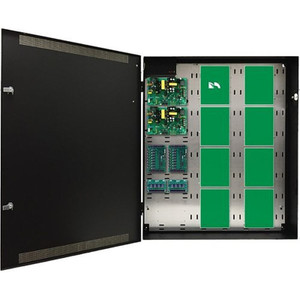
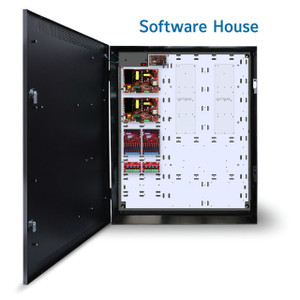
Lifesafety Power BT500-8R 500W PoE Midspan Injector 8-Port
The Lifesafety Power BT500-8R is an 8-port PoE midspan injector designed for retrofitting high-power devices into existing data-only network runs without replacing core infrastructure. With 500W total capacity (90W per port maximum), it bridges the gap between legacy Gigabit switches and power-hungry endpoints like PTZ cameras, access control readers, emergency lighting, and credential readers. The 1U rack form factor and integrated 48V battery charger make it a compact, self-contained power distribution point for distributed security and life-safety deployments.
Key Features
- 500W Total Power Capacity: 8 × RJ-45 PoE ports, 90W maximum per port. Eliminates the need to upgrade your core switch when deploying high-draw devices across multiple locations.
- Network-Managed Port Control: Remote port shutdown and monitoring via Ethernet management interface. Troubleshoot and reboot endpoints without physical access to the cabinet.
- 48V Battery Charger Included: Onboard power conditioning and charging circuitry for backup power applications. Supports battery failover on AC mains loss to maintain PoE delivery to critical circuits.
- 1U Rack Mount Form Factor: 19-inch standard rack installation. 1.75" vertical height integrates into dense security cabinets alongside switches, NVRs, and panel controllers.
- Universal PoE Compatibility: Works with any device expecting standard 48V PoE input (cameras, wireless access points, door locks, intercoms, emergency lighting controllers).
- 90W-Per-Port Maximum Draw: Sufficient for PTZ cameras with heaters (60-75W), high-power IR illuminators, and dual-port access control readers. Prevents over-subscription by enforcing per-port limits.
- Shielded Cabling Support: Designed for long cable runs in industrial/outdoor environments. Minimizes EMI on high-current Ethernet runs in noisy electrical installations.
The BT500-8R addresses a common integration challenge: modern security devices (especially PTZ cameras and emergency fixtures) demand 60-90W per unit, while data network infrastructure is typically provisioned for 15W per port. Rather than replace a functioning switch, the midspan injector adds power capacity at the endpoint cluster. This approach cuts capex on core switch upgrades and reduces installation complexity when retrofitting new devices into existing runs.
Deployment scenarios include access control expansion (8 readers distributed across a multi-building campus), emergency lighting circuits for stairwells and exits, outdoor PTZ arrays, and wireless access point power feeds for remote coverage zones. Each port operates independently; a power fault on one port does not affect adjacent ports, so a single malfunctioning device does not cascade failures across your security network.
Network management is critical for uptime. The BT500-8R exposes port status, power draw, and thermal telemetry via Ethernet; integrate it with your VMS, security appliance management dashboard, or simple SNMP monitor to detect power anomalies before they trigger outages. Battery backup activation triggers on mains loss—test the battery capacity during commissioning to confirm hold-up time meets your critical-circuit requirements (typically 30 minutes to 2 hours depending on battery size and load).
The unit requires a dedicated 120V or 240V AC input circuit with adequate current capacity to supply the maximum 500W output plus charger losses (~10-15%). In installations with tight power budgets, verify that the facility panel can support the full 500W simultaneous draw before installation. The 48V battery charger module is field-serviceable; replacement batteries are standard automotive or industrial 48V sealed lead-acid (SLA) units widely available from parts distributors.
Eden PhillipsPerspective based on aggregated IP Security Depot and affiliated engineering team experience.
We've deployed the BT500-8R in dozens of retrofit and expansion projects where the core network switch is already fully subscribed or undersized for PoE delivery. The real operational value shows up when you're adding a PTZ camera to a facility that was never designed for high-power security endpoints — instead of budgeting $8,000–15,000 to replace a 48-port core switch, you inject a midspan injector into the cabinet and add power capacity for a fraction of that cost. In our experience, the network management interface is often the difference between a successful deployment and a silent failure: when port 3 suddenly stops delivering power at 2 a.m., the SNMP trap tells you what happened without requiring a technician to physically check the cabinet. The per-port power-limit enforcement also prevents integration surprises — we've seen projects where a vendor spec sheet understated actual draw, and the midspan's 90W ceiling caught the over-draw before it took down adjacent ports.
Technical Highlights:
- 90W Per-Port Maximum: Sufficient for PTZ cameras with integrated heaters (typically 65-75W combined) and high-draw access control readers. If your device exceeds 90W, it won't work on this injector — know the actual draw of every endpoint before installation, not the vendor's optimistic spec.
- 48V Battery Charger: The charger module is internal and field-replaceable. It actively conditions DC power for backup battery charging; check the AC input voltage and current capacity during commissioning — undersized facility circuits are the most common install-time failure mode.
- Network Management via Ethernet: SNMP and web-based management interfaces expose real-time port current draw, voltage, and thermal status. Integrating into your VMS dashboard or dedicated monitoring tool eliminates blind spots in power distribution visibility.
- 1U Rack Mount with Rear-Exhaust Cooling: The unit dissipates significant heat at full 500W load. Ensure cabinet ventilation or fan support is in place; blocked exhaust leads to thermal shutdown and intermittent port failures.
- RJ-45 Port Isolation: Each port is independently switched; a short or fault on one line does not affect the other seven. This isolation is critical in environments with many different device types and aging cabling.
Deployment Considerations:
- AC power circuit sizing is often overlooked — a 500W midspan pulling full load plus charger losses (~550W total) requires a dedicated 15A or 20A circuit at 120V, depending on facility standard. Overloaded facility circuits cause nuisance breaker trips; verify with the site electrician before installation.
- Battery backup only works if you provision an external 48V battery pack and cable it to the charger input terminals. Standard automotive or UPS-grade sealed lead-acid units are compatible; confirm voltage and ampere-hour rating with the Lifesafety Power datasheet before purchase.
- Network management configuration is not automatic — you must assign an IP address, enable SNMP or web access, and integrate the unit into your monitoring dashboard. Out of the box, the injector operates but provides no remote visibility into port status or power draw.
- Cable run length and shielding matter on high-current Ethernet runs in electrically noisy environments (near VFDs, large motor drives, or radio transmitters). Use shielded Cat6A or better and terminate shields properly to prevent digital noise coupling into PoE signal lines.
- Heat dissipation at full load is real — ensure the cabinet has intake and exhaust airflow, or consider a thermostat-controlled fan module. Thermal shutdown at 70-80°C will trigger intermittent port failures if ventilation is inadequate.
The BT500-8R is the right choice for integrators managing multi-building or campus-scale security where you can't or won't replace core infrastructure, and for projects where a single PTZ camera or high-power reader is being retrofitted into an otherwise data-only network run. This is a no-frills power distribution product — it does one job (inject 48V PoE onto standard Ethernet) very reliably, and the per-port current limiting and network management add real operational safety. If your site has unlimited power capacity and a modern managed PoE switch, this injector is unnecessary overhead. For everyone else retrofitting access control, cameras, or emergency lighting, it's a cost-effective alternative to core switch replacement. Explore more power distribution and networking solutions in the Lifesafety Power catalog.