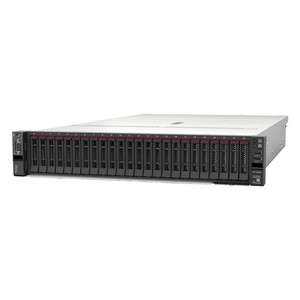
Lenovo 4XG7A91480 Intel Xeon Gold 5520+ 28-Core Processor Option for SR630 V3
Overview
The Lenovo 4XG7A91480 is a factory-configured processor option kit delivering an Intel Xeon Gold 5520+ to the Lenovo ThinkSystem SR630 V3 platform. Designed specifically for the SR630 V3's dual-socket LGA 4677 (Socket E) architecture, this option installs a 5th Generation Intel Xeon Scalable processor featuring 28 cores, 56 threads, and a 205W thermal design power envelope — the class of compute resource that fits demanding virtualization stacks, high-throughput analytics workloads, and multi-camera AI inference engines running on the same physical node. If you're sizing a rack server for a mixed workload — video management, edge inference, and enterprise applications sharing a single two-socket chassis — this is the processor tier worth evaluating carefully.
Key Features
- 28 Cores / 56 Threads at 2.2 GHz Base: With 56 logical processors visible to the OS, a single socket handles heavyweight thread-parallel workloads — think concurrent VMS streams, real-time analytics pipelines, and database query engines running simultaneously without the head-of-line contention that kills latency-sensitive security applications on lighter 16-core processors.
- 4 GHz Single-Core Boost: The processor scales from 2.2 GHz base to 4 GHz under Intel Turbo Boost — critical for latency-sensitive tasks like alarm processing, event indexing, and VMS API calls that are single-threaded by nature. You don't sacrifice responsiveness to get core count.
- Intel Performance Hybrid Architecture — 8 High-Priority Cores at 2.4 GHz: Eight cores are designated high-priority, running at a sustained 2.4 GHz base (versus 2.0 GHz for the remaining 20), giving the OS and hypervisor a natural tier to pin latency-sensitive VMs or containers. This matters in co-located deployments where one workload (live video decoding) cannot yield to another (batch analytics).
- 52.5 MB Last-Level Cache: The on-die cache backs 28 active cores with enough headroom to hold large working sets in flight — reducing main-memory round-trips on workloads like database lookups, in-memory analytics, or real-time video buffering. More cache per core means fewer cycles stalled waiting on DRAM.
- 20 GT/s Intel UPI Interconnect: In a dual-socket SR630 V3 configuration, the two processors communicate over UPI at 20 GT/s — the highest speed tier for this platform. Memory attached to the remote socket is accessible with minimal coherency penalty, which matters when a workload's working set exceeds one socket's local DIMM capacity and NUMA-crossing becomes inevitable.
- LGA 4677 (Socket E) Platform: The SR630 V3 uses the Socket E platform, which supports DDR5 memory and PCIe Gen 5 I/O. Pairing the 4XG7A91480 with the SR630 V3 gives downstream access to both bandwidth tiers — DDR5 for memory-intensive analytics and Gen 5 expansion slots for high-throughput storage or GPU accelerators without a platform upgrade.
- 5th Gen Intel Xeon Scalable (Emerald Rapids): The 5th Gen Scalable family brings Intel Advanced Matrix Extensions (AMX) for AI inference acceleration at the CPU level. Workloads like onboard license-plate recognition, object classification, or anomaly detection can leverage AMX without a discrete GPU — reducing BOM cost and rack-unit consumption in constrained deployments.
- 205W TDP: At 205W, this processor sits at the upper boundary of what standard SR630 V3 cooling is rated to handle. Verify your chassis cooling configuration — particularly fan speed policies and ambient temperature limits — before commissioning in a high-density row where adjacent nodes raise inlet temperatures.
Integration and Compatibility
The 4XG7A91480 is a Lenovo option part, purpose-built for the ThinkSystem SR630 V3. It is not a stand-alone boxed processor — it ships as an option kit intended for factory integration or field installation by qualified personnel into a compatible SR630 V3 chassis. Confirm the target chassis's power supply sizing supports the combined TDP of both sockets if deploying in a dual-socket configuration: two 205W processors plus memory, storage, and expansion cards can push total system draw above 1,000W under full load.
For environments running network video recorders or AI-driven video analytics at scale, the SR630 V3 with this processor option supports up to 32 DDR5 DIMM slots across both sockets, enabling memory configurations large enough to keep multi-stream decode and ML inference working sets resident in DRAM. Pair with NVMe storage for low-latency frame indexing or with a high-throughput network switch for aggregating camera feeds into the server tier.
Frequently Asked Questions
Q: Is the 4XG7A91480 a stand-alone retail processor or a Lenovo option kit?
A: It is a Lenovo option kit (part number 4XG7A91480) designed specifically for the ThinkSystem SR630 V3 chassis. It is not a stand-alone retail-boxed CPU and is intended for installation into a compatible SR630 V3 server.
Q: How many cores and threads does the Xeon Gold 5520+ in this kit provide?
A: The Intel Xeon Gold 5520+ delivers 28 physical cores and 56 threads via Hyper-Threading, running at a 2.2 GHz base frequency with boost up to 4 GHz.
Q: What socket does the 4XG7A91480 use, and is it compatible with older ThinkSystem servers?
A: This processor uses the LGA 4677 (Socket E) interface, which is specific to the SR630 V3 and other 5th Gen Xeon Scalable platforms. It is not compatible with earlier SR630 or SR650 generations that use LGA 4189 (Socket P4).
Q: What is the TDP, and does it require special cooling?
A: The Intel Xeon Gold 5520+ has a 205W thermal design power rating. Verify that your SR630 V3 chassis is configured with the appropriate heatsink and fan module rated for 205W processors — Lenovo offers TDP-specific heatsink options for the SR630 V3 platform.
Q: Can this processor handle AI inference workloads for video analytics?
A: Yes. As a 5th Gen Intel Xeon Scalable (Emerald Rapids) processor, the Xeon Gold 5520+ includes Intel Advanced Matrix Extensions (AMX), which accelerate matrix-based AI inference workloads at the CPU level. This supports on-server video analytics tasks such as object detection and classification without requiring a discrete GPU, depending on throughput requirements.
Q: What is the UPI speed and why does it matter in a dual-socket configuration?
A: The processor operates at 20 GT/s UPI (Intel Ultra Path Interconnect), which is the highest-speed interconnect tier for this platform. In a dual-socket SR630 V3, this minimizes latency and bandwidth loss when workloads access memory attached to the remote socket — important for large in-memory datasets that span both NUMA domains.
The 4XG7A91480 puts a 28-core, 205W Intel Xeon Gold 5520+ into the SR630 V3 — and that 205W TDP is the first number I look at when a customer is sizing a dual-socket node for a mixed security-and-analytics stack. Two of these processors plus a loaded DIMM configuration can push system draw past 1,000W, which changes the PDU and UPS math considerably before a single line of software is configured.
Technical Highlights:
- 8 High-Priority Cores at 2.4 GHz: The performance core split — 8 cores at 2.4 GHz, 20 at 2.0 GHz — gives hypervisors and container schedulers a natural tier to pin latency-sensitive processes. In a VMS deployment this means alarm-handling and live decode threads can be isolated from background analytics jobs without manual CPU affinity pinning.
- 52.5 MB L3 Cache: For in-memory video indexing or real-time analytics working sets, 52.5 MB of last-level cache backing 28 active cores reduces DRAM round-trips measurably. On workloads where frame buffers or metadata indexes fit in cache, the difference between this and a lighter 20-core SKU shows up in sustained throughput, not just peak benchmark numbers.
- 20 GT/s UPI at Maximum Platform Speed: In a populated dual-socket SR630 V3, remote-socket memory access over 20 GT/s UPI stays coherent with acceptable latency. For workloads that genuinely span both NUMA nodes — large ML model inference, for instance — this is the interconnect tier that keeps performance from falling off a cliff as memory pressure grows.
Deployment Considerations:
- Confirm heatsink compatibility before installation: the SR630 V3 has distinct heatsink SKUs for standard and high-TDP processors, and a 205W chip installed under a standard heatsink will thermal-throttle under sustained load — degrading analytics throughput in exactly the scenarios this processor is selected to handle.
- The LGA 4677 socket is generation-specific: this option kit does not drop into SR630 V1/V2 or SR650 V2 chassis. Verify the target server's model and generation before ordering if retrofitting an existing rack rather than commissioning new iron.
This processor option is well-matched to SR630 V3 nodes serving as on-premises VMS hosts or edge inference servers in enterprise physical security deployments where a single two-socket chassis needs to carry concurrent camera stream decoding, AI analytics, and management-plane workloads without partitioning across multiple physical servers.