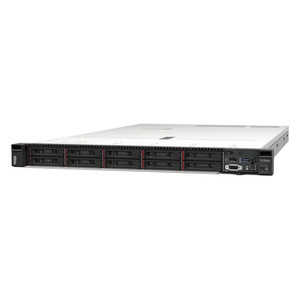
Lenovo 4XG7A86665 Xeon Platinum 8462Y+ 32-Core Processor Option for ThinkSystem SR650 V3
The Lenovo 4XG7A86665 is a processor option kit that installs an Intel Xeon Platinum 8462Y+ into the ThinkSystem SR650 V3 rack server — a 32-core, 64-thread 4th Gen Intel Xeon Scalable CPU operating at a 2.8 GHz base clock with 300W TDP. If you're scaling a second processor socket in an SR650 V3 or speccing the platform from scratch with a high-core-count workload in mind, this is the part number to order.
Key Features
- 32 Cores / 64 Threads at 2.8 GHz Base: The 8462Y+ delivers 64 logical processors per socket under the x86-64 instruction set. For parallel workloads — video analytics inference, large VMS environments, virtual machine density — more threads mean fewer co-tenancy bottlenecks without spinning up additional physical nodes.
- 4.1 GHz Boost Frequency: Intel Turbo Boost pushes single-thread performance to 4.1 GHz when thermals and power budget allow. Latency-sensitive tasks (database lookups, real-time event processing) benefit without requiring a separately binned high-frequency SKU.
- Heterogeneous Core Architecture — 12 High-Priority + 20 Efficiency Cores: The 8462Y+ uses Intel's performance-hybrid design: 12 cores run at up to 3.0 GHz for priority workloads, while 20 cores operate at 2.6 GHz handling background threads. Properly configured schedulers and OS thread-pinning can extract real latency separation between services sharing the socket.
- 60 MB On-Die Cache: 60 MB of last-level cache reduces memory-subsystem pressure for data-intensive workloads. For VMS platforms streaming dozens of camera feeds simultaneously, larger cache means fewer round-trips to DRAM — which shows up as reduced latency during indexing and search operations.
- 300W TDP — Plan Your Power and Cooling Budget Accordingly: At 300W, this CPU consumes substantially more power than mid-range Xeon options. SR650 V3 supports it, but confirm your rack PDU capacity and the server's configured cooling path before deployment. A dual-socket SR650 V3 with two 300W processors will draw over 600W from CPU alone before memory, storage, and NIC load is factored in.
- LGA 4677 (Socket E) — SR650 V3 Platform Lock-In: The 8462Y+ uses Intel's LGA 4677 socket with 16 GT/s system bus. This socket is specific to 4th Gen Xeon Scalable (Sapphire Rapids) platforms. The SR650 V3 is engineered around this socket, so 4XG7A86665 is a direct fit — no firmware hacks, no interposer required.
- 64-Bit Processing Mode: Full 64-bit operating mode means no address-space ceiling for memory-intensive applications — relevant for large in-memory databases, AI inference runtimes, or VMS servers managing retention indexes for thousands of camera-hours.
Integration & Compatibility
The 4XG7A86665 is engineered specifically for the ThinkSystem SR650 V3 platform. The SR650 V3 supports up to two LGA 4677 processors, making this kit appropriate either as a primary CPU or as the second socket in a dual-processor configuration. Verify that your SR650 V3's current UEFI firmware version supports 4th Gen Xeon Scalable processors before installation — Lenovo publishes firmware compatibility matrices in their Fix Central repository. Memory configuration is also socket-dependent: each CPU in the SR650 V3 controls its own memory channels, so adding a second processor also unlocks additional DIMM slots and expands total addressable memory capacity.
For high-core-count rack server deployments in security operations centers, AI-assisted video analytics platforms, or enterprise NVR infrastructure, the SR650 V3 with the 8462Y+ provides the thread count and cache depth to consolidate workloads that would otherwise span multiple physical servers. Integrators building out IP camera back-end infrastructure at scale should evaluate total socket TDP against available UPS and PDU capacity early in the design phase — a 300W-per-socket platform changes rack power planning meaningfully compared to 165W or 205W Xeon options in the same family.
Frequently Asked Questions
Q: What server platform is the Lenovo 4XG7A86665 compatible with?
A: The 4XG7A86665 is a processor option kit designed specifically for the Lenovo ThinkSystem SR650 V3 rack server. It installs an Intel Xeon Platinum 8462Y+ into the server's LGA 4677 (Socket E) processor socket.
Q: How many cores and threads does the 8462Y+ provide?
A: The Intel Xeon Platinum 8462Y+ delivers 32 cores and 64 threads per socket. The core configuration uses 12 high-priority cores running at up to 3.0 GHz and 20 efficiency cores at 2.6 GHz base, with an all-core boost reaching 4.1 GHz.
Q: What is the TDP of the Xeon Platinum 8462Y+, and does it affect cooling requirements?
A: The processor has a 300W Thermal Design Power (TDP). This is a high-TDP part — confirm your SR650 V3 cooling configuration and rack PDU capacity supports this thermal and power draw before deployment, particularly in a dual-socket configuration.
Q: Can this processor be used in a dual-socket SR650 V3 configuration?
A: Yes. The SR650 V3 supports up to two LGA 4677 processors. Adding a second processor via a kit like the 4XG7A86665 also unlocks additional DIMM slots controlled by that socket, expanding total memory capacity.
Q: What generation of Intel Xeon does the 8462Y+ belong to?
A: The Intel Xeon Platinum 8462Y+ is a 4th Generation Intel Xeon Scalable processor (Sapphire Rapids architecture), operating on the LGA 4677 platform with a 16 GT/s system bus.
The Lenovo 4XG7A86665 installs an Intel Xeon Platinum 8462Y+ into the SR650 V3 — and the spec that defines what this platform can actually do in a security or analytics context is the 32-core / 64-thread count paired with 60 MB of on-die cache at a 300W TDP envelope. That's a meaningful step up from mid-range Xeon options, and it's the right processor to reach for when you're running concurrent workloads that would saturate a lower-core-count chip.
Technical Highlights:
- Heterogeneous Core Topology: 12 high-priority cores at 3.0 GHz + 20 efficiency cores at 2.6 GHz — properly mapped by the OS scheduler, this lets latency-sensitive services (real-time event correlation, API front-ends) run on the P-cores while background indexing or transcoding occupies the E-cores without contention.
- 4.1 GHz Single-Thread Boost: For workloads with serial bottlenecks — report generation, stream demux, license-plate lookup — the burst to 4.1 GHz from the 2.8 GHz base matters. It's the difference between a result in 120ms and one in 200ms at scale.
- 60 MB LLC: At this cache depth, multi-camera NVR indexing engines and in-memory analytics pipelines see meaningfully lower DRAM latency. For a 128-channel VMS platform, that cache is working every second of recording.
Deployment Considerations:
- A 300W TDP CPU in a dual-socket SR650 V3 means your power budget planning starts at 600W before memory, NVMe, and NIC load. Verify rack PDU amperage and UPS headroom before commissioning — this is the most common oversight on high-density Xeon builds.
- LGA 4677 is a 4th Gen Xeon Scalable-only socket. Don't assume SR650 V2 or earlier Lenovo SR-series platforms are compatible — they are not. The 4XG7A86665 is SR650 V3-specific.
This processor option is the right fit for enterprise-scale video analytics infrastructure or large VMS consolidation projects where a single SR650 V3 node needs to handle 64+ concurrent logical threads without spinning up additional physical hosts — high thread count per socket keeps licensing and rack space costs in check.