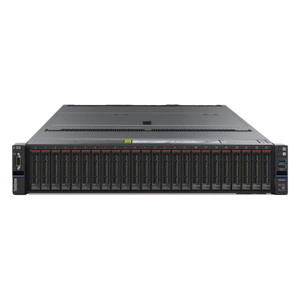
Lenovo 4XG7A63620 AMD EPYC 7643 48-Core Processor Option for ThinkSystem SR665
Overview
The Lenovo 4XG7A63620 is the AMD EPYC 7643 processor option kit for the ThinkSystem SR665, delivering 48 cores and 96 threads on AMD's 7nm "Milan" architecture. At a 2.3 GHz base clock with a 3.6 GHz boost, it sits in the mid-to-upper tier of the EPYC 7003 family — enough headroom for compute-dense workloads like large-scale video analytics, AI inference at the edge, virtual machine hosts, and high-throughput data processing where per-core software licensing costs make raw core count a budget variable worth optimizing. If you're building or expanding a Lenovo SR665 node and need a processor that balances core density with memory throughput, this is the configuration to evaluate.
Key Features
- 48 Cores / 96 Threads (7nm Milan): AMD's 7nm process packs 48 physical cores into a 225W TDP envelope — meaningful when rack power budgets are fixed. More cores per watt than previous-generation EPYC means you get higher VM density or more concurrent analytics pipelines without adding a second CPU socket or a second server chassis.
- 2.3 GHz Base / 3.6 GHz Boost: The 1.3 GHz boost headroom matters for bursty workloads — VMS event correlation, database query spikes, or AI inference jobs that need fast single-threaded response but spend most of their time at lower clock speeds. Sustained multi-threaded tasks like 24/7 video decoding will run at or near base clock.
- 256 MB L3 Cache: AMD's large unified L3 (256 MB on the 7643) keeps frequently accessed data close to the cores, reducing main memory round-trips. For surveillance VMS platforms processing hundreds of concurrent streams, this translates to lower latency on object detection and indexing operations.
- Octa-Channel DDR4-3200, 204.8 GB/s Bandwidth: Eight memory channels at DDR4-3200 produce 204.8 GB/s of peak bandwidth — enough to sustain high-resolution, multi-stream video decode and AI inference pipelines simultaneously. If your workload is memory-bandwidth constrained (GPU-to-CPU data movement, large dataset analytics), this bandwidth ceiling is the spec to compare across processor options.
- Socket SP3 — SR665 Native Fit: The SP3 socket is designed for dual-processor configurations on the SR665 platform. Installing the 4XG7A63620 as a second processor (in a single-socket SR665) doubles total core count and memory channel capacity without changing the chassis, cabling, or storage configuration — a direct capacity upgrade path.
- 225W TDP — Plan Your Cooling: The 225W thermal envelope requires the SR665's qualified heatsink and fan configuration. The 4XG7A63620 ships without a cooler — confirm the appropriate Lenovo heatsink option is already installed or ordered alongside this kit. Underspecifying cooling on a 225W processor will trigger thermal throttling and reduced sustained performance.
- 64-Bit Operating Mode: Full 64-bit support is table stakes for any modern hypervisor, Linux distribution, or Windows Server deployment, but worth confirming explicitly — especially for legacy VMS platforms that still ship 32-bit installer variants alongside 64-bit builds.
Integration and Compatibility
The 4XG7A63620 is a Lenovo-qualified option kit, meaning it ships with the firmware and microcode validation required for the ThinkSystem SR665. It is not a generic OEM tray processor — it carries the Lenovo part number and is intended for installation by system integrators or IT staff following Lenovo's SR665 Hardware Maintenance Guide. Compatible memory types are DDR4-SDRAM at speeds up to DDR4-3200 across eight channels; confirm your existing DIMM configuration matches the memory population rules for dual-processor SR665 operation, as slot-filling requirements change when the second socket is populated. Hypervisor compatibility (VMware vSphere, Microsoft Hyper-V, Red Hat KVM) is governed by the SR665 system compatibility matrix — the EPYC 7643 is within the supported processor family for all major platforms. For network video recorders and AI-driven video surveillance applications, pairing this processor with adequate GPU resources and a certified network switching infrastructure will determine overall system throughput. Consult the Lenovo ServerProven compatibility guide for validated memory, storage, and GPU combinations before finalizing your bill of materials.
Frequently Asked Questions
Q: Is the Lenovo 4XG7A63620 compatible with the ThinkSystem SR665?
A: Yes. The 4XG7A63620 is a Lenovo-qualified option kit specifically validated for the ThinkSystem SR665 platform, using the Socket SP3 interface native to that chassis.
Q: Does the 4XG7A63620 include a heatsink or cooler?
A: No. This processor option kit does not include a cooler. You must verify that the appropriate Lenovo-qualified heatsink is installed or ordered separately before commissioning the server. Operating a 225W EPYC processor without the correct heatsink will result in thermal throttling.
Q: What memory does the EPYC 7643 support?
A: The EPYC 7643 supports DDR4-SDRAM at up to DDR4-3200 speed across eight memory channels, delivering up to 204.8 GB/s of peak memory bandwidth. Confirm DIMM population rules in the SR665 Hardware Maintenance Guide, especially when populating both processor sockets.
Q: Can this processor run virtualized workloads for video analytics?
A: Yes. With 48 cores, 96 threads, and 256 MB of L3 cache, the EPYC 7643 handles high VM density and parallel analytics processing. For large-scale video analytics deployments, pair with adequate GPU resources and sufficient memory capacity to avoid bandwidth bottlenecks.
Q: What is the TDP of the 4XG7A63620 and does it affect rack planning?
A: The TDP is 225W. In a dual-processor SR665 configuration, plan for up to 450W of processor-only thermal output before accounting for memory, storage, and GPU loads. Factor this into your rack PDU capacity and cooling airflow calculations.
The 4XG7A63620 puts AMD's EPYC 7643 into the Lenovo SR665 platform — and the spec that anchors my recommendation is the combination of 48 cores and 204.8 GB/s memory bandwidth. For security operations centers running enterprise VMS platforms with AI-driven analytics, those two numbers together determine whether your server keeps up with stream ingestion and inference simultaneously or forces you to offload one of them.
Technical Highlights:
- 256 MB L3 Cache: The 7643's large L3 reduces cache-miss penalties on concurrent analytics workloads — critical when dozens of AI inference threads are competing for data. This is one of the headline architectural advantages of Milan-generation EPYC over equivalent-core-count alternatives.
- Octa-Channel DDR4-3200 (204.8 GB/s): Eight memory channels at DDR4-3200 is the memory subsystem you need for GPU-coupled AI pipelines where CPU-GPU data movement is a bottleneck. A processor with fewer channels will starve a capable GPU on high-throughput decode-plus-inference workloads.
- 2.3 GHz Base / 3.6 GHz Boost: The 1.3 GHz boost range gives the platform headroom for event-driven spikes — alarm correlation, forensic search queries, motion indexing bursts — without requiring the server to sustain peak clocks under steady load, which helps keep 24/7 thermal output manageable at 225W TDP.
Deployment Considerations:
- No cooler is included with this option kit — confirm the qualified Lenovo heatsink for the SR665 dual-processor configuration is on your BOM before ordering. Thermal throttling at 225W is a real operational risk if this step is missed.
- When populating the second socket on an SR665, DIMM slot population rules change. Consult the SR665 Hardware Maintenance Guide before adding or rearranging memory — populating incorrectly can reduce effective memory channels from eight to four, cutting bandwidth nearly in half.
For an enterprise physical security server build — high-camera-count VMS host, AI analytics node, or centralized recording and indexing server — the SR665 with the EPYC 7643 is a well-matched platform where the processor's memory bandwidth and cache size directly translate to fewer servers needed to handle the same stream count.