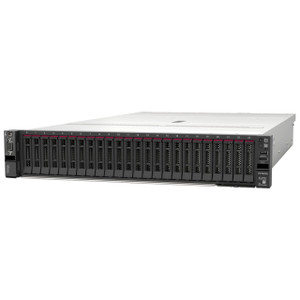
Lenovo 4XG7A63608 AMD EPYC 7543 32-Core Processor Option Kit
Overview
The Lenovo 4XG7A63608 is a factory-configured processor option that installs the AMD EPYC 7543 into the ThinkSystem SR665 platform. Purpose-built for memory-intensive enterprise workloads — virtualization stacks, in-memory databases, and high-density compute — the EPYC 7543 delivers 32 physical cores and 64 threads on a single Socket SP3 die, giving the SR665 a credible dual-socket path to 64 cores and 128 threads without leaving the same chassis. If your workload is CPU-bound and you're evaluating whether to scale up or scale out, this processor tier is typically the inflection point where scale-up wins on latency and licensing cost.
For teams deploying Lenovo ThinkSystem infrastructure, this option sits in the mid-to-upper tier of the server processor options lineup — above the entry EPYC 74xx series on core count and cache, below the flagship 7763 on raw frequency ceiling. That makes it the right call when you need density without paying for cores you won't saturate.
Key Features
- 32 Cores / 64 Threads at 2.8 GHz Base: The EPYC 7543 sustains 2.8 GHz across all 32 cores under full load — not just the single-core marketing figure. For virtualization hosts running 40–60 VMs, that sustained multi-core frequency matters more than peak boost numbers. Boost reaches 3.7 GHz on lightly threaded workloads where single-core speed is the bottleneck.
- 256 MB L3 Cache: AMD's chiplet design stacks 256 MB of L3 across the die — roughly 8 MB per core. That cache depth keeps frequently accessed working sets on-die rather than hitting main memory, which translates directly to lower latency on database query engines and analytics runtimes. If you're running Redis, PostgreSQL with large shared_buffers, or SAP HANA, this is the spec that matters most.
- 3.7 GHz Boost Frequency: Single-threaded workloads — application startup, JIT compilation, legacy transactional software — benefit from the 3.7 GHz ceiling. The 0.9 GHz spread between base and boost (2.8 to 3.7 GHz) is wide enough to meaningfully accelerate bursty single-core tasks without thermal throttling on multi-core loads.
- Octa-Channel DDR4 with 204.8 GB/s Bandwidth: Eight memory channels feeding 204.8 GB/s of aggregate bandwidth removes memory as a bottleneck for data-parallel workloads. This is the figure that separates EPYC from Intel Xeon Scalable at equivalent core counts — particularly relevant for in-memory analytics, ML inference, and storage controllers that need fast DMA throughput.
- 225 W TDP (Configurable to 240 W): The base TDP is 225 W with a configurable TDP-up of 240 W for environments where the chassis thermals and power delivery can support it. Plan your power budget at 240 W per socket for headroom. A dual-socket SR665 with both sockets populated at TDP-up draws up to 480 W from processors alone — factor that into PDU and UPS power planning.
- Socket SP3 — Platform Longevity: SP3 is AMD's LGA4094 platform used across multiple EPYC generations. For IT architects managing refresh cycles, SP3 compatibility means the SR665 chassis and memory can potentially survive a processor upgrade within the same socket generation — reducing forklift upgrade cost.
- 64-Bit Operating Mode: Full 64-bit instruction support across all cores is table stakes for any modern enterprise OS or hypervisor (VMware vSphere, Microsoft Hyper-V, RHEL, Ubuntu Server). Worth confirming for any legacy mixed-mode virtualization environments before deployment.
- DDR4-SDRAM Memory Support: The EPYC 7543 works with standard DDR4 modules — no proprietary memory required. For procurement teams, that means commodity pricing on DIMMs and multi-vendor sourcing options rather than platform-locked memory SKUs.
Integration and Compatibility
The 4XG7A63608 is a Lenovo-qualified option kit for the ThinkSystem SR665 platform. It installs into the primary or secondary Socket SP3 socket depending on your chassis configuration. This processor option is not a standalone retail CPU — it is factory-validated for the SR665 bill of materials and should be paired with compatible DDR4 RDIMMs sourced from Lenovo's SR665 memory compatibility matrix. Before ordering, confirm your SR665 firmware version supports this processor stepping; Lenovo publishes UEFI update prerequisites in their SR665 product guide.
For workloads requiring high-bandwidth network connectivity — 25GbE or 100GbE — pair the SR665 with a compatible OCP or PCIe NIC. The octa-channel memory controller's 204.8 GB/s bandwidth can sustain multiple high-speed NICs without becoming a bottleneck. Similarly, NVMe-over-Fabrics storage deployments benefit from the EPYC's PCIe lane count, which the SR665 exposes through its I/O subsystem.
This processor is also a viable anchor for video management server deployments where high-density camera stream decoding and analytics processing demand sustained multi-core throughput and large last-level cache for buffering decoded frames.
Frequently Asked Questions
Q: What server platform is the Lenovo 4XG7A63608 compatible with?
A: The 4XG7A63608 is a processor option kit validated for the Lenovo ThinkSystem SR665. It uses the AMD Socket SP3 interface (LGA4094) and is not cross-compatible with other vendors' server platforms.
Q: Does the 4XG7A63608 include a CPU cooler?
A: No. This option kit does not include a cooler. The SR665 chassis ships with its own heatsink and cooling solution; confirm heatsink compatibility with your specific SR665 configuration before ordering.
Q: What is the TDP of the AMD EPYC 7543 included in this kit?
A: The base TDP is 225 W. The processor supports a configurable TDP-up of 240 W for environments where chassis power delivery and thermal capacity allow it.
Q: How many memory channels does the EPYC 7543 support?
A: The EPYC 7543 supports eight DDR4 memory channels per socket, delivering up to 204.8 GB/s of aggregate memory bandwidth — relevant for memory-intensive workloads like in-memory databases and analytics engines.
Q: What is the boost clock speed of the EPYC 7543?
A: The processor boosts to 3.7 GHz on lightly threaded workloads, up from its 2.8 GHz all-core base frequency.
Q: Is the 4XG7A63608 suitable for virtualization workloads?
A: Yes. With 32 physical cores, 64 threads, and 256 MB of L3 cache per socket, the EPYC 7543 is well-suited for high-density virtualization. In a dual-socket SR665 configuration, you get 64 cores and 128 threads per chassis — a strong foundation for VMware vSphere or Microsoft Hyper-V deployments.
The 4XG7A63608 is the processor option I reach for when a customer is building a high-density SR665 node and needs to squeeze maximum vCPU count out of a single chassis without sacrificing the memory bandwidth that keeps those VMs from fighting over cache. The EPYC 7543's 256 MB L3 cache is the number that stands out — at 8 MB per core, it's enough to keep hot working sets on-die for most database and analytics workloads, which translates directly to lower tail latency in production.
Technical Highlights:
- 32 Cores / 64 Threads: In a dual-socket SR665, you land at 64 physical cores and 128 threads per chassis — a meaningful density milestone for VDI and container orchestration platforms where per-core licensing often makes scale-out more expensive than scale-up.
- 204.8 GB/s Memory Bandwidth: Eight DDR4 channels per socket removes memory bandwidth as the constraint for data-parallel workloads. This is especially relevant for NVMe-oF storage targets and ML inference nodes where DMA throughput determines sustainable I/O rates.
- 225 W TDP / 240 W TDP-up: The 15 W configurable headroom isn't trivial at scale. In a dual-socket SR665, TDP-up adds 30 W to your per-chassis draw — plan your PDU circuits accordingly before rack commissioning.
Deployment Considerations:
- This is a Lenovo-qualified option kit, not a retail AMD tray CPU. Ordering the wrong stepping or pairing with an incompatible SR665 firmware revision can result in a no-POST condition — verify the UEFI prerequisite in Lenovo's SR665 product guide before the kit ships to site.
- No cooler is included. The SR665 heatsink is chassis-supplied, but confirm your specific SR665 config (standard vs. high-performance heatsink) supports 225 W / 240 W TDP-up operation — some entry chassis configs are thermal-limited to lower TDP brackets.
For teams standing up a new SR665-based virtualization or in-memory analytics cluster, the 4XG7A63608 hits the right balance of core count, cache depth, and memory bandwidth for workloads in the 40–80 VM range per socket — particularly where per-core software licensing makes maximizing vCPU density per chassis a real budget lever.