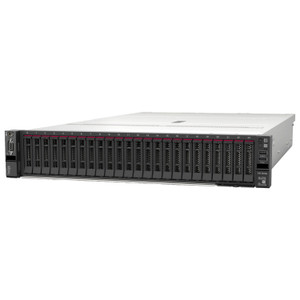
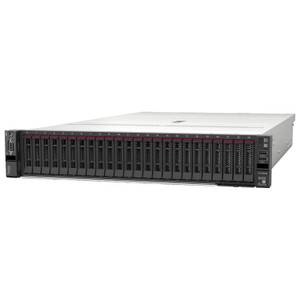
Lenovo 4XG7A63478 Intel Xeon Gold 6330N 28-Core Processor Option for ThinkSystem SR650 V2
Overview
The Lenovo 4XG7A63478 is an Intel Xeon Gold 6330N 28-core processor option kit designed for the ThinkSystem SR650 V2 rack server. Built on Intel's 3rd Generation Xeon Scalable platform and fabricated on a 10nm process node, the 6330N targets compute-dense workloads where thread count and sustained throughput matter more than raw single-core clock speed — virtualization hosts, large-scale network video recorder backends, analytics pipelines, and enterprise middleware stacks running dozens of concurrent services.
At 165W TDP seated in an LGA 4189 socket, this processor fits the SR650 V2's dual-socket design, giving architects the option to populate both sockets for a 56-core, 112-thread system without stepping outside the platform's thermal and power envelope. The 2.2 GHz base clock and 3.4 GHz boost across 28 cores, paired with a 42 MB L3 cache and 11.2 GT/s system bus, make it a practical fit for workloads that sustain high parallelism rather than relying on burst performance from a handful of high-frequency cores.
For teams deploying video analytics infrastructure, AI inference at the edge-to-core boundary, or dense VM consolidation across a Lenovo ThinkSystem server fleet, the 6330N's core-count-per-watt profile is the right tradeoff — not the fastest chip in the family, but one of the most efficient for sustained multi-threaded loads.
Key Features
- 28 Cores / 56 Threads at 165W TDP: A 28-core, 56-thread configuration gives hypervisors enough headway to schedule dozens of VMs without contention. At 165W, it stays within the SR650 V2's dual-socket thermal budget — you can populate both sockets and still run standard server cooling without exotic airflow modifications.
- 2.2 GHz Base / 3.4 GHz Boost Clock: The 2.2 GHz base is conservative by design — Intel binned this processor for sustained multi-core throughput, not peak single-thread performance. The 3.4 GHz boost handles burst workloads (indexing, compression, short-duration analytics tasks) without requiring you to over-provision core count.
- Heterogeneous Core Architecture — 18 High-Priority + 10 Low-Priority Cores: The 6330N uses Intel's priority core model: 18 high-priority cores run at 2.3 GHz base while 10 low-priority cores operate at 1.9 GHz. This lets the OS scheduler push latency-sensitive processes (database queries, real-time analytics) onto the faster cores while background tasks consume the efficiency cores — useful in mixed-workload environments where you're running surveillance VMS software alongside storage management services.
- 42 MB L3 Cache: A 42 MB shared L3 cache reduces memory round-trips for workloads with large working sets — particularly relevant in network-intensive deployments processing high-bitrate video streams or running in-memory databases. Less cache pressure translates directly to lower latency at the application layer.
- 11.2 GT/s System Bus: The 11.2 GT/s UPI interconnect speed keeps inter-socket latency manageable in dual-socket SR650 V2 configurations. If you're running a two-socket build, this bus rate determines how efficiently the two processors share memory and cache state — critical for NUMA-aware workloads.
- 10nm Process Node: The 10nm Ice Lake fabrication improves power efficiency relative to 14nm predecessors, which matters in rack density scenarios where per-socket wattage directly limits how many compute nodes fit on a circuit. Lower process node = more compute per kilowatt, relevant to anyone counting kWh in a co-location environment.
- 64-bit Operating Mode: Full 64-bit support is expected at this tier, but confirms compatibility with every enterprise OS — RHEL, Windows Server, VMware ESXi, and major Linux distributions used in security and analytics deployments.
- LGA 4189 Socket (Ice Lake-SP Platform): Socket LGA 4189 is the standard for 3rd Gen Xeon Scalable processors. This processor slots into any SR650 V2 that supports the Ice Lake-SP platform — verify your server's firmware revision supports 6330N before ordering if you're adding it to an existing unit rather than a new build.
Integration & Compatibility
The 4XG7A63478 is a Lenovo-configured processor option for the Lenovo ThinkSystem SR650 V2 — it is not a retail-boxed Intel processor. Lenovo validates these options against specific SR650 V2 firmware and BIOS revisions, so compatibility is tied to the server platform, not just the socket. Before deploying into an existing chassis, confirm the installed UEFI/BIOS version supports 3rd Gen Xeon Scalable processors via Lenovo's ServerProven compatibility tool.
For software stacks, the 6330N's 64-bit architecture and broad OS certification base covers the full range of enterprise platforms used in physical security infrastructure: VMware vSphere, Microsoft Hyper-V, Red Hat Enterprise Linux, and Ubuntu Server all run without modification. VMS platforms like Milestone XProtect and Genetec Security Center that publish server hardware recommendations based on channel count and analytics load will see this processor as a strong fit for mid-to-large deployments running 64+ camera channels with server-side analytics enabled.
Architects building out multi-server NVR and analytics clusters should account for the 6330N's NUMA topology when configuring memory — align memory population to the socket's memory channels for maximum bandwidth and minimum latency under load. Lenovo's ThinkSystem memory configuration tool provides validated DIMM population guides for the SR650 V2 platform.
Frequently Asked Questions
Q: What server is the Lenovo 4XG7A63478 compatible with?
A: The 4XG7A63478 is a processor option kit validated for the Lenovo ThinkSystem SR650 V2. It uses the LGA 4189 socket and is part of the 3rd Generation Intel Xeon Scalable (Ice Lake-SP) platform supported by that server. Confirm your SR650 V2 UEFI/BIOS revision supports 6330N before installation.
Q: How many cores and threads does the Xeon Gold 6330N provide?
A: The Intel Xeon Gold 6330N delivers 28 physical cores and 56 threads via Intel Hyper-Threading. In a dual-socket SR650 V2 configuration, you can achieve 56 cores and 112 threads total.
Q: What is the TDP of the 6330N, and will it fit the SR650 V2's cooling?
A: The 6330N has a 165W TDP. The ThinkSystem SR650 V2 is designed to support processors in this power class within its standard thermal configuration. Verify your chassis and airflow configuration against Lenovo's thermal guidelines if running high ambient temperatures or high-density rack configurations.
Q: What is the boost clock speed of the 4XG7A63478?
A: The Intel Xeon Gold 6330N boosts to 3.4 GHz on its high-priority cores. The base frequency is 2.2 GHz, with 18 high-priority cores running at 2.3 GHz base and 10 low-priority cores at 1.9 GHz base.
Q: Is the Lenovo 4XG7A63478 the same as buying an Intel Xeon Gold 6330N retail processor?
A: No. The 4XG7A63478 is a Lenovo-branded option kit, validated and supported under Lenovo's server platform qualification program for the SR650 V2. Lenovo processor options include platform-specific firmware support and are the correct procurement path for warranty-covered SR650 V2 builds.
Q: What is the L3 cache size on the 6330N?
A: The Intel Xeon Gold 6330N includes 42 MB of shared L3 cache across its 28 cores, which helps sustain throughput on workloads with large in-memory datasets such as video analytics, database queries, and large VM footprints.
The 4XG7A63478 catches my attention specifically because of the heterogeneous core architecture — 18 high-priority cores at 2.3 GHz base and 10 low-priority efficiency cores at 1.9 GHz. In mixed-workload server environments, that distinction between core classes is genuinely useful: your VMS recording engine and real-time analytics processes get scheduled to the faster cores, while housekeeping tasks (log rotation, storage tiering, health monitoring) land on the low-priority pool without stealing headroom from production workloads.
Technical Highlights:
- 28 Cores / 56 Threads at 165W: High thread density for the wattage — keeps dual-socket SR650 V2 builds within standard thermal limits while delivering 56 cores and 112 threads for VM-dense or analytics-heavy deployments.
- 42 MB L3 Cache: Enough shared cache to keep frequently accessed video metadata and index structures resident, reducing DRAM round-trips on sustained analytics workloads — where cache misses translate directly to processing latency.
- 3.4 GHz Boost / 11.2 GT/s UPI: The boost headroom handles burst decode and indexing tasks without requiring clock-speed headroom to be provisioned into the base. The 11.2 GT/s inter-socket bus keeps dual-socket NUMA latency predictable across the SR650 V2 platform.
Deployment Considerations:
- This is a Lenovo platform option, not a retail Intel processor — it must be paired with a ThinkSystem SR650 V2 running a UEFI revision that supports 3rd Gen Xeon Scalable. Check Lenovo ServerProven before deploying into an existing chassis rather than a new build.
- The 6330N's 2.2 GHz base clock is lower than the broader Gold 6300 series average — workloads with a single-threaded critical path (some legacy VMS engines, older database backends) will see less headroom than a lower-core-count, higher-clocked Gold variant. Right-size to your actual thread utilization profile before committing.
For architects building a centralized analytics and VMS backend handling 64 to 128+ camera channels with server-side motion detection, object classification, and concurrent playback — this is a practical processor choice that keeps power draw in check while delivering the thread count those workloads actually consume.