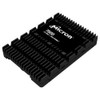
Lenovo 4XB7A95052 ThinkSystem 7.68TB U.3 NVMe PCIe 4.0 Read Intensive SSD
Overview
The Lenovo 4XB7A95052 is a 7.68TB U.3 NVMe PCIe Gen 4 x4 hot-swap SSD engineered for read-intensive workloads in ThinkSystem server platforms. At 1,100,000 random read IOPS and a 70 µs read latency, this drive is built for applications where storage throughput directly gates application performance — think high-density video surveillance archives, AI inference data pipelines, and database read replicas that simply cannot tolerate the latency floor of SATA or SAS alternatives.
The U.3 tri-mode form factor is the key differentiator here. Unlike M.2 or standard U.2, the 2.5-inch U.3 interface supports hot-swap in compatible ThinkSystem backplanes, meaning you can swap a failed or capacity-saturated drive without a maintenance window. For enterprise storage deployments running 24/7, that matters more than raw spec numbers on a datasheet.
Key Features
- 7.68TB 3D TLC NAND Capacity: Dense, cost-efficient storage in a single 2.5-inch bay. At this capacity, a four-drive NVMe pool delivers roughly 30TB usable before RAID overhead — enough to hold weeks of high-bitrate video or years of transaction logs without a chassis expansion.
- 1,100,000 Random Read IOPS (4KB): For read-dominated workloads — VMS playback, AI model serving, analytics query acceleration — this IOPS ceiling means the drive rarely becomes the bottleneck. Most application servers will saturate their CPU or network fabric long before this SSD runs out of headroom.
- 250,000 Random Write IOPS (4KB): Write performance is intentionally asymmetric, which is the correct engineering tradeoff for a read-intensive class drive. Workloads with sustained write bursts (continuous surveillance ingest, for example) should evaluate a mixed-use or write-intensive variant instead.
- 70 µs Read Latency / 15 µs Write Latency: Sub-100µs read latency means individual I/O operations complete in under a tenth of a millisecond. For latency-sensitive applications like real-time video analytics or in-memory database acceleration, these numbers translate directly to faster query response and lower jitter on time-critical pipelines.
- PCIe 4.0 x4 Interface: Gen 4 doubles the per-lane bandwidth of PCIe 3.0. In a properly configured ThinkSystem platform, this means the host-to-drive bus is not the limiting factor for sequential workloads — the NAND itself sets the ceiling, not the interconnect.
- 2,000,000-Hour MTBF: The 2M-hour MTBF rating reflects enterprise-class NAND validation and controller screening. Translate that to practical terms: at a typical data center duty cycle, this drive is rated for over 228 years of continuous operation — the failure mode in production will be writes-to-endurance exhaustion long before random component failure.
- Hot-Swap U.3 Form Factor: The 2.5-inch U.3 carrier is compatible with ThinkSystem hot-swap backplanes, enabling live replacement in RAID arrays or storage pools without powering down the server. For server components in always-on environments, this is a non-negotiable operational requirement.
- 13.5W Read / 17.5W Write Power Envelope: Under read load, this drive draws 13.5W — moderate for a high-performance NVMe. Write operations peak at 17.5W. In a fully populated 24-bay chassis, power budget planning is mandatory: 24 drives at peak write draw 420W from storage alone, before compute and networking.
- 0–70°C Operating Temperature: Standard commercial operating range suitable for properly cooled server enclosures. This is not a ruggedized or extended-temp drive — airflow in the chassis must be maintained per Lenovo's thermal specifications. Deploy in environments where inlet air temperature stays under 35°C to stay within the drive's validated envelope.
Integration & Compatibility
The 4XB7A95052 is a ThinkSystem-branded option drive, meaning it is validated for integration into Lenovo's Lenovo ThinkSystem server lineup. U.3 backplane compatibility is required — not all ThinkSystem chassis support U.3 natively; some require a backplane upgrade from U.2. Verify your server's Storage Configuration Guide before ordering. The PCIe 4.0 x4 host interface requires a Gen 4-capable slot or backplane controller; Gen 3 platforms will negotiate down to PCIe 3.0 speeds, which reduces sequential bandwidth but does not affect the drive's function.
For NVMe SSD deployments in surveillance infrastructure, this drive pairs well with high-channel-count NVR platforms or software-defined VMS servers where the storage tier is the performance constraint. Pair it with a RAID controller or NVMe-oF fabric if your architecture requires shared storage across multiple compute nodes. Check your VMS vendor's hardware compatibility list for validated server-drive combinations before finalizing the storage design. See the storage planning guide for channel-count-to-storage-capacity benchmarks across common VMS platforms.
Frequently Asked Questions
Q: What servers is the Lenovo 4XB7A95052 compatible with?
A: The 4XB7A95052 is a ThinkSystem option drive validated for Lenovo ThinkSystem server platforms with U.3-compatible hot-swap backplanes. Verify compatibility against your specific server model's Storage Configuration Guide, as U.3 support varies by chassis generation and backplane configuration.
Q: What is the difference between U.2 and U.3 for this drive?
A: U.3 is a tri-mode successor to U.2 that uses the same 2.5-inch SFF-8639 connector but adds protocol flexibility (NVMe, SATA, SAS over the same physical interface) and is designed for hot-swap in enterprise backplanes. The 4XB7A95052 uses U.3 with NVMe over PCIe 4.0 x4. Some older U.2 backplanes are not electrically compatible with U.3 drives — confirm backplane support before deploying.
Q: Is the 4XB7A95052 suitable for continuous video surveillance recording workloads?
A: It depends on the write profile. This is a read-intensive class drive with 250,000 write IOPS — appropriate for VMS architectures where playback and analytics dominate I/O, or where writes are distributed across multiple drives in a RAID or erasure-coded pool. For pure ingest workloads with sustained sequential writes across many cameras simultaneously, a mixed-use or write-intensive NVMe variant would provide better endurance.
Q: What is the random read IOPS of the 4XB7A95052?
A: The drive delivers up to 1,100,000 random read IOPS at a 4KB block size with a read latency of 70 µs. This makes it well-suited for latency-sensitive read workloads such as real-time video analytics, database query acceleration, and AI inference pipelines.
Q: What is the power draw of this SSD under load?
A: The 4XB7A95052 draws 13.5W during read-intensive operation and peaks at 17.5W during write operations. In dense multi-drive configurations, account for worst-case write power in chassis power budget calculations.
Q: Does this SSD support hot-swap?
A: Yes. The U.3 2.5-inch form factor supports hot-swap in compatible ThinkSystem backplanes, allowing drive replacement or addition without powering down the server — a critical requirement for high-availability storage in 24/7 operational environments.
The 4XB7A95052 is one of the few enterprise NVMe options at the 7.68TB capacity point that combines a U.3 hot-swap form factor with PCIe 4.0 bandwidth — and that combination matters in practice. The 1,100,000 read IOPS spec is the headline, but the 70 µs read latency is what I focus on when evaluating drives for latency-sensitive server workloads.
Technical Highlights:
- 1.1M Read IOPS at 70 µs: For VMS platforms running concurrent video analytics across dozens of streams, this IOPS ceiling and latency floor means the storage tier stays ahead of the CPU — you're not waiting on disk when running motion search or AI-based object classification across archived footage.
- 17.5W Peak Write Power: In a fully populated ThinkSystem chassis with 24 U.3 bays, worst-case write power from drives alone is 420W. This needs to be on the power budget worksheet before chassis selection — not after the rack is wired.
- 2,000,000-Hour MTBF: Enterprise NAND screening at this level means the realistic failure mode in a properly cooled deployment is write endurance exhaustion, not random component failure. For read-intensive archive workloads, endurance life will typically far outlast the server platform itself.
Deployment Considerations:
- U.3 compatibility is not universal across ThinkSystem generations — older backplanes designed for U.2 may require a hardware upgrade before this drive will operate at its rated interface speed. Validate backplane part numbers against Lenovo's compatibility matrix before procurement.
- The 0–70°C operating range is a commercial-grade thermal envelope, not extended temp. In high-density chassis configurations, ensure the server's internal airflow can maintain drive inlet temperatures within spec under sustained write loads, which run 4W hotter than read operations.
The 4XB7A95052 is the right call for ThinkSystem-based VMS servers or AI inference platforms where the storage pool is read-dominated and a maintenance window for drive replacement is operationally unacceptable — the hot-swap U.3 form factor is what closes that requirement.