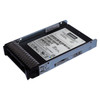
Lenovo 4XB7A93122 1.92TB U.2 NVMe PCIe 5.0 Read Intensive SSD
The Lenovo 4XB7A93122 is a 1.92TB, hot-swap U.2 NVMe solid-state drive built for read-intensive server and workstation deployments where sequential throughput and random read latency are the limiting factor on application performance. Riding the PCIe 5.0 x4 interface, it delivers up to 1,440,000 random read IOPS at 4KB block size — a meaningful step above PCIe 4.0 NVMe predecessors in the same form factor. If your workload is dominated by database reads, VDI boot storms, video surveillance archive retrieval, or analytics that hammer cached datasets, this drive is sized and specified for that pressure.
Key Features
- 1,440,000 Random Read IOPS (4KB): At 4KB random reads, the 4XB7A93122 sustains 1.44 million IOPS — the kind of headroom that keeps latency-sensitive workloads from queuing up at the storage layer. Relevant for any deployment where dozens of concurrent read threads compete for the same NVMe queue depth.
- 135,000 Random Write IOPS (4KB): Write performance is intentionally balanced for a read-optimized profile. At 135K write IOPS, this drive handles mixed workloads without write stalls, but if your ratio flips to write-heavy (log ingestion, event recording at scale), evaluate a mixed-use variant instead.
- PCIe 5.0 x4 Interface: PCIe 5.0 doubles the per-lane bandwidth of PCIe 4.0. In a U.2 x4 slot, that translates to roughly twice the peak sequential throughput ceiling compared to the prior generation — important if your server platform is already PCIe 5.0 capable and you want to avoid bottlenecking future storage expansion.
- 1.92TB Capacity in U.2 Form Factor: The 2.5-inch U.2 (SFF-8639) footprint fits standard hot-swap drive bays on ThinkSystem and compatible multi-vendor server platforms. 1.92TB per bay lets dense storage configurations hit usable capacity targets without adding more bays or enclosures.
- Hot-Swap (HS) Design: The hot-swap designation means the drive can be replaced without powering down the host server — a practical requirement in any environment running continuous workloads where even a brief maintenance window carries a service-level cost.
- Multi-Vendor Compatibility: Lenovo designates this as a multi-vendor drive, meaning it is qualified for use across compatible server platforms beyond Lenovo ThinkSystem — useful in mixed-vendor data center environments where a single drive SKU needs to cover multiple host platforms.
- Read Intensive Endurance Profile: The read-intensive classification signals an endurance profile optimized for high-read, lower-write duty cycles. This is the right choice for surveillance video retrieval, analytics read queries, and VDI linked clones — not for continuous write workloads like primary logging or write-dominant databases.
Integration and Compatibility
The 4XB7A93122 connects via the U.2 (SFF-8639) connector standard and operates over a PCIe 5.0 x4 NVMe lane. Verify that the target server platform provides PCIe 5.0 U.2 backplane connectivity — PCIe 5.0 NVMe drives are backward compatible with PCIe 4.0 and PCIe 3.0 slots, but will operate at the lower generation's bandwidth ceiling when installed in an older backplane. For Lenovo ThinkSystem platforms, confirm the storage backplane firmware level supports PCIe 5.0 NVMe enumeration before deployment. In mixed-vendor rack environments, consult the host HBA or RAID controller's NVMe compatibility matrix — this drive's multi-vendor designation covers hardware qualification, not controller firmware edge cases. Pair with a capable server storage platform and cross-reference your NVMe deployment planning guide to validate lane availability and thermal envelope in dense configurations. For surveillance infrastructure specifically, this drive fits NVR and video management server builds where retrieval performance on deep archives is a bottleneck — the 1.44M read IOPS profile directly addresses the random-read patterns of multi-channel concurrent video playback.
Frequently Asked Questions
Q: What interface does the Lenovo 4XB7A93122 use?
A: The 4XB7A93122 uses a PCIe 5.0 x4 NVMe interface via the U.2 (SFF-8639) connector. It is backward compatible with PCIe 4.0 and PCIe 3.0 U.2 backplanes, though maximum throughput will be limited to the installed generation's bandwidth ceiling.
Q: Is this drive suitable for write-intensive workloads like continuous video recording?
A: This drive carries a read-intensive endurance classification, meaning it is optimized for workloads dominated by reads. At 135,000 random write IOPS, it handles mixed workloads adequately, but for sustained high-write duties — such as multi-channel continuous video recording to a single drive — a mixed-use or write-intensive NVMe variant would be a better long-term fit.
Q: Can this drive be replaced without shutting down the server?
A: Yes. The hot-swap (HS) designation confirms the drive supports live replacement in compatible hot-swap bays without requiring a server power-down, provided the host platform and OS support NVMe hot-swap.
Q: Is the 4XB7A93122 compatible with non-Lenovo servers?
A: Lenovo designates this as a multi-vendor drive, indicating qualification beyond ThinkSystem platforms. Compatibility with specific non-Lenovo server models should be verified against the host platform's storage compatibility list and the U.2 backplane's PCIe generation support.
Q: What capacity does the 4XB7A93122 provide?
A: The drive provides 1.92TB of raw capacity in a 2.5-inch U.2 form factor.
The 4XB7A93122 hits the spec that actually moves the needle in read-heavy server builds: 1,440,000 random read IOPS at 4KB. That number is not marketing headroom — it is the throughput floor you need when a multi-channel video management server is pulling concurrent streams from archive across dozens of camera feeds, or when a VDI host is simultaneously serving linked-clone desktops through a read cache. The PCIe 5.0 x4 interface is the enabler here, and the U.2 hot-swap packaging means you are not architecting around downtime windows for drive maintenance.
Technical Highlights:
- 1,440,000 Read IOPS (4KB): For a video surveillance archive or analytics query tier, random read throughput is the dominant constraint. 1.44M IOPS at 4KB means this drive does not become the bottleneck even when dozens of concurrent read threads hit it simultaneously.
- PCIe 5.0 x4 Lane: PCIe 5.0 delivers twice the per-lane bandwidth of PCIe 4.0. In a U.2 x4 slot on a current-generation ThinkSystem platform, that headroom future-proofs the storage layer when workloads expand — you will hit application limits before you hit the interface ceiling.
- 135,000 Write IOPS (4KB): The write profile is intentionally conservative for a read-intensive class drive. It is adequate for event-driven writes and metadata updates, but plan around it — this is not the right drive for primary continuous-recording workloads generating sustained high-write streams.
Deployment Considerations:
- Confirm your server backplane is PCIe 5.0 capable before ordering. Backward compatibility with PCIe 4.0 and 3.0 slots exists, but you will see the drive throttled to the older generation's bandwidth — negating the reason to specify PCIe 5.0 hardware.
- The read-intensive endurance class means write endurance (DWPD) is lower than mixed-use or write-intensive variants. Size your deployment so write pressure per drive stays within the read-intensive profile — in a multi-drive NVMe array, distribute write load across enough spindles to keep per-drive write duty within spec.
This drive is well-positioned as the storage tier in a dedicated video management server or analytics platform where the workload is retrieval and query-heavy — specifically multi-channel concurrent playback from deep archives, or AI inference pipelines reading large model datasets from local NVMe rather than network storage.