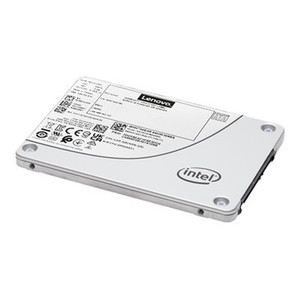
Lenovo 4XB7A77461 ST50 V2 2.5" 960GB SATA SSD
Overview
The Lenovo 4XB7A77461 is a 960GB 2.5-inch SATA III solid-state drive built specifically for deployment in Lenovo ThinkSystem ST50 V2 tower servers. Based on Intel's S4520 platform with 3D TLC NAND flash and a 6 Gbit/s SATA interface, it delivers consistent read-heavy workload performance and enterprise-grade data integrity features — the kind of drive you specify when the server will handle continuous workloads like video archiving, database reads, or OS/application hosting in a space-constrained tower chassis. It is not an NVMe device; if your ST50 V2 workload is write-intensive or latency-critical at the sub-millisecond level, weigh that tradeoff before committing.
For environments running network video recorders or server-side VMS applications where storage reliability over multi-year deployments matters more than peak throughput, the 4XB7A77461 hits the right balance of capacity, endurance, and native server qualification.
Key Features
- 960GB Capacity on a 2.5" Footprint: Nearly 1TB in a standard 2.5-inch form factor means you can fit meaningful on-server storage without occupying a 3.5-inch bay — relevant in the ST50 V2's compact tower layout where bay count is limited. For a VMS host storing days of motion-clip cache or event recordings locally, this capacity tier is usable without an external NAS.
- 6 Gbit/s SATA III Interface: Saturates the SATA bus at full bandwidth. Sequential workloads — OS boots, large file transfers, VM image reads — run at the interface ceiling. This is not NVMe, so random small-block latency won't match PCIe drives, but for mixed-read server workloads it's the appropriate interface given the ST50 V2's storage controller.
- 90,000 Random Read IOPS (4KB): At 90K read IOPS, the drive handles database query patterns, VMS index lookups, and concurrent read requests from multiple application threads without queuing delays. Most enterprise tower server workloads are read-dominant; this drive is sized for that profile.
- 43,000 Random Write IOPS (4KB): Write performance at 43K IOPS covers logging, event recording, and transactional writes without becoming a bottleneck — provided the workload isn't sustained sequential write-heavy (bulk video ingest at scale, for example). Plan your server storage architecture around the expected write-to-read ratio before selecting this drive.
- Read Latency 102 µs / Write Latency 49 µs: Sequential latency floors at 36 µs for both reads and writes; random read latency is rated up to 102 µs, random write up to 49 µs. These figures confirm that write operations are actually snappier in latency terms than reads at the random 4KB level — typical of TLC NAND with write buffering. For interactive application hosting this is acceptable; for latency-sensitive transactional databases, validate against your application SLA.
- 256-Bit AES Hardware Encryption: Encryption is handled in the drive controller, not the CPU — no performance penalty on encrypted workloads. For servers storing access-control logs, video evidence, or personally identifiable data, AES-256 at the hardware level satisfies data-at-rest encryption requirements without adding software overhead or licensing cost. This is a meaningful compliance feature for deployments subject to audit.
- 3D TLC NAND Flash: 3D TLC stacks memory cells vertically to achieve high density at lower cost per GB versus MLC or SLC, while the enterprise firmware and error-correction on the S4520 platform manage the endurance trade-offs inherent to TLC. For a read-primary server workload, TLC endurance is entirely adequate — the UBER spec confirms this.
- UBER < 1 per 1017 Bits Read: The uncorrectable bit error rate of less than 1 in 10^17 bits read is an enterprise-tier spec. To put that in context: at 6 Gbit/s sustained read, you would need to transfer approximately 2 million terabytes before expecting a single uncorrectable error. This is the data integrity number that matters most for servers holding production data or evidence archives.
- 2,000,000-Hour MTBF: A rated mean time between failures of 2 million hours translates to a theoretical annualized failure rate under 0.05%. For a server that runs 24/7 in a security operations context — where unplanned downtime means missing recorded events or losing access-control functionality — this reliability figure supports multi-year continuous operation planning.
- S.M.A.R.T. Monitoring Support: Native S.M.A.R.T. telemetry integrates with server management tools and VMS platforms that poll drive health. Predictive failure alerts let you schedule proactive replacement before data loss — critical in deployments where the server is unattended or remotely managed across a distributed Lenovo server fleet.
Integration and Compatibility
The 4XB7A77461 is qualified for the Lenovo ThinkSystem ST50 V2 server platform. As a non-hot-swap (NHS) drive, installation requires powering down the server — factor this into your maintenance window planning if the server hosts production workloads. The 2.5-inch SATA form factor installs into the ST50 V2's internal drive bays using the server's standard drive carrier; confirm bay availability against your existing installed storage before ordering.
The SATA III interface is universally compatible with any SATA 6Gb/s controller. Hardware AES-256 encryption requires enabling the feature through the server's storage controller or drive management tooling — it is not active by default on all configurations. Verify your BIOS and RAID controller settings support TCG Opal or ISE if encryption activation is a deployment requirement.
For deployments pairing this drive with a network video recorder application running on the ST50 V2, 960GB provides on-server buffer or clip storage. For full continuous-recording NVR workloads at scale, supplement with additional drives or external storage — this drive is best positioned as an OS/application drive or a secondary clip-storage volume rather than a primary high-capacity recording target.
Pair this drive with a qualified server storage configuration and review Lenovo's compatibility matrix for the ST50 V2 to confirm no firmware dependencies before deployment. Organizations building out edge server infrastructure should also review PoE switch and network architecture alongside server storage to avoid bottlenecks at the edge node level.
Frequently Asked Questions
Q: Is the Lenovo 4XB7A77461 an NVMe drive?
A: No. The 4XB7A77461 uses a SATA III (6 Gbit/s) interface, not NVMe. It installs in a standard 2.5-inch SATA bay. If your ST50 V2 workload requires NVMe-level random IOPS or sub-50 µs sustained latency, you will need a different drive from the Lenovo storage portfolio.
Q: Does the 4XB7A77461 support hardware encryption?
A: Yes. The drive includes 256-bit AES hardware encryption, handled at the controller level with no CPU overhead. Activation typically requires enabling the feature through the server's storage controller configuration — verify your BIOS and RAID controller settings support TCG Opal or ISE before relying on encryption being active out of the box.
Q: What is the rated reliability of this SSD?
A: Lenovo rates the 4XB7A77461 at 2,000,000 hours MTBF and an uncorrectable bit error rate (UBER) of less than 1 per 10^17 bits read. These are enterprise-tier figures appropriate for 24/7 server operation.
Q: Is this drive hot-swappable?
A: No. The NHS (Non-Hot-Swap) designation means the server must be powered down to install or replace this drive. Plan installation during a scheduled maintenance window if the server is hosting live workloads.
Q: What server platform is this drive qualified for?
A: The 4XB7A77461 is qualified for the Lenovo ThinkSystem ST50 V2 tower server. It is a server/workstation component; always verify against Lenovo's official compatibility matrix for your specific ST50 V2 configuration before ordering.
Q: What NAND type does this SSD use?
A: 3D TLC NAND. This provides high density and cost-efficiency per gigabyte. The enterprise-class firmware and error-correction on the S4520 platform manage TLC endurance for read-primary server workloads, backed by the 2M-hour MTBF and UBER ratings above.
The spec I keep coming back to on the 4XB7A77461 is that 2,000,000-hour MTBF paired with a UBER below 1 per 10^17 bits — those two numbers together tell you this drive is built for servers that run unattended for years, not workstations that get rebooted weekly. If you're provisioning ST50 V2 units as edge VMS hosts at remote sites where a failed drive means a truck roll, that reliability profile matters more than peak throughput.
Technical Highlights:
- 90,000 Read IOPS at 4KB: Handles concurrent read requests from VMS index lookups, application threads, and OS operations simultaneously — read-dominant server profiles won't hit a queue ceiling with this drive.
- 256-Bit AES Hardware Encryption: Offloads encryption entirely to the drive controller, preserving server CPU headroom for application workloads. For deployments subject to data-at-rest compliance requirements, this is the correct way to implement encryption — not software-layer solutions that tax the processor.
- 49 µs Random Write Latency: Write latency at under 50 µs means event logging, database commits, and VMS metadata writes resolve quickly even under concurrent load — tighter than the read latency figure, which is characteristic of the S4520's write-path buffering.
Deployment Considerations:
- This is an NHS (Non-Hot-Swap) drive — the ST50 V2 must be fully powered down for installation or replacement. If you are building a high-availability node where live drive swap is required, this drive and this server platform are not the right fit; you'll need a hot-swap chassis configuration instead.
- Hardware encryption requires explicit activation through the storage controller or BIOS — it is not guaranteed to be enabled by default. Validate your TCG Opal or ISE support before treating the drive as encrypted in a compliance audit. Do not assume encryption is active simply because the drive supports it.
The 4XB7A77461 is the correct call for Lenovo ST50 V2 deployments serving as edge VMS application hosts or access-control server nodes at branch locations — sites where a 2M-hour MTBF and hardware-native AES-256 matter more than NVMe latency, and where scheduled maintenance windows make the NHS form factor acceptable.