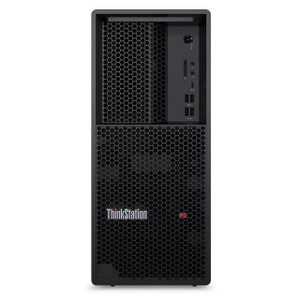
Lenovo 30HT0052US ThinkStation P3 Tower Gen 2 Surveillance Workstation
Overview
The Lenovo ThinkStation P3 Tower Gen 2 (30HT0052US) is a commercial-grade tower workstation built around Intel's Core Ultra 7 265 vPro processor and an NVIDIA RTX 2000 Ada Generation 16GB GPU — a pairing that hits the right balance for multi-stream video decoding, VMS client workstations, and edge analytics processing in physical security environments. At 9.0 lb in a standard tower chassis, it deploys cleanly into server rooms, SOC consoles, and operations centers without demanding rack space.
For security integrators evaluating a dedicated surveillance workstation or VMS decode station, the P3 Tower Gen 2 checks the boxes that matter: a high-core-count processor with AI-acceleration support, professional-grade discrete GPU with sufficient VRAM for multi-monitor decode, DDR5 memory headroom, and next-generation NVMe storage. If you're sizing a system against a network video recorder deployment or a hybrid VMS architecture, the hardware profile here supports serious throughput.
Key Features
- Intel Core Ultra 7 265 vPro — 20 Cores, E-cores to 4.60GHz: The 265 is a 20-core hybrid architecture (P-cores + E-cores) with the E-cores boosting to 4.60GHz on sustained workloads. For VMS applications running parallel stream decode, motion search, and analytics simultaneously, the E-core cluster handles background threads without starving the P-cores handling display and UI. vPro support adds Intel AMT for out-of-band remote management — useful for security operations centers where physical access to the workstation is inconvenient.
- NVIDIA RTX 2000 Ada Generation — 16GB GDDR6: The RTX 2000 Ada is a professional-tier Lovelace-architecture GPU with 16GB of GDDR6. In VMS environments, GPU-accelerated decode offloads H.265/H.264 stream decoding from the CPU — this matters when you're driving 32+ camera feeds simultaneously on a VMS client. The 16GB VRAM headroom also supports multi-monitor configurations (up to 4 displays from a single card) without hitting memory limits during peak-load playback.
- 64GB DDR5-5600 ECC-Ready — Expandable to 256GB: 64GB of DDR5 at 5600MHz arrives in a 2×32GB configuration across 4 available DIMM slots, leaving two slots open. Maximum supported capacity is 256GB, giving you a clear upgrade path as channel counts or analytics workloads grow. DDR5 bandwidth — roughly double DDR4 — benefits memory-intensive tasks like simultaneous multi-stream decode and AI inference.
- 512GB PCIe Gen5 NVMe SSD (M.2 2280, TLC Opal): The boot and OS drive is a PCIe 5.0 NVMe, delivering sequential read speeds roughly double what PCIe 4.0 drives achieve. For VMS software that performs frequent database writes (event metadata, thumbnail caches, analytics logs), Gen5 NVMe keeps I/O from becoming a bottleneck. The Opal self-encrypting drive (SED) capability supports hardware-level full-disk encryption — relevant for deployments with data-at-rest compliance requirements.
- Intel BE200 vPro — Wi-Fi 7 + Bluetooth: The integrated Intel BE200 delivers Wi-Fi 7 (802.11be) connectivity with vPro manageability extensions. For operations centers or temporary deployments where wired Ethernet isn't immediately available, Wi-Fi 7 provides multi-gigabit wireless throughput. Ethernet is also available for standard wired network integration.
- Slim DVD±RW Optical Drive: The integrated Slim DVD RAMBO (Read And Multiple Burn Optical) drive handles installation media and evidence archival to disc — a requirement in some law enforcement and court-admissible evidence workflows where optical media remains the chain-of-custody format.
- Windows 11 Pro 64-bit Pre-installed: Ships with Windows 11 Pro, compatible with the major VMS platforms targeting Windows-based deployment. No separate OS licensing needed for standard commercial deployments.
- Tower Form Factor — 9.0 lb: The standard tower chassis fits under a desk, in a console cabinet, or on a shelf without requiring rack rails or rack-unit planning. At 9.0 lb, it's light enough for periodic repositioning during infrastructure changes.
Integration and Compatibility
The 30HT0052US is positioned as a VMS workstation or decode client in multi-camera surveillance deployments. The RTX 2000 Ada GPU supports NVIDIA NVDEC hardware decode acceleration, which most enterprise VMS platforms (Milestone XProtect, Genetec Security Center, Avigilon Control Center, Hanwha Wave, and others) can leverage to offload H.265 and H.264 stream decoding from the CPU — a meaningful performance gain when operating at high camera counts.
The PCIe expansion slots in the P3 Tower chassis support additional storage controllers, capture cards, or secondary GPU installations if your deployment requires it. The USB and Ethernet interfaces cover standard peripheral integration for access control workstations, operator input devices, and network connectivity.
For teams evaluating PoE switch infrastructure or NVR-based recording alongside a centralized VMS client architecture, the P3 Tower Gen 2 fits naturally as the operator console — handling live view, playback, and analytics review while dedicated recorders handle continuous write throughput. For a broader view of the Lenovo commercial portfolio, including ThinkStation and ThinkSystem lines, the full range covers rack, tower, and mobile form factors suited to security infrastructure deployments.
Frequently Asked Questions
Q: What processor does the Lenovo 30HT0052US use, and how many cores does it have?
A: The 30HT0052US is equipped with an Intel Core Ultra 7 265 vPro processor featuring 20 cores and 20 threads, with E-cores boosting up to 4.60GHz. The hybrid architecture handles parallel workloads — like multi-stream video decode plus analytics — efficiently by distributing background threads across the efficiency core cluster.
Q: How much RAM does the 30HT0052US ship with, and what is the maximum supported?
A: It ships with 64GB of DDR5-5600 memory in a 2×32GB configuration. The system has 4 DIMM slots, leaving two open, and supports up to 256GB maximum — giving you a direct upgrade path as workload demands increase.
Q: Is the SSD in the 30HT0052US self-encrypting?
A: Yes. The 512GB M.2 2280 PCIe Gen5 NVMe SSD uses TLC NAND with Opal SED (Self-Encrypting Drive) support, enabling hardware-level full-disk encryption without CPU overhead. This is relevant for deployments with data-at-rest security or compliance requirements.
Q: What GPU does the 30HT0052US include, and how many monitors can it drive?
A: The system includes an NVIDIA RTX 2000 Ada Generation with 16GB GDDR6. This is a professional Lovelace-architecture GPU supporting up to 4 simultaneous display outputs from a single card, and it provides NVDEC hardware acceleration for H.265/H.264 video stream decode — a significant benefit in VMS multi-camera environments.
Q: Does the 30HT0052US include wireless networking?
A: Yes. The Intel BE200 vPro adapter provides Wi-Fi 7 (802.11be) and Bluetooth, in addition to the standard wired Ethernet port. The vPro designation extends Intel AMT out-of-band management capabilities.
Q: Does the 30HT0052US have an optical drive?
A: Yes. A Slim DVD±RW (RAMBO) optical drive is included, supporting both read and write functions. This is useful for software installation from disc and for evidence archival workflows that require optical media.
When I look at the 30HT0052US for a security deployment, the spec that jumps out first is the NVIDIA RTX 2000 Ada with 16GB GDDR6 — that GPU is doing real work in a VMS environment, not just pushing pixels. Hardware-accelerated H.265 decode across 32 or more simultaneous camera streams is a fundamentally different performance profile than CPU-only decode, and most integrators underestimate how quickly CPU resources get consumed once you add analytics overlays and event search on top of live view.
Technical Highlights:
- Intel Core Ultra 7 265 vPro — 20C/20T, E-cores to 4.60GHz: The hybrid core architecture distributes background VMS threads (database writes, thumbnail generation, alert processing) across E-cores, keeping P-cores available for display rendering and interactive playback. vPro AMT enables out-of-band remote management — valuable in unmanned SOC closets.
- 64GB DDR5-5600, 2×32GB, max 256GB: DDR5 at 5600MHz delivers the memory bandwidth that multi-stream decode and concurrent AI inference demand. Two open DIMM slots mean you can double to 128GB or reach the 256GB ceiling without replacing existing sticks.
- 512GB PCIe Gen5 NVMe, Opal SED: Gen5 NVMe roughly doubles the sequential throughput of Gen4 — VMS metadata databases and analytics logs benefit directly. The hardware Opal encryption keeps data-at-rest compliance within the drive itself, with no CPU overhead penalty.
Deployment Considerations:
- The 512GB boot SSD is sufficient for the OS and VMS client software, but not for local video storage. Plan for secondary internal drives or NAS/SAN connectivity for any on-box retention requirements — the PCIe and interface expansion in the P3 Tower chassis supports additional storage controllers.
- The RTX 2000 Ada is a professional-tier GPU, not a consumer GeForce card — driver stability and ISV certification matter here. Confirm your VMS vendor's GPU certification list before deployment, particularly for NVDEC acceleration support on your specific software version.
The 30HT0052US fits best as a dedicated VMS operator console or analytics decode station in a mid-to-large physical security deployment — SOC environments running 32–100+ camera feeds where GPU-accelerated decode and solid CPU headroom keep the workstation responsive under continuous load.