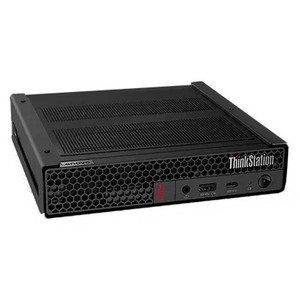
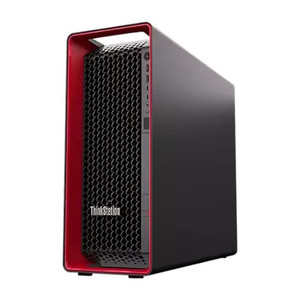
Lenovo 30F3004XUS ThinkStation P7 Tower Workstation
Overview
The Lenovo ThinkStation P7 (30F3004XUS) is a professional tower workstation built around Intel's Xeon w7-3445 processor — a 20-core, 40-thread chip that runs at a 2.6 GHz base and boosts to 4.8 GHz under load. If your deployment involves running high-channel-count video management software, real-time analytics engines, or parallel encoding pipelines, this is the class of hardware that handles those workloads without throttling or compromise. The P7 supports DDR5-SDRAM up to 1 TB of system memory, making it a realistic platform for enterprise-scale compute tasks where memory capacity is the constraint, not just clock speed.
This configuration ships with 64 GB of DDR5 memory across four channels — enough headroom for most production deployments, with substantial room to scale without replacing the platform. For teams evaluating commercial workstations for VMS server duty or edge analytics, the P7's memory ceiling matters as much as its current config.
Key Features
- 20-Core / 40-Thread Xeon w7-3445: With 20 performance cores and 40 threads, the w7-3445 handles simultaneous workloads that would saturate a standard desktop processor — think multi-stream H.265 decoding, analytics inference, and database I/O running concurrently without scheduling contention. The 4.8 GHz boost frequency means single-threaded operations (license plate reads, event correlation) don't fall behind either.
- 52.5 MB Smart Cache: The large on-die cache reduces main-memory round trips on frequently accessed data — relevant when a VMS is continuously indexing video metadata or when an analytics engine is running inference against a resident model. Fewer cache misses translates directly to lower latency per decoded frame.
- DDR5-SDRAM at 64 GB, Expandable to 1 TB: DDR5 delivers roughly double the bandwidth of DDR4 at equivalent frequencies. The practical benefit: feeding a high-core-count processor at full throughput without memory becoming the bottleneck. The 1 TB ceiling means this platform won't need to be replaced as your channel count or analytics load grows.
- PCIe 4.0 and 5.0 Slot Support: Dual-generation PCIe means you can install current-gen GPU accelerators (PCIe 5.0) alongside PCIe 4.0 capture or NIC cards without slot negotiation problems. For deployments adding deep-learning inference cards or high-bandwidth storage controllers, this flexibility matters at configuration time.
- 270 W Base / 324 W Max Turbo TDP: The Xeon w7-3445 is a high-TDP processor — plan the power budget and rack/room cooling accordingly. This is not a low-power edge device; it's a full workstation-class CPU designed for sustained compute, and the thermal envelope reflects that.
- LGA 4677 (Socket E) Platform: The Xeon W platform on Socket E is a long-lived socket with broad ecosystem support for validated memory, accelerators, and storage. For enterprise buyers, platform longevity reduces refresh risk over a multi-year deployment window.
Integration and Compatibility
The ThinkStation P7 is built on the Intel Xeon W-3400 series platform, which carries broad compatibility with enterprise software stacks. The PCIe 5.0 and 4.0 slot mix accommodates GPU accelerators from major vendors, high-port-count NICs, and storage controllers — all relevant for network video recorder builds or dedicated VMS server configurations. DDR5 RDIMM compatibility follows Intel's validated memory list for the w7-3445; confirm specific DIMM part numbers against the platform QVL before ordering additional memory. For integrators building out a IP camera infrastructure that needs a centralized compute node, the P7's expandability — both in memory capacity and PCIe I/O — makes it a platform you can grow into rather than one you'll outgrow in the first refresh cycle. Pairing it with a dedicated PoE switch infrastructure on the network side keeps the camera-to-server pipeline clean and manageable.
Frequently Asked Questions
Q: What processor does the Lenovo 30F3004XUS use, and how many cores does it have?
A: The 30F3004XUS is equipped with the Intel Xeon w7-3445, a 20-core, 40-thread processor with a 2.6 GHz base frequency and a 4.8 GHz maximum turbo frequency. It carries 52.5 MB of Intel Smart Cache.
Q: How much RAM does this configuration ship with, and what is the maximum supported?
A: This configuration ships with 64 GB of DDR5-SDRAM across four channels. The platform supports up to 1 TB of total system memory, giving significant headroom for future expansion without replacing the workstation.
Q: What PCIe generations are supported in the ThinkStation P7?
A: The ThinkStation P7 supports both PCIe 4.0 and PCIe 5.0 slots, allowing installation of current-generation GPU accelerators, high-bandwidth NIC cards, and storage controllers alongside existing PCIe 4.0 peripherals.
Q: What is the processor socket on the 30F3004XUS?
A: The Xeon w7-3445 uses the LGA 4677 (Socket E) socket, part of Intel's enterprise Xeon W platform. This socket supports validated RDIMM and LRDIMM DDR5 memory modules.
Q: What is the power draw of this workstation?
A: The Xeon w7-3445 processor has a base power of 270 W and a maximum turbo power of 324 W. Plan the power delivery and room cooling for these levels — this is a full workstation-class thermal envelope, not a low-power appliance.
Q: Where is the ThinkStation P7 30F3004XUS manufactured?
A: The 30F3004XUS is manufactured in Mexico, per the distribution feed country-of-origin data.
The 30F3004XUS sits at the serious end of workstation compute — the Xeon w7-3445's 270 W base TDP alone tells you this isn't a quiet office box. What it is: a platform with 20 real performance cores, 40 threads, and a 1 TB memory ceiling that most VMS and analytics deployments won't hit for years. If you're specifying a centralized server for a high-channel camera network or a dedicated analytics node, this is the class of hardware to be evaluating.
Technical Highlights:
- 4.8 GHz Boost on 20 Cores: The w7-3445 reaches 4.8 GHz on boost — meaning single-threaded tasks like event correlation or license plate recognition don't get penalized by the shift to a many-core architecture. You get both throughput and responsiveness in the same chip.
- 1 TB DDR5 Memory Ceiling: Most workstation-class VMS builds run out of CPU before RAM, but deployments running in-memory databases, large analytics models, or multi-tenant VMS instances will eventually need headroom. The P7 platform's 1 TB ceiling means you're not re-speccing hardware when that day comes.
- PCIe 5.0 + 4.0 Coexistence: The dual-generation PCIe support means you can drop a PCIe 5.0 inference accelerator into the same chassis as your existing PCIe 4.0 capture cards. No slot negotiation, no bandwidth compromise — each device runs at its native gen.
Deployment Considerations:
- At 324 W max turbo power, this processor needs dedicated circuit capacity and active room cooling — verify rack power delivery before installing in an existing enclosure, and don't assume a shared UPS has headroom for it.
- The 64 GB shipping configuration uses four DDR5 DIMMs; confirm available slots and the QVL before ordering additional memory to avoid compatibility issues on the DDR5 RDIMM side.
The ThinkStation P7 30F3004XUS is best positioned as a dedicated compute node for a multi-site VMS deployment or a high-channel analytics server — not a general-purpose office workstation. If you're centralizing camera management for 50+ channels with active analytics, this is where the processor and memory architecture pay off.