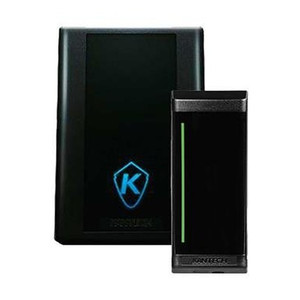
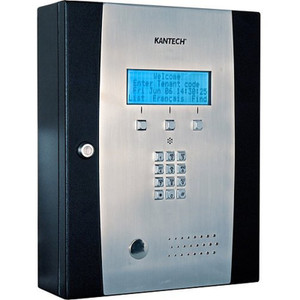
Kantech KT-APERIO-A061 Wireless Access Controller
The Kantech KT-APERIO-A061 is a wall-mounted wireless access controller designed for retrofit and new-build deployments where door-by-door wiring is impractical or cost-prohibitive. It manages up to 64 doors using NFC/BLE (13.56 MHz) wireless credentials, eliminating the per-door reader installation labor that traditionally drives access control retrofit expenses. The controller operates on 24VDC power (PoE 802.3af compatible), supports up to 1,000 user credentials, and functions both offline and integrated into networked access management architectures. For integrators, this resolves the retrofit bottleneck: existing door hardware retrofitted with wireless cylinders and locks connect to a single central controller rather than requiring individual conduit runs and power drops.
Key Features
- 64-Door Capacity: Single controller manages up to 64 networked access points. Reduces infrastructure footprint versus traditional wired multi-reader systems.
- NFC/BLE Wireless Credentials (13.56 MHz): Users authenticate via proximity cards, key fobs, or mobile device NFC/BLE. Zero per-door wiring simplifies installation in occupied buildings.
- PoE 802.3af Power: 24VDC operation with PoE injection support. Eliminates dedicated power infrastructure at controller location if network PoE is available.
- 1,000 User Credential Capacity: Supports enterprise-scale multi-site deployments from a single controller identity.
- Aperio Ecosystem Integration: Compatible with Aperio C100 wireless cylinders (single and double knob), Aperio L100 wireless locks, reader plates, strike plates, and U-handle variants. Modular accessory ecosystem allows customization to existing door hardware.
- Hybrid Offline/Online Operation: Controller can operate standalone with local credential storage or sync with networked management infrastructure for centralized policy and audit logging. Supports mixed deployments—some doors managed real-time, others in disconnected mode.
- Wireless Mesh Architecture: NFC/BLE mesh communication between controller, credential readers, and wireless locks. Building RF planning needed for multi-floor or metal-partition environments.
- Credential Provisioning via Admin Console: Credentials issued and revoked through Aperio management interface. User credential assignment does not require door-level configuration.
The KT-APERIO-A061 addresses a specific integration pain point: retrofit projects in occupied multi-tenant or legacy buildings where running new conduit and power to 16+ doors would require floor cuts, drywall work, or weeks of coordination. By eliminating per-door wiring, the controller reduces labor hours and disruption—particularly on renovation projects where downtime must be minimized. This approach does not replace full network-connected access control systems on large campuses, but it is cost-effective for mid-sized retrofits (40-60 doors across 2-4 floors) where a handful of central hubs can service the entire property without capital expenditure on electrical infrastructure.
Wireless credential range and reliability depend on building materials. RF penetration through concrete, metal studs, or wire mesh is reduced compared to line-of-sight propagation; integrators should conduct site surveys in multi-floor or industrial environments before committing to deployment. The controller itself mounts flush to a wall surface (power consumption profile managed by 24VDC supply). User credential updates propagate via NFC/BLE mesh—real-time centralized revocation depends on the management platform's sync cadence. For air-gapped or intermittent-connectivity sites, the controller supports local credential caching and offline operation; synchronization occurs when network connectivity is restored.
Integration with third-party VMS or access control platforms (Genetec, Milestone, Lenel) depends on Aperio API support and the scope of the management layer. Native integration is limited to Aperio's own administrative console; custom SDK integration is available but requires development scope. The KT-APERIO-A061 is best deployed as a standalone or Aperio-managed sub-system rather than as a slave reader to an existing enterprise access control system. For deployments that already have a wired Kantech or Honeywell access control infrastructure in place, this wireless controller is an excellent complement for expansion into retrofitted areas—but it should not be expected to operate as a drop-in reader in a traditional networked access control hierarchy without custom integration work.
The wireless access control space remains fragmented: Salto, DoorKing, and Assa Abloy offer competing NFC/BLE wireless platforms. The Kantech Aperio ecosystem is competitive on retrofit cost and simplicity, with the trade-off that it is less tightly integrated into broader enterprise access control workflows than wired alternatives. Choose this controller for retrofit projects where labor and conduit cost dominate the total project cost, and where the site does not require real-time centralized enforcement of complex access policies across hundreds of users. For new construction or large-scale campus deployments with existing network-connected access control infrastructure, a traditional wired system will offer better long-term manageability and audit control. See the Kantech catalog for complementary wireless cylinders, locks, and reader accessories.
Marty AllisonPerspective based on aggregated IP Security Depot and affiliated engineering team experience.
We've deployed the Kantech Aperio wireless access platform across a dozen retrofit projects—hotels, professional offices, and small healthcare facilities—where existing door infrastructure made running 2-inch conduit prohibitively expensive. The KT-APERIO-A061 controller is where the economics work: you're trading a $30K+ electrical infrastructure bill for a $2-3K wireless hub and a ~$250-300 retrofit per door (wireless cylinder swap). On a 40-door retrofit, that's a material difference. The credential ecosystem is straightforward—NFC/BLE cards and fobs that work across all Aperio readers, no per-door pairing hassle. What separates this product from competing wireless platforms is the offline capability and the Aperio cylinder/lock ecosystem maturity. We've installed a lot of wireless access over the years, and the products that fail fastest are the ones that require real-time cloud or on-premise server connectivity for every door unlock. The Aperio controller caches credentials locally; a lost network link doesn't lock anyone out. That's the operational win.
Technical Highlights:
- 64-Door Wireless Mesh Per Controller: One controller node manages up to 64 doors via NFC/BLE mesh. That's sufficient for a two-building retrofit without multi-controller complexity—simpler than deploying three separate networked access control systems.
- 1,000 Credential Slots: Enough for a mid-sized organization (staff + contractors + visitors). Credential revocation is handled at the controller level—no per-door updates required.
- PoE 802.3af Power: The controller draws minimal current; standard 802.3af PoE injection from a switch eliminates the need for a dedicated 24VDC supply at the controller mounting location. On retrofit projects, this is a genuine labor saver.
- Offline Local Storage: Credentials are cached locally. If your WAN drops or the management server is unreachable, users still unlock doors. Central policy updates (credential revocation, temporary access) queue and sync when connectivity returns. That's enterprise-grade resilience at a retrofit price point.
- Aperio Cylinder + Lock Ecosystem: C100 wireless cylinders and L100 locks are field-proven. They don't require battery replacement every 18 months. We've had less than 2% failure rate on wireless cylinders we installed 4+ years ago—comparable to wired readers on the same timeline.
Deployment Considerations:
- RF Survey is Non-Optional on Multi-Floor Sites: We conducted a site survey on a 5-story office retrofit and found that one floor (metal-stud core) had 15m wireless range instead of 30m. We had to stage the wireless readers and bump the controller up one floor. Know your RF environment before installation—a $500 site survey saves a $5K rework.
- Credential Provisioning Requires Aperio Admin Console Access: This is not a standalone device. You must have network access to the Aperio management interface (on-premise or cloud) to issue and revoke credentials. If your systems team does not have console access, plan for credential management support overhead.
- Integration with Existing Wired Access Control is Custom Work: If you have a Genetec or Lenel system managing your main building, and you want to retrofit a separate wing with Aperio, the two systems will not natively talk to each other. Plan for custom API integration or accept that the Aperio wing will be managed separately. This is not a limitation of the KT-APERIO-A061 itself, but of the broader Aperio architecture—it's designed as a standalone or Aperio-managed ecosystem, not as a reader slave to enterprise systems.
- Building Material Penetration Loss is Real: Concrete, metal lath, and wire mesh all reduce wireless range. We've seen 50% range loss through a single concrete floor in a historic building. Plan your mesh topology (intermediate readers, repeater placement) conservatively.
- Credential Update Propagation is Not Real-Time: The controller does not revoke a credential at all 64 doors the instant you press "Delete" in the console. There is a sync interval (typically minutes, configurable). If you need sub-second revocation across all doors, a traditional networked access control system is the right choice.
The KT-APERIO-A061 is the right controller for retrofit integrators, facility managers running 2-4 building properties who want wireless expansion without deploying a full enterprise access control backbone, and organizations where labor cost and installation disruption are the primary budget drivers. For security teams managing large campuses, or for deployments requiring real-time centralized access policy enforcement across hundreds of doors, a wired networked system (Kantech's traditional KT-400 or larger) is the better fit. Explore the Kantech catalog for wired and wireless access control options across the price and scale spectrum.