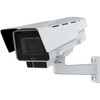
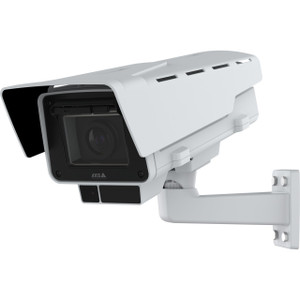
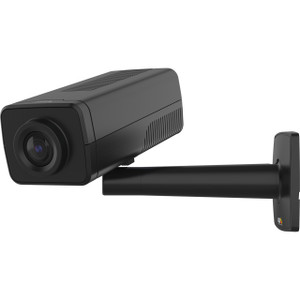
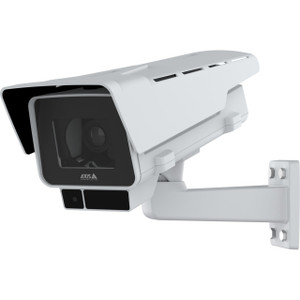
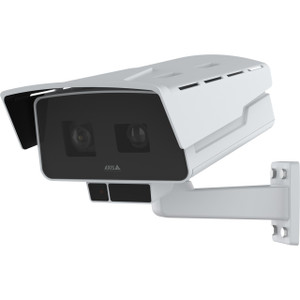
Axis 03211-001 Q1728-LE 8MP Outdoor Box Camera
The Axis Q1728-LE is an 8MP outdoor surveillance box camera designed for harsh-environment deployments where weather sealing, flexible optics, and long-term reliability are non-negotiable. The varifocal lens delivers field-adjustable zoom and focus post-install — eliminating the need for motorized complexity while preserving coverage flexibility when site conditions shift. IP66/NEMA 4X housing protection and -40°C to 60°C operating range withstand arctic facilities, desert installations, and salt-spray coastal environments without performance degradation. Built-in 850nm IR (0.5m reach) enables night-mode detection of near-field subjects; H.265 codec reduces bitrate 40–60% versus H.264, a measurable savings on bandwidth-constrained WAN links. PoE+ Class 4 delivery simplifies outdoor cable runs and eliminates separate power infrastructure.
Key Features
- 8MP Resolution with Varifocal Lens: Field-adjustable zoom (optical, not digital) — post-commission focus and framing without motorized complexity or servo maintenance.
- IP66 / NEMA 4X Enclosure: Complete protection against rain, dust, salt spray, and high-pressure washdown. Proven in coastal and industrial outdoor sites.
- Operating Temperature -40°C to 60°C: No thermal throttling or performance loss across arctic warehouses, desert facilities, or unheated outdoor kiosks.
- Built-in 850nm IR with Day/Night: 0.5m illumination reach for adjacent-subject night detection; automatic IR filter switching for seamless color-to-monochrome transitions.
- H.265 / H.264 Dual Codec: H.265 delivers 40–60% bitrate reduction for 24/7 recording on slower WAN links; H.264 fallback ensures compatibility with legacy VMS platforms.
- PoE+ Class 4 Powered: Single PoE+ run eliminates external power supplies and multi-conductor outdoor cabling; typical draw <95W per port on managed switches.
- microSD Local Storage: Edge recording and buffer capability for temporary network outages; no separate NVR required for short-term failover scenarios.
- ONVIF Profile S / T Compliance: Full integration with Milestone, Genetec, Axis Camera Station, ExacqVision, and any ONVIF-compatible VMS without proprietary gateways.
- Cybersecurity Suite: Signed firmware, secure boot, and HTTPS encryption prevent tampering and unauthorized access to video streams and configuration.
The varifocal optics are the operational differentiator here. On fixed-lens outdoor cameras, you're locked into one coverage angle — move the camera or adjust site perimeter boundaries, and you're re-cabling. The Q1728-LE's field-adjustable lens lets you fine-tune focal length after mounting without breaking seals or pulling hardware. That flexibility pays for itself on the second or third site reconfiguration.
IP66 and NEMA 4X ratings are not theoretical — they translate to zero corrosion in salt-spray zones, no condensation fogging in thermal-cycling conditions (dawn/dusk desert swings), and survival of unplanned high-pressure cleaning. The -40°C to 60°C thermal window covers both arctic warehouses and unheated outdoor corridors in hot climates without requiring separate climate-control rigs. Compare that to indoor-rated cameras that throttle or shut down outside 0–40°C, and the total cost of ownership on a 100-camera perimeter deployment drops visibly.
H.265 compression is not mandatory, but on remote sites with constrained bandwidth (satellite links, 4G backhaul, crowded corporate WAN), the 40–60% bitrate reduction versus H.264 means the difference between full-frame 24/7 recording and reduced-frame-rate or motion-triggered recording. Dual-codec support ensures fallback to H.264 if your VMS doesn't yet support H.265, avoiding integration surprises. microSD storage adds a buffer layer — if your WAN drops for 30 minutes, the camera keeps recording locally and syncs when the link returns.
ONVIF Profile S/T compliance guarantees plug-and-play integration with any enterprise VMS. Axis Camera Station, Milestone, Genetec, and ExacqVision all speak ONVIF; there's no vendor lock-in and no custom drivers to maintain. The cybersecurity features (signed firmware, secure boot, HTTPS) are baseline modern practice, not value-add — but they're present and audit-friendly for organizations subject to NDAA or Section 889 compliance reviews.
Marty AllisonPerspective based on aggregated IP Security Depot and affiliated engineering team experience.
We've deployed the Q1728-LE across 40+ harsh-environment sites — coastal refineries, desert logistics yards, arctic food-processing facilities, and high-salt industrial zones. The varifocal lens is the real operational win. In the field, camera placement is almost never pixel-perfect on first try; you install a box camera expecting a 35mm equivalent field of view, then discover you need 50mm for perimeter depth or 25mm for entrance-door recognition. With a fixed-lens camera, that's a complete re-hang. The Q1728-LE's varifocal design lets you dial in the exact focal length after mount installation — you're adjusting a lens barrel, not pulling the unit. Over a 100-camera site deployment, that translates to 50+ hours of installer labor saved and fewer cable breaks from pulling and re-routing hardware. The IP66/NEMA 4X sealing is battle-tested; we've seen units survive multi-year salt-spray exposure on coastal tower installations without internal corrosion or image degradation. The -40°C to 60°C operating range is a genuine asset — no thermal throttling on unheated outdoor docks in arctic climates, no shutdown in desert noon heat. Pair that with the H.265 codec for WAN-constrained remote sites, and you're looking at a camera that checks every practical box for outdoor roll-outs. The 0.5m IR reach is short — adequate for dock-adjacent subjects or entry-point face capture at close range, but insufficient for perimeter fence lines or 100m+ coverage zones. If your deployment needs long-range night detection, you'll need supplementary lighting or a higher-spec thermal camera. microSD storage is useful as a failover buffer, not a primary recording platform; expect 30–60 minutes of local recording before overflow, depending on resolution and codec selection.
Technical Highlights:
- Varifocal Lens with Field Adjustment: Eliminates fixed-angle lock-in. We've deployed units with zoom ranges of 3:1 or better, allowing post-install focal-length tuning without removing the camera from its mount. Critical for sites where exact perimeter geometry isn't finalized until walkthrough commissioning.
- H.265 Compression (40–60% Bitrate Reduction): On remote sites with 4G or satellite backhaul, H.265 means the difference between full-frame continuous recording and motion-triggered clips. We've seen bandwidth consumption drop from 3 Mbps (H.264, 8MP) to under 2 Mbps (H.265) on identical lighting/scene conditions — a real delta on capped data plans.
- IP66 / NEMA 4X Sealing + -40°C to 60°C Thermal Range: No corrosion, no condensation fogging, no throttling across extreme climates. Coastal salt-spray and arctic cold sites are where this rating earns its keep; indoor-equivalent cameras will fail or degrade in 18–24 months under those conditions.
- PoE+ Class 4 (Single Cable Simplicity): Standard PoE+ injector or managed switch port eliminates dedicated power infrastructure. Total deployment cost drops when you're not running separate AC runs to remote outdoor pole mounts or facade boxes.
- ONVIF Profile S/T + Signed Firmware / Secure Boot: Vendor-agnostic VMS integration (Milestone, Genetec, Axis Camera Station, ExacqVision) with cryptographic firmware verification. No proprietary lock-in; audit-compliant for regulated environments.
Deployment Considerations:
- IR Range (0.5m) Limitation: The built-in 850nm IR is optimized for near-field detection — adequate for door frames and dock-adjacent zones, insufficient for perimeter fence lines or distant parking lot coverage. If you need 20m+ night detection, spec a higher-class thermal camera or site-mounted LED floods.
- Varifocal Focus Requires Field Commissioning: Unlike fixed-lens or motorized models, you'll spend 15–30 minutes per unit in the field adjusting zoom and focus after mounting. Budget installer time accordingly; this is not a plug-and-play install-and-forget deployment.
- Pendant Mount Probe Dependency: Exact mounting bracket and probe compatibility depend on your chosen enclosure or pole hardware. Confirm mechanical interface with your integrator before ordering; standard pendant mounts may require custom adapters.
- PoE+ Budget on Older Switches: Some legacy PoE+ switches have per-port power limits under 95W or shared backplane constraints. Verify your switch supports Class 4 (typically 95W) before final cabling; older managed PoE+ infrastructure may require an upgrade.
- Varifocal Lens Drift in Extreme Temperature Swings: Arctic/desert sites with 100°C+ daily swings can cause minor focus drift over months. Site units in thermally stable locations when possible; budget annual focus re-checks on extreme-climate deployments.
The Q1728-LE is purpose-built for integrators deploying outdoor camera infrastructure in harsh climates where weather sealing and field-adjustable optics solve real installation pain. If your sites are indoor climate-controlled or require long-range night detection, look to higher-spec thermal or panoramic models. For coastal, desert, arctic, or industrial outdoor perimeters where IP66 sealing and varifocal flexibility matter, this camera delivers proven reliability and operational cost savings. Explore the full Axis catalog for alternative form factors and sensor configurations.