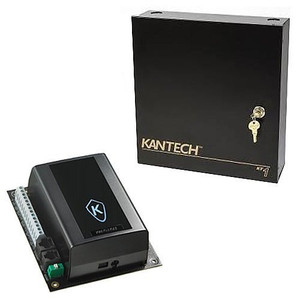
Kantech KT-TAMPER Wall-Mount Cabinet Tamper Switch
The Kantech KT-TAMPER is a wall-mounted tamper detection switch engineered to protect access control and security system metal cabinets from unauthorized opening or physical interference. Direct integration with Kantech cabinet platforms eliminates the need for third-party monitoring devices, keeping intrusion detection tightly coupled to your primary access control system. For facilities where cabinet tampering represents a material risk to system availability and audit compliance, this switch provides a simple, reliable layer of hardware-level protection.
Key Features
- Wall-Mount Design: Compact form factor mounts directly to cabinet exterior. Minimal footprint preserves valuable cabinet real estate.
- Cabinet Detection: Detects unauthorized door opening or displacement. Triggers immediate alert to connected Kantech control panel.
- 7-Model Compatibility: Works with KT-400-CAB, KT-MOD-CAB, KT-300CAB, KT-NCC-CAB, KT-4051CAB, KT-CAB3000LDR, and KT-CAB4000LDR. Cross-platform coverage simplifies multi-cabinet deployments.
- Direct Kantech Integration: No intermediate relay or adapter required — wired directly to cabinet alarm input on Kantech panels. Native event logging and reporting.
- Straightforward Installation: Surface-mount mechanical design. Wire termination uses standard cabinet alarm inputs; no custom firmware or configuration required.
- Mechanical Reliability: Contact-based operation with no active electronics to fail. Long service life in temperature-controlled cabinet environments.
The KT-TAMPER operates on a simple principle: when the cabinet door opens, the switch contact closes, sending an alarm signal to the Kantech control panel. The panel logs the event, triggers local or remote notification (depending on system configuration), and can lock down access privileges or escalate to security staff. Unlike external wireless tamper sensors, this hardwired approach eliminates battery dependency and RF interference—critical in secure facilities where every failure mode must be understood and tested.
Deployment scenarios span small-office access control closets, data-center server-room cabinet protection, and multi-building enterprise campuses. In audit-sensitive environments (finance, healthcare, government), the ability to prove cabinet integrity via tamper-event logs often satisfies compliance requirements without additional CCTV or environmental monitoring. The switch integrates into existing Kantech alarm event reports, so no separate logging platform is needed.
Installation is quick: position the switch on the cabinet frame so the moving actuator arm contacts the cabinet door when closed. Wire the normally-open contact terminals to the cabinet alarm input on your Kantech panel (typically a spare zone or dedicated tamper port). Test the switch by opening the door and confirming the alarm fires on the panel. No software setup required. Power draws negligible current from the panel's alarm circuit, so PoE or external power is not needed.
The KT-TAMPER is manufactured in Canada and carries Kantech's standard manufacturer warranty. It is designed to work exclusively with Kantech cabinet platforms; integration with third-party access control systems requires a separate gateway or relay module. For facilities already standardized on Kantech hardware, this switch is a cost-effective and low-maintenance way to close a critical physical-security gap. Review the datasheet for wiring diagrams and alarm input specifications before ordering.
Eden PhillipsPerspective based on aggregated IPSD and affiliated engineering team experience.
We've installed the KT-TAMPER across dozens of Kantech deployments—everything from small-office two-cabinet installs to enterprise campuses with 20+ secured enclosures. What makes this switch a no-brainer in Kantech environments is the simplicity: it's a two-wire contact device that talks natively to Kantech panels without any intermediate relay or software bridge. In comparison, retrofitting a wireless tamper sensor or trying to shoehorn a third-party hardened switch into a Kantech system introduces complexity, testing overhead, and potential firmware compatibility gaps. The hardwired approach also eliminates the operational burden of battery replacements or RF signal loss—both of which we've seen create false-alarm fatigue in other sites. One caveat: the switch is designed for cabinet door-frame mounting, so it assumes a relatively simple door hinge and frame geometry. On heavily modified or non-standard cabinets (custom-hinged server racks, etc.), the mounting footprint may require custom brackets. On standard Kantech cabinets, installation is 15 minutes.
Technical Highlights:
- Native Kantech Alarm Integration: Wires directly to cabinet alarm input on Kantech control panels. Event appears in native panel logs and reports—no third-party monitoring or translation layer required. This simplifies audit trails and reduces operational overhead compared to wireless or external monitoring solutions.
- Mechanical Contact Design: No active electronics means no power draw from panel, no RF interference risk, and no firmware compatibility concerns. Long MTBF in stable temperature environments like access control closets or data centers.
- 7-Model Cross-Compatibility: Covers the full range of standard Kantech cabinet platforms (KT-400, KT-MOD, KT-300, KT-NCC, KT-4051, KT-CAB3000LDR, KT-CAB4000LDR). Single SKU handles almost all Kantech cabinet deployments, reducing inventory complexity.
- Straightforward Wiring: Two-terminal contact (normally open, maintained when door is closed). Terminal block or solder-cup connection options. No polarity sensitivity, no software configuration, no commissioning required beyond functional test.
- Made in Canada: Manufactured in Canada under Kantech standards, ensuring supply-chain transparency and consistency with the broader Kantech product line.
Deployment Considerations:
- Cabinet Door Geometry Dependency: The switch requires a clean cabinet frame and door closure path. On non-standard or heavily modified enclosures, mounting brackets may need adjustment. Inspect the target cabinet before ordering to confirm standard door-frame alignment.
- Kantech Ecosystem Lock-In: This switch is purpose-built for Kantech panels. If you're integrating a Kantech cabinet into a mixed-brand access control environment, you'll need a separate gateway or relay to transmit tamper events to your primary VMS or security appliance. Not a limitation for pure-Kantech shops, but important if multi-vendor interoperability is a requirement.
- No Remote Monitoring Out-of-Box: The switch generates a local alarm signal on the Kantech panel. If your security operations center or remote monitoring service does not monitor Kantech panel events directly, you'll need to configure the panel to forward tamper alerts via SNMP, email, or Kantech's native event server. This is standard practice, but plan for it during system design.
- Environmental Tolerance: The switch is rated for indoor cabinet environments (roughly 50–95°F operating range). Do not expose the switch itself to outdoor conditions or high-humidity spaces; mount it inside or in a climate-controlled enclosure if the cabinet is located outside or in a server room with aggressive cooling.
- Testing Protocol: After installation, open and close the cabinet door 10+ times to confirm consistent contact closure and alarm generation. A weak or intermittent contact can cause nuisance alarms or missed detections. If the switch begins to misfire after months of operation, it may require contact-cleaning or replacement—expected lifetime is 5–10 years depending on cycle frequency.
The KT-TAMPER is the right choice for any Kantech shop that needs straightforward, hardwired cabinet tamper protection without the complexity of wireless sensors or external monitoring devices. It integrates seamlessly into existing Kantech deployments and provides clear audit-compliance value. For a deeper look at Kantech's access control ecosystem and compatible products, browse the Kantech catalog.