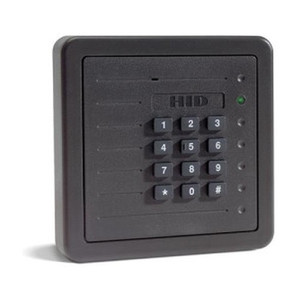
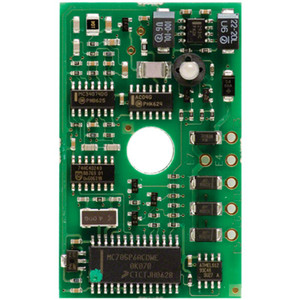
Kantech HID-PP6005B ProxPoint Plus 125kHz Proximity Reader
The Kantech HID-PP6005B ProxPoint Plus is a professional-grade proximity card reader engineered for integration into commercial and institutional access control systems. This wall and rack-mountable reader delivers 125 kHz passive card detection with native support for 26-bit Wiegand protocol and Kantech KSF format, making it compatible with Kantech ioProx controllers, door controllers, and standard third-party ACS panels. Built for hallways, entry points, and equipment rooms where mounting flexibility and installation speed matter.
Key Features
- 26-Bit Wiegand Protocol: Native output to any access control panel or door controller that accepts Wiegand input. No protocol conversion or custom firmware required.
- KSF Format Support: Direct integration with Kantech ioProx controllers and compatible systems. Reduces wiring complexity when expanding existing Kantech deployments.
- Passive 125 kHz Technology: Reads standard HID proximity cards at standard distances without card battery or active electronics. Cards are durable, low-cost, and require no maintenance.
- Dual Mount Configuration: Wall-mounted or rack-mountable design fits hallways, electrical closets, equipment rooms, and retrofit installations where space is constrained.
- Gray Professional Housing: Neutral finish integrates into corporate, educational, healthcare, and government facility aesthetics without looking institutional.
- 5-16 VDC Power Input: Standard linear power supply (16 VDC recommended). Low current draw allows daisy-chaining from single supply on multi-reader installations.
- Wiegand Output Only: Simplified data path — no IP, no Ethernet, no firmware updates. Integrates with any panel that understands Wiegand; reduces points of failure in access control circuits.
The HID-PP6005B operates passively at 125 kHz, a mature standard that has dominated access control for two decades. Read distance is standard proximity range — approximately 0.5-3 inches depending on card orientation — sufficient for handheld presentation at reader face. No active batteries in the card means zero lifecycle maintenance for credential replacement.
Wiegand output is the operational backbone here. Every byte transmitted is a simple binary pulse sequence — no handshaking, no authentication, no encryption. This is a deliberate trade-off: installation is straightforward, troubleshooting is straightforward, and the reader works with legacy ACS panels from the 1990s and modern controllers alike. The 26-bit format encodes a 16-bit facility code and 16-bit card code, supporting up to 65,536 unique credentials per facility before rollover. For most single-site deployments, that's sufficient; large enterprises with multiple facilities should plan credential numbering carefully.
Mounting flexibility reduces installation labor. Wall mounting via standard electrical box or surface-mount bracket works for new construction and retrofit. Rack mounting is useful in central equipment rooms where readers feed a single door controller or access control panel. The gray finish doesn't dominate the visual field the way stainless steel or black ABS housings do, reducing objections from architects and facility managers in public-facing areas.
Power consumption is minimal — the reader draws a few hundred milliamps at 16 VDC under normal conditions. This allows a single 24 VAC/16 VDC power supply to feed 4-6 readers in a typical installation, provided wiring distances are kept under 100 feet and Wiegand line termination is correct (120-ohm resistor at the panel, not at the reader). A missed termination resistor will cause intermittent read failures that are agonizing to diagnose on-site.
The reader does not support encrypted or facility-specific card formats (EM4100, HID iClass, MIFARE). It reads passive proximity only — HID 125 kHz and compatible technologies. If your credential ecosystem includes iClass or other encrypted formats, you'll need a different reader. Kantech offers the HID-CP5005B for MIFARE support; consult datasheets before specifying.
Kantech recommends this reader for Kantech ioProx controller ecosystems, but Wiegand compatibility means it will operate with Salto, Gallagher, Axis A1001, Honeywell NetAXS, and virtually any ACS panel manufactured in the past 15 years. No proprietary software or firmware updates are required — the reader ships field-ready and remains compatible through product lifecycle.
Marty AllisonPerspective based on aggregated IP Security Depot and affiliated engineering team experience.
We've installed the HID-PP6005B across office parks, university access points, and light industrial settings where 125 kHz proximity is the standard. The real strength is simplicity — it's a dumb reader in the best sense. It reads a passive card, outputs 26-bit Wiegand, and stays out of your way. There's no IP stack to patch, no cloud dependency, no firmware quirks. That reliability matters when a reader failure means a disabled entry point at 2 AM on a Saturday. The dual mount options saved time on retrofit jobs where we couldn't install a traditional wall box; rack mounting in a nearby electrical closet kept the reader close to the controller and wiring clean. The gray finish has never triggered aesthetic objections — unlike bright yellow readers or industrial black housings, it's invisible. One trade-off: Wiegand is unencrypted and unidirectional. A proximity card reader can't detect if the panel heard the transmission correctly; if your site requires encrypted challenges or mutual authentication, this isn't the product. But for traditional corporate badge access and single-facility deployments, the simplicity is a feature, not a limitation.
Technical Highlights:
- 125 kHz Passive Technology: No batteries in credentials. A single card lasts 10+ years and never requires replacement due to power failure. This is a decisive advantage over active 13.56 MHz MIFARE systems when total cost of ownership across 500+ badge holders is calculated.
- Wiegand 26-Bit Output: Standard protocol supported by every access control panel since 1995. No vendor lock-in. A failed reader can be replaced with any compatible 125 kHz reader from Kantech, HID, or third parties without firmware changes to the ACS panel.
- Standard Proximity Distance: Read range is 0.5–3 inches under normal conditions. Adequate for hand-presented badges at a reader face; not suitable for vehicle-mounted long-range applications. Know your distance requirements before installation.
- Dual Mount (Wall / Rack): Wall mounting uses standard electrical box or surface bracket; rack mounting is 2U or 4U depending on configuration. Flexibility reduces installation complexity on retrofit jobs where wall cuts are expensive or undesirable.
- Gray Housing, Professional Appearance: Blends into hallway and entry corridor aesthetics. Reduced visual clutter compared to stainless or black housings. Important for client-facing areas where reader visibility is a design consideration.
- 5-16 VDC Power, Linear Supply Recommended: Low current draw allows multiple readers on single supply. Switching supplies introduce noise on Wiegand lines; linear supplies are preferred. Budget $50–100 per supply for industrial-grade 16 VDC regulated power.
Deployment Considerations:
- Wiegand termination is critical: a 120-ohm resistor must be installed at the ACS panel end of the Wiegand line pair, never at the reader. Missing termination causes intermittent read failures and phantom transactions that are difficult to diagnose. Verify termination during commissioning.
- Proximity cards are non-directional and read across short distances. Plan for clear line-of-sight from card to reader face within 3 inches. Cards in back pockets or purses will not read reliably; end-user training on card presentation reduces support calls.
- The reader does not support encrypted or facility-specific formats (iClass, MIFARE, EM4100 proprietary). If your credential ecosystem includes mixed technologies, verify that all cards in circulation are standard HID 125 kHz compatible before installation.
- Power consumption is low (approximately 300 mA at 16 VDC), but Wiegand loop impedance must be verified on runs over 100 feet. Long cable runs or poor termination introduce transmission errors. Keep reader-to-panel distances under 150 feet for reliable operation.
- The reader ships field-ready and requires no configuration. This is a feature: no firmware version management, no cloud portal, no firmware update failures. Plan accordingly if your organization expects reader-level remote management.
The HID-PP6005B is the right fit for Kantech ioProx deployments, retrofit access control upgrades, and any facility standardized on 125 kHz passive proximity. If your next project involves multi-tenant facilities, high-security encryption requirements, or long-range vehicle identification, look elsewhere. For traditional corporate badge access, education, and healthcare badge programs, this reader has earned 20+ years of field reliability. See the Kantech catalog for complementary controllers, power supplies, and credential options.