Comnet SFP-VDSLAB Industrial Long Reach Ethernet over VDSL2 SFP
Overview
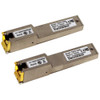
The Comnet SFP-VDSLAB is a pre-packaged CO and CPE (Central Office / Customer Premises Equipment) pair that extends Ethernet connectivity over standard copper telephone lines using VDSL2 technology. This is a working solution for surveillance networks, building automation, and remote site connectivity where you need to push IP feeds several kilometers from a core switch without trenching fiber. The SFP-VDSLAB (often searched as SFP VDSLAB) delivers up to 150 Mbps data rate and handles real-world surveillance traffic — multi-camera streams, NVR backhaul, and dual-path failover — across distances that would otherwise require dark fiber or expensive leased circuits.
Key Features
- 3000-meter reach on twisted pair copper: Extends Ethernet to remote camera arrays, pump stations, or perimeter cabinets using existing telephone infrastructure — no new cable runs needed, no permit delays. Standard Cat3 cable works; Cat5/5e is better but not required.
- 150 Mbps data rate (full duplex at variable distance): Handles 2–4 concurrent 1080p streams or a single 4K feed per link. At 400 meters, you get solid 100 Mbps full-duplex performance — enough for dual HD cameras with bandwidth to spare.
- 1000BaseFx SFP interface (MSA compliant): Plugs into any standard SFP slot on industrial switches, rack-mount gear, or media converters. No proprietary backplane; swaps in alongside fiber SFPs or other optical modules without recabling your core.
- 2.5 W maximum power consumption: Draws minimal current from the SFP power rail — roughly 750 mA at 3.3 V operating voltage. In a 24-port SFP cage, this is a marginal load; won't trigger power-supply upgrades or fan escalation.
- Industrial temperature range (-40°C to +75°C operating; -40°C to +85°C storage): Survives unheated cabinets, roof-mounted equipment, and freezing rural sites. No thermal derate or seasonal service calls — the module specs are solid across seasonal swings.
- Pre-packaged CO & CPE pair: One central-office unit, one customer-premises unit. Arrives tested and paired. No firmware syncing, no line negotiation quirks — unbox, plug RJ-45 patch cables into your switches, and run copper to the far end. Minimal onsite troubleshooting.
Integration & Compatibility
The SFP-VDSLAB is a transparent Ethernet bridge — it doesn't care what VMS, access control system, or IP camera lives on the other end. Your NVR sends frames into one SFP, the module encodes them as VDSL2 over copper, and the far-end CPE decodes and delivers standard 10/100/1000 Ethernet to the remote site. ONVIF, RTSP, SSH, SNMP, and all standard IP protocols pass through unchanged. Network architects commonly pair this with industrial Ethernet switches to create site-to-site links for distributed video capture or multi-building NVR deployments where a single recorder needs feeds from five or six remote outdoor camera clusters.
One critical integration note: VDSL2 performance degrades predictably with cable length and copper quality. At 3000 meters, expect 10–20 Mbps throughput (usable for 2–3 low-bitrate streams or PTZ telemetry). At 400 meters, you hit 100 Mbps and gain comfortable headroom for redundancy or future camera additions. Always verify the actual copper loop before deployment — old telephone lines with splice points, gauged-down sections, or corroded terminations will reduce range by 20–40%.
What's in the Box
The SFP-VDSLAB ships as a pre-paired set: 1x Central Office SFP module, 1x Customer Premises Equipment SFP module. Both are 1000BaseFx MSA-compliant form factor, ready to install into any standard SFP cage. No additional drivers, firmware, or configuration software — the modules handle VDSL2 line establishment automatically on power-up.
Frequently Asked Questions
Q: Can the SFP-VDSLAB work with Category 3 telephone cable, or do I need Cat5e?
A: Cat3 works — that's the point. VDSL2 is engineered for legacy telephone plant. Cat3 copper gives you the full 3000-meter reach specification. Cat5e or Cat6 will perform equivalently (no better range, same bandwidth). Only upgrade if your existing runs are damaged or unterminated; don't tear up buildings to replace functional telephone cable.
Q: What happens to performance if my copper loop is 1500 meters instead of 400 meters?
A: Data rate scales down gracefully. At 1500 meters on clean copper, expect 30–50 Mbps full-duplex throughput — enough for 1–2 IP camera streams. The SFP-VDSLAB will negotiate the best stable rate and hold it. No packet loss, no retransmits; VDSL2 is inherently robust to distance attenuation.
Q: Does the SFP-VDSLAB require any management interface or web portal?
A: No. It's a passive bridge. Once the CO and CPE units sync (roughly 30–60 seconds after power-up), Ethernet frames flow through with zero configuration. No CLI, no SNMP, no console access needed. Plug and operate.
Q: Can I mix the CO and CPE modules, or must they stay paired?
A: They're pre-paired at the factory and optimized as a matched set. You cannot swap a CO module from one pair with a CPE from another — they won't sync reliably. Keep them together. If one module fails, you'll need a replacement pair, not a single spare.
Q: Is the SFP-VDSLAB suitable for harsh industrial environments?
A: Yes. Operating range of -40°C to +75°C and relative humidity 0–90% (non-condensing) covers outdoor cabinet installations, unheated equipment shelters, and tropical humidity zones. Module itself is potted and sealed — condensation inside the SFP is not a risk. However, the copper terminations at each end (your RJ-45 connections) must remain dry. Use weatherproofed cable glands and strain relief at outdoor splice points.
The SFP-VDSLAB fills a real gap in industrial video networks — it's the bridge between fiber-only switching and the reality that most campuses and rural deployments have copper telephone runs already in place. I've seen integrators use this pair to extend an NVR recorder 800 meters to a perimeter building or push a 1080p feed 2+ kilometers from a remote warehouse back to a central security center, all without the cost and lead-time of a new fiber circuit. The key insight is that VDSL2 is not a wireless replacement or a stopgap — it's engineered for distance and operates reliably in industrial temperature swings (-40°C to +75°C on this module) that would stress consumer-grade Ethernet extenders.
Technical Highlights:
- 150 Mbps data rate with distance-dependent throughput: At 400 meters you get 100 Mbps full-duplex — real headroom for dual-camera feeds or PTZ telemetry. At 1500 meters, 30–50 Mbps is still workable for a single 1080p stream plus metadata. This graceful scaling means you don't have a hard "distance cliff" — link budgeting is predictable.
- 2.5 W power envelope: Negligible load on the SFP cage power rail. In an industrial switch with 24 SFP slots, even if you populate half with SFP-VDSLAB units, you're under 30 W total — no auxiliary power supplies, no thermal fans spinning up. Critical for unattended remote cabinets.
- Pre-paired CO/CPE factory sync: One of the biggest pain points with VDSL2 deployments is line training and handshake delays. Comnet ships these locked together — power them up, and they sync in under a minute. No firmware loading, no CLI configuration. Saves hours of commissioning time on a multi-site rollout.
Deployment Considerations:
- Copper loop quality is everything. A 10-year-old telephone line with corroded splice points or sections of thinner-gauge wire will choke range down 30–40%. Always request loop qualification from the telephone company or run a site survey with a qualified technician before committing to distance.
- VDSL2 is sensitive to impulse noise and crosstalk. If your copper bundle runs parallel to power mains for long stretches, expect occasional sync resets during high-load conditions. Shield where possible, separate runs at termination blocks, and keep RJ-45 connectors off the floor.
Deploy the SFP-VDSLAB on perimeter loops, inter-building video feeds, or remote pump-house / tank-farm camera sites where laying fiber is economically prohibitive and wireless latency is unacceptable. It's the workhorse for campus surveillance networks that grew organically and inherited 1970s telephone infrastructure.