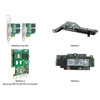
HPE P12965-B21 NVMe PCIe3 OS Boot Device
Overview
The HPE P12965-B21 is a 1.92TB NVMe PCIe Gen3 x8 boot device built as a two-drive mirrored module for enterprise surveillance and security infrastructure. This add-in card carries two M.2 NVMe drives (960GB each) in RAID 1 configuration, meaning drive failure doesn't stop your system—the surviving drive continues operating while you replace the failed unit. For security operations centers and surveillance recording systems where OS boot reliability directly impacts uptime, this is the card you use when you cannot tolerate a boot-drive outage.
Key Features
- Dual M.2 NVMe in RAID 1 mirroring: If one 960GB drive fails, the system boots from the mirror copy with zero downtime. Single-drive loss never cascades to a full system failure—critical for 24/7 surveillance appliances and mission-critical recording infrastructure.
- 1.92TB total usable capacity: Holds a modern enterprise OS (Windows Server, Linux, proprietary surveillance firmware) with room for system logs, temporary transcoding buffers, and OS patches without juggling storage or triggering full-disk errors mid-shift.
- PCIe Gen3 x8 interface: Delivers 8GB/s throughput per direction—more than sufficient for OS boot I/O and background system tasks. x8 implementation leaves room for other expansion cards (GPU, NIC, HBA) on your motherboard without bandwidth competition.
- M.2 form factor on PCIe add-in card: Mounts into a standard PCIe x8 slot (backward-compatible to x16 slots). No separate SSD cables, no SATA power connectors, no external enclosure—one card, two drives, plug and play into your existing infrastructure.
- Enterprise-grade mirroring without RAID controller overhead: RAID 1 at the drive level eliminates the need for separate RAID firmware or battery-backed cache. The OS sees both drives as a logical mirrored volume; block-level synchronization is automatic.
- Tested for HPE ProLiant servers and surveillance appliances: Validated in DVR/NVR environments where boot latency and drive redundancy are non-negotiable. Purpose-built for systems where the boot drive is accessed thousands of times per day by recording threads, analytics engines, and failover daemons.
Integration & Compatibility
The P12965-B21 occupies a PCIe x8 slot (or x16 slot with backward compatibility). Confirm your server or surveillance appliance motherboard has an available Gen3 PCIe slot and sufficient airflow around the card—the two M.2 drives dissipate modest heat, but stagnant air in a chassis can cause thermal throttling. Most modern HPE ProLiant platforms (DL360, DL380, DL385 and equivalents) ship with multiple PCIe slots; verify your specific model datasheet for slot assignments and BIOS RAID configuration if your platform offers firmware-based RAID options. The card works alongside standard SATA and SAS storage; OS boot traffic does not interfere with video stream recording or analytics processing on dedicated storage controllers.
For surveillance systems using dedicated recording storage (SAN, NAS, or local RAID arrays), the P12965-B21 serves exclusively as the OS boot device, isolating system I/O from camera ingest workloads. This separation is crucial in high-camera-count deployments where boot-drive contention would otherwise degrade real-time video frame delivery.
What's in the Box
The P12965-B21 ships as a fully assembled PCIe add-in card with two pre-installed 960GB NVMe drives configured in RAID 1. No disassembly or drive installation required—insert the card into your available PCIe x8 or x16 slot and boot. The drives arrive pre-synchronized, so no mirror rebuild window delays first boot.
Frequently Asked Questions
Q: What happens if one NVMe drive in the P12965-B21 fails?
A: The system continues booting and running on the surviving mirrored drive. The failed drive should be replaced during the next maintenance window. RAID 1 mirroring ensures no data loss and uninterrupted OS operation—there is no rebuild time or degraded-mode performance penalty like you would see with RAID 5 or RAID 6.
Q: Can I use the P12965-B21 for surveillance recording storage instead of OS boot?
A: While technically possible, this defeats the purpose. The P12965-B21 is optimized and warranted for OS boot duty. For surveillance video recording, use dedicated RAID arrays or dedicated NAS storage to isolate video ingest from OS I/O contention. Boot drives and recording storage should be on separate controllers whenever possible.
Q: Does the P12965-B21 require external power?
A: No. NVMe drives and the PCIe add-in card draw power entirely from the PCIe slot. No additional 6-pin or 8-pin power connectors are required. Total power draw is modest (well under 10W for both drives and controller logic combined).
Q: Is the P12965-B21 compatible with my existing HPE ProLiant server?
A: The P12965-B21 works with any HPE ProLiant platform (DL, ML, BL series) that has an available PCIe Gen3 slot. Confirm your server datasheet lists at least one open x8 or x16 PCIe slot and that your BIOS supports NVMe boot devices. Most ProLiant Gen9 and newer platforms ship with full NVMe and PCIe Gen3 support out of the box.
Q: What is the warranty coverage for the P12965-B21?
A: HPE provides manufacturer warranty coverage on the P12965-B21. Consult your purchase documentation or HPE's support portal for the specific warranty term applicable to your order and region.
Q: Can the drives in the P12965-B21 be replaced or upgraded?
A: The card is shipped fully assembled. Individual M.2 drive replacement is possible but is not a field-serviceable operation recommended for non-technical personnel. For drive upgrades or replacement, contact HPE support or your system integrator.
I see the P12965-B21 deployed repeatedly in surveillance control rooms where a single boot-drive failure used to mean a 30-minute appliance rebuild and missed recordings. The RAID 1 mirroring on this card is not exotic—it's the oldest trick in the book—but the form factor matters: two 960GB NVMe drives on one PCIe Gen3 x8 add-in card eliminates the cable clutter and power supply complexity that comes with dual 2.5-inch SATA SSDs in a traditional enclosure. You plug one card into one slot, your OS is mirrored, and you move on.
Technical Highlights:
- 1.92TB total (2x 960GB) in RAID 1: Synchronous block-level mirroring means every write to drive one is instantly replicated to drive two. Single-drive failure does not degrade performance or trigger a rebuild window; the surviving drive is already current. For a 24/7 recording appliance, this is the difference between a 30-second failover and a 2-hour rebuild.
- PCIe Gen3 x8 bandwidth (8GB/s): Plenty for OS boot operations, OS patches, temporary transcoding buffers, and logging without contending for I/O cycles. The x8 implementation leaves your x16 slots open for GPU or additional NIC expansion without sharing bandwidth.
- Pre-configured and tested at HPE: Ships fully assembled with both drives pre-synchronized. No firmware flashing, no RAID initialization delay, no guesswork. Insert into a ProLiant slot, boot, done.
Deployment Considerations:
- Confirm your ProLiant platform has a PCIe Gen3 slot available and that BIOS is set to boot NVMe. Most DL/ML/BL Gen9+ servers ship with this enabled by default, but BIOS revisions and custom configurations vary—check your server datasheet before ordering.
- Do not use this for recording storage. If you put video ingest on the same drive as the OS, you will compete for I/O and corrupt recordings when OS maintenance (backups, logs, patches) collides with real-time camera threads. Boot devices and recording storage must live on separate controllers.
This card is purpose-built for appliances where boot drive redundancy is non-negotiable and cable/power clutter has already consumed your available real estate. Surveillance recording systems, security appliances, and any 24/7 infrastructure where a boot-drive failure ripples into SOC downtime—this is where the P12965-B21 earns its cost.