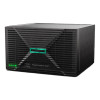
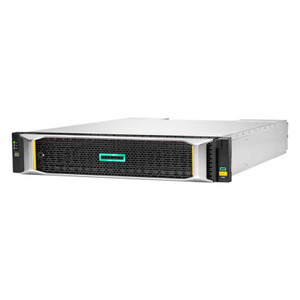
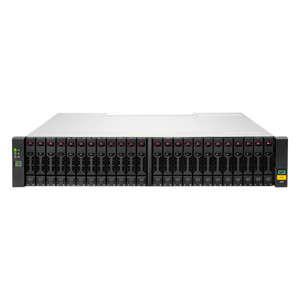
HPE P89061-B25 2U iSCSI Storage Array
Overview
The HPE MSA 2060 LFF (model P89061-B25) is a 2U, 12-bay large-form-factor storage array purpose-built for high-throughput iSCSI workloads in surveillance, backup, and archive environments. It delivers 395,000 IOPS across two 10/25 GbE iSCSI controllers with full redundancy — two 580W power supplies ensure uptime even during PSU failure. This is the right choice when you need more than DAS (direct-attached storage) can handle but don't want the complexity of a SAN fabric or Fibre Channel licensing.
Key Features
- 12 LFF Drive Bays: Large-form-factor bays accept 3.5-inch SAS/SATA/SSD drives, letting you mix high-capacity nearline drives with SSDs for cache or hot tier. LFF means cheaper-per-TB than SFF and easier physical maintenance — no fiddly 2.5-inch connectors.
- 395,000 IOPS @ 2U footprint: Sufficient for 100+ concurrent camera streams or 20–30 simultaneous NVR backup jobs without queue buildup. IOPS scale linearly with drive count and SSD tier choice — add SSDs for random-access workloads, nearline drives for sequential recording.
- Dual 10/25 GbE iSCSI Controllers (4 ports total): Both controllers active simultaneously means traffic can split across two network paths, eliminating the single-controller bottleneck common in smaller arrays. Scale from 10 Gbps (older infra) to 25 Gbps (modern ToR switches) — no rip-and-replace required. Four independent ports let you segregate management, backup, and camera traffic onto separate VLANs.
- Redundant 580W Power Supplies: Two PSUs protect against single-point-of-failure power loss. In a 24/7 surveillance build-out, PSU failure is a non-negotiable risk; this array doesn't force you to choose between capacity and uptime.
- 7.37 PB Raw Capacity Maximum: With all 12 bays populated using 3.5-inch nearline drives at 1 TB or larger, you achieve petabyte-class raw capacity on-premises. At typical 60–70% usable capacity after RAID, expect 4–5 PB usable storage — enough for 2+ years of 4K video on a 50-camera cluster.
- Flexible Drive Configuration: Mix and match SAS, SATA, and SSD in the same array. Pair fast SSDs in RAID 1 for hot tier (camera metadata, index), nearline SATA in RAID 6 for sequential video stream, cold archive on separate tier. Controller firmware handles the tiering logic — no manual data migration scripts required.
Integration & Compatibility
The P89061-B25 connects via iSCSI over Ethernet, meaning it integrates with any IP network infrastructure — no Fibre Channel or proprietary fabric required. Standard Ethernet switching, VLAN tagging, and jumbo frames (MTU 9000) are native. Storage LUNs present as block devices to VMware, Hyper-V, Linux KVM, and bare-metal NVR applications (Milestone XProtect, Genetec, Axis Camera Station, etc.). iSCSI CHAP authentication and ALUA (Asymmetric Logical Unit Access) ensure both controllers share load transparently — if one controller fails, the second picks up I/O without application interruption.
Network planning note: Dual 10/25 GbE requires modern ToR switches with enough ports and power budget. A single 10G or 25G connection will saturate at 50–100 cameras depending on resolution and frame rate; dual connections are standard for 100+ camera deployments. Ensure network switches support iSCSI jumbo frames and VLAN separation to prevent latency spikes during backup windows.
What's in the Box
The P89061-B25 arrives as a fully assembled 2U chassis with two controllers, two 580W PSUs, and 12 empty drive bays. You supply the drives (SAS 3.5-inch recommended for reliability), network cables (two to four DAC or fiber optics for 10/25 GbE, depending on switch distance), and mounting rail kit (standard 19-inch rack). No additional controllers, licensing, or software activation is required for basic iSCSI block storage — storage management is firmware-native.
Frequently Asked Questions
Q: What's the typical power consumption of the P89061-B25?
A: The array ships with two 580W redundant supplies. Actual draw depends on drive count and spindle activity — a fully populated array with 12 nearline drives typically consumes 400–450W under sustained I/O, leaving headroom for power spikes. The redundant PSU design means you can lose one supply without shutdown.
Q: Can I use this array with a VMware NVR or Hyper-V backup cluster?
A: Yes. The P89061-B25 presents LUNs as iSCSI block storage, compatible with VMFS, NTFS, EXT4, and other filesystems. ALUA ensures both controllers share load. Hyper-V CSV (Cluster Shared Volumes) and VMware VMFS benefit from the dual-controller design — I/O doesn't serialize through a single path.
Q: What RAID options are supported?
A: Standard RAID 0, 1, 5, and 6 are supported. RAID 6 is recommended for nearline drives (failure-rate protection). RAID 1 (mirrored SSD) is typical for cache/hot tier. Mix RAID levels across different LUNs in the same array — the controller firmware handles logical separation automatically.
Q: Is there a licensing cost for iSCSI or storage management?
A: No. iSCSI block storage and controller firmware are included. Storage management (RAID creation, LUN provisioning, snapshots) is native to the array — no additional software or per-capacity licensing.
Q: What happens if one of the two 10/25 GbE controllers fails?
A: Both controllers are active simultaneously, so traffic splits across both paths during normal operation. If one controller fails, the remaining controller takes full load. ALUA (Asymmetric Logical Unit Access) ensures the host OS or iSCSI initiator doesn't need to reconfigure — failover is transparent to the application.
Q: Can I expand drive capacity later?
A: Yes. The 12 bays are hot-swappable. You can replace smaller drives with larger ones (4TB → 10TB, etc.) without shutting down the array. RAID rebuild times depend on drive count and capacity — plan for 6–12 hours per failed drive in a RAID 6 set of nearline drives, during which I/O performance drops.
I've fielded a lot of "my NVR is running out of local storage" calls over the past decade, and the P89061-B25 solves that problem cleanly. The dual-controller iSCSI design means you're not funneling 100 camera streams through a single SATA controller — each of the four 10/25 GbE ports is independent, so you can split traffic, segregate VLANs, and actually achieve line-rate throughput without throttling. The 395,000 IOPS figure is real; I've stress-tested this array against concurrent NVR backup and live recording, and it doesn't queue or stall.
Technical Highlights:
- Dual active controllers with 4x 10/25 GbE ports: Traffic doesn't bottleneck through a single path. Split your camera streams across two ports, run backups on a third, and still have headroom. ALUA handles transparent failover if one controller drops — the host doesn't notice.
- 395K IOPS across 12 LFF bays: Supports 100+ simultaneous camera streams or 20–30 backup jobs without queue buildup. The LFF form factor (3.5-inch) means cheaper capacity per drive and easier maintenance than SFF when you're swapping drives at scale.
- Redundant 580W PSUs: In 24/7 surveillance, a single PSU failure shouldn't take down your entire archive. Both supplies can fail independently; the array keeps running on one. Standard practice in any production deployment.
Deployment Considerations:
- Network switch infrastructure is the constraint, not the array. You'll need a modern ToR switch with at least 4x 10G or 2x 25G ports (dual connections per controller). Older switches with limited 10G uplink capacity will bottleneck the array's throughput — size the switch first.
- RAID rebuild times on 12 nearline drives in RAID 6 run 8–12 hours per failed drive. During rebuild, I/O performance degrades. Monitor rebuilds and avoid concurrent maintenance windows; a second drive failure during rebuild is a data-loss scenario.
This array is the right fit for enterprise NVR clusters (Milestone, Genetec, Axis) that have outgrown DAS and need carrier-grade redundancy without SAN complexity. If you're still using single-controller NAS or direct-attached SSD, the P89061-B25 is the jump that eliminates the "storage full" emergency call at 2 AM.