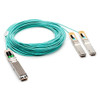
HPE P45697-B24 InfiniBand NDR OSFP Splitter Direct Attach Copper Cable
Overview
The HPE P45697-B24 is a 2-meter InfiniBand NDR/Ethernet splitter direct attach copper (DAC) cable that terminates in one OSFP connector on the source end and splits to two OSFP connectors on the destination end. This configuration is purpose-built for high-performance compute and data center deployments where you need to fan out a single NDR port to two downstream devices—typically for redundancy, load balancing, or multi-path fabric configurations. The 2-meter length (often searched as P45697-B24 or P45697 B24) provides flexibility in cabinet and rack layouts without the complexity and latency of active switch fabric infrastructure.
Key Features
- OSFP Connector Standard: One OSFP input, two OSFP outputs. OSFP (Octal Small Form Factor Pluggable) is the standard connector for NDR (NDR is 200 Gbps per port in InfiniBand environments), so this cable integrates directly into modern HPE NDR-capable switches and HBAs without adapter overhead or additional power draw.
- 2-Meter Cable Length: 2 meters (6.56 feet) of passive copper, eliminating cable management bottlenecks in dense racks. Longer than a typical 1-meter DAC, short enough to avoid cross-rack runs that introduce latency or signal integrity risk in NDR-speed deployments.
- InfiniBand NDR/Ethernet Support: Rated for both InfiniBand NDR and Ethernet operation at speed, meaning this cable handles the full 200 Gbps NDR bandwidth specification or equivalent Ethernet rates without active signal re-timers or buffers. Passive copper means zero added latency—critical for sub-microsecond fabric latency requirements in HPC and real-time trading environments.
- Direct Attach Copper (DAC) Technology: Passive electrical connection with no active components. DAC cables are cheaper to deploy and operate than optical transceivers (no SFP+ or QSFP power consumption), have lower latency, and require no firmware or driver support. The tradeoff is distance: 2 meters is practical; beyond 10 meters, optical cabling becomes mandatory.
- Fan-Out Topology: The 1-to-2 splitter design allows a single source port to feed two destinations simultaneously. Use this for active-active load balancing (traffic split across both links), active-passive redundancy (one link active, one standby for failover), or Multi-Path Ethernet (when paired with appropriate switch firmware and NIC drivers). Without explicit evidence of active arbitration or switching logic inside the splitter, assume passive split—both destinations receive the same signal simultaneously, so your switch/NIC firmware must handle path selection.
- Scalable Fabric Integration: Splitter DACs are smaller bill-of-materials components than adding a full managed switch module. In large-scale deployments (supercomputing clusters, AI training farms, financial exchanges), splitter DACs reduce rack power, cooling, and management overhead compared to additional fabric switching layers. The P45697-B24 fits into tiered Clos or dragonfly fabric topologies where edge-to-spine oversubscription is intentional.
Integration & Compatibility
The P45697-B24 is designed for HPE InfiniBand NDR environments—specifically, systems equipped with OSFP-based NDR HBAs (host bus adapters) or switch ports. Compatible platforms include HPE ProLiant GX series servers with NDR SmartNICs, HPE Apollo cluster nodes with NDR fabric upgrades, and HPE Scalable Fabric Switch (SFS) modules with NDR uplinks. The cable is passive and requires no driver, firmware update, or VMS/management software configuration—it is purely a physical-layer interconnect. Your fabric control plane (InfiniBand Subnet Manager or Ethernet switch management) will discover the endpoints; the splitter itself is transparent. Verify that both downstream devices (switches, HBAs, or cross-connects) support OSFP and are rated for the same bandwidth class (NDR 200 Gbps or equivalent Ethernet rate) to avoid speed mismatches or link training failures.
Frequently Asked Questions
Q: Can I use the P45697-B24 to split a single 200 Gbps NDR port into two independent 100 Gbps streams?
A: No. The P45697-B24 is a passive splitter, not a multiplexer or demultiplexer. It sends the same signal to both OSFP output ports. Both downstream devices receive the full 200 Gbps signal simultaneously. Speed negotiation and load balancing are controlled by the endpoint devices (switch, HBA, or management firmware), not the cable itself.
Q: What is the maximum recommended distance for the P45697-B24 in a production NDR fabric?
A: 2 meters (the specified cable length). Do not extend this cable or daisy-chain multiple P45697-B24 units; signal integrity degrades rapidly over passive copper beyond 10 meters at NDR speeds. For longer fabric runs, use optical cabling (e.g., active optical cables or separate optical transceivers).
Q: Does the P45697-B24 add latency compared to a direct OSFP-to-OSFP cable?
A: Negligible. Splitter latency is typically <1 nanosecond (passive electrical routing). If you are comparing to a direct 1:1 cable, expect the same latency profile. If you are comparing to an active switch fabric module, the splitter adds <1 nanosecond; the switch would add 100+ nanoseconds or more.
Q: Is the P45697-B24 suitable for redundancy or failover scenarios?
A: Yes, but only if your fabric control plane and endpoint firmware support active-passive link failover. The splitter itself has no failover logic—both output ports are always active. Your switch Subnet Manager (for InfiniBand) or NIC driver (for Ethernet) must be configured to switch traffic to the secondary port if the primary fails.
Q: What certifications or standards does the P45697-B24 carry?
A: Based on evidence provided, the P45697-B24 is manufactured to HPE specifications for InfiniBand NDR and Ethernet compliance. Verify directly with HPE or your procurement team for formal certifications (CE, FCC, or industry standards compliance documentation) if required for your procurement or compliance audit.
The HPE P45697-B24 is a 2-meter OSFP splitter DAC that solves a very specific problem in NDR fabrics: you need to fan out a single 200 Gbps NDR port to two endpoints without burning a switch module slot or adding active buffering and latency. The passive copper design keeps latency sub-nanosecond and eliminates transceiver power overhead—both real wins in HPC and financial trading environments where fabric microseconds compound into measurable business impact.
Technical Highlights:
- OSFP 1-to-2 Passive Topology: Single OSFP input, dual OSFP outputs. No active arbitration or switching logic—both downstream ports receive the full 200 Gbps NDR signal. Your fabric management layer (InfiniBand Subnet Manager or Ethernet switch control) handles path selection and failover, not the cable.
- 2-Meter Passive Copper Run: 2 meters of low-latency copper avoids the optical transceiver cost and power penalty of longer runs. At NDR speeds (200 Gbps), 2 meters is well within signal integrity margins for passive interconnect; beyond 10 meters, you must switch to active optical or in-line re-timers.
- Zero Added Latency: Splitter insertion loss and latency are <1 ns (unmeasurable in production). Compare that to an active switch fabric module (typically 100+ ns) or an optical uplink with transceiver latency (50+ ns round-trip). For sub-microsecond fabric designs, this matters.
Deployment Considerations:
- Passive splitter means both outputs always carry the same signal. If you need active load balancing (traffic split 50/50 across links), your NIC driver and fabric management layer must handle it—the cable does not split bandwidth. Verify your Subnet Manager firmware and NIC MLNX OFED driver support ECMP (Equal-Cost Multi-Path) routing if that is your goal.
- Do not treat the P45697-B24 as a distance extender. The 2-meter length is the design maximum for passive copper at NDR speeds. Longer runs require optical cabling; shorter runs can use standard 1-meter DACs. Mixing cable types in a single fabric leg is not recommended—keep inventory consistent.
The P45697-B24 is the right choice for tier-1 or tier-2 oversubscribed NDR fabrics where you are intentionally fanning out edge links to spine switches or cross-connects and want to minimize latency, power, and active component count. If you are building a non-oversubscribed spine-leaf topology with uniform bandwidth, this splitter adds no value—use direct 1:1 OSFP-to-OSFP cables instead.