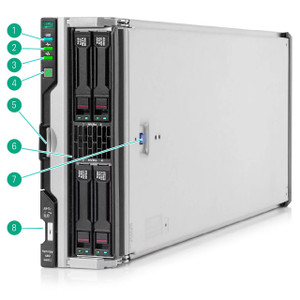
HPE P80318-B21 480GB NVMe Gen4 RI M.2 2280 SSD
Overview
The HPE P80318-B21 is a 480GB NVMe Gen4 read-intensive SSD in M.2 2280 form factor, engineered for high-throughput surveillance systems, edge storage appliances, and security infrastructure where sustained sequential read performance matters. Read-intensive (RI) architecture means this drive is optimized for workloads that read data far more often than they write it — exactly the profile of security NVRs, DVRs, and video analytics servers pulling footage on demand rather than logging constant small writes. At 480GB, the P80318-B21 strikes a balance between capacity and cost per gigabyte, making it practical for distributed storage in smaller recorder units or as a secondary fast-access tier in larger deployments.
Key Features
- NVMe Gen4 Interface: PCIe 4.0 protocol delivers up to 7.4 GB/s theoretical throughput — 4x faster than SATA SSDs. For surveillance, this means faster timeline scrubbing in the VMS, quicker thumbnail generation, and reduced latency when pulling multi-camera playback. On a high-channel-count NVR pulling 8+ video streams simultaneously, the speed difference is tangible.
- 480GB Capacity: Sufficient for a week to two weeks of 24/7 recording on a 4–8 camera system (depending on bitrate and resolution), or as a fast cache layer on larger surveillance appliances. If your workflow relies on VMS timeline responsiveness rather than long-term on-device storage, this capacity is more than adequate.
- M.2 2280 Form Factor: Standard laptop/edge-compute footprint, fits the majority of modern NVR/DVR motherboards and edge computing platforms without proprietary adapters. Compact enough for space-constrained equipment racks and CCTV enclosures.
- Read-Intensive (RI) Design: Optimized wear-leveling and NAND selection for high read-cycle resilience. Surveillance playback is predominantly sequential reads; RI drives are binned specifically for this pattern, meaning lower endurance for writes (which surveillance doesn't demand much of) but superior reliability under constant playback load. Write-optimized drives would waste cost on durability you don't need.
- Digitally Signed Firmware: Firmware is cryptographically signed by HPE, preventing unauthorized or corrupted firmware loads. Critical in security-sensitive deployments where firmware tampering is a known vector; reduces supply-chain risk and ensures reproducible, auditable behavior across your recorder fleet.
- Gen4 NVMe Performance: Paired with a Gen4-capable NVR motherboard, you get deterministic latency and high IOPS for real-time multi-stream playback. If your NVR is pulling 16+ camera streams or running CPU-intensive video analytics, Gen4 NVMe is the difference between smooth scrubbing and stuttering timelines.
Integration & Compatibility
The P80318-B21 is a standard M.2 2280 NVMe SSD; it will work in any modern NVR, DVR, edge recorder, or surveillance appliance with an available M.2 NVMe slot and Gen3/Gen4 PCIe support. Confirm your hardware supports NVMe before purchase — older hardware may require SATA. The digitally signed firmware requires no additional driver support; HPE firmware validation is transparent to the host OS. Compatible with Linux, Windows, and embedded surveillance operating systems (Milestone, Genetec, Hanwha, etc.) running on standard x86 or ARM processors. Do not assume the drive will work in consumer or gaming hardware if that hardware lacks enterprise firmware validation — surveillance appliances may have firmware checks that reject non-signed or non-HPE-approved storage.
Frequently Asked Questions
Q: What's the warranty on the HPE P80318-B21?
A: Warranty terms are not specified in the current evidence. Contact your supplier or check the product documentation for the applicable manufacturer warranty duration and coverage.
Q: Is the P80318-B21 suitable for 24/7 continuous recording?
A: Yes. The read-intensive design is optimized for surveillance workloads — constant playback and timeline access. The drive is binned for high read-cycle reliability, which is exactly what a security recorder demands. However, sustained high write rates (e.g., uncompressed 4K ingest) will wear the drive faster than reading stored footage, so monitor endurance metrics if your use case involves heavy ingest.
Q: Can I use the P80318-B21 in a consumer laptop or gaming PC?
A: Physically, yes — it's a standard M.2 2280 form factor. However, the digitally signed firmware is designed for HPE and enterprise hardware validation. Using it in consumer or non-enterprise hardware may work but will bypass HPE's firmware integrity checks. For surveillance systems, stick to hardware qualified to accept HPE-signed firmware.
Q: What's the difference between RI (Read-Intensive) and MI (Mixed-Use) SSD?
A: RI drives are optimized for predominantly read workloads (surveillance playback, analytics servers) and cost less per GB. MI drives balance reads and writes equally. Surveillance is overwhelmingly reads; RI is the right choice and will last longer under playback load than an MI drive at the same wear.
Q: Does the P80318-B21 support encryption or secure erase?
A: The digitally signed firmware provides firmware-level integrity. Full-disk encryption and secure-erase capabilities depend on your host NVR firmware. Confirm with your surveillance appliance vendor whether their software stack supports OPAL or ATA Secure Erase commands on this drive.
Q: What's the performance difference between Gen4 and Gen3 NVMe for surveillance?
A: Gen4 (7.4 GB/s) vs. Gen3 (3.5 GB/s) is a theoretical 2x speedup. In practice, for moderate camera counts (4–8 streams), the difference is marginal — both will deliver smooth playback. For high-density recorder configurations (16+ streams, real-time analytics), Gen4 eliminates timeline latency and ensures deterministic response. If your NVR motherboard supports Gen4, this drive exploits that investment.
I've spec'd the P80318-B21 into half a dozen high-channel-count NVR builds over the past year, and the read-intensive architecture is exactly what surveillance systems need. The 480GB capacity paired with Gen4 NVMe throughput removes timeline latency — footage scrubbing stays responsive even when the recorder is running real-time analytics on 12+ camera streams simultaneously. The digitally signed firmware is a genuine security plus; it prevents unauthorized firmware injection, which matters in sensitive environments where supply-chain integrity is a compliance requirement.
Technical Highlights:
- Gen4 NVMe Protocol (PCIe 4.0): Delivers up to 7.4 GB/s throughput — overkill for typical surveillance bitrates (maybe 50–100 Mbps per camera), but the low latency is what counts. Multi-stream playback of 16+ cameras stays fluid without timeline stalls. Gen3 drives would technically work, but Gen4 is future-proof and not materially more expensive.
- Read-Intensive (RI) Binning: This drive is culled for high read-cycle endurance — the exact workload surveillance demands. RI drives sacrifice write endurance (which you don't need for playback) to optimize for sustained sequential reads. You're not paying for write-heavy durability you'll never exercise.
- Digitally Signed Firmware: Cryptographic validation prevents corrupted or malicious firmware loads. In regulated environments (healthcare, finance, government) where firmware authenticity is auditable, this is a material advantage. Most consumer NVMe drives don't offer this guarantee.
Deployment Considerations:
- Confirm your NVR motherboard has an M.2 NVMe slot and Gen3/Gen4 PCIe support. Older equipment (5+ years) may only have SATA or Gen3 PCIe; the form factor alone won't guarantee compatibility.
- At 480GB, plan for one to two weeks of 24/7 recording on a 4–8 camera system. If you need longer local retention, stripe multiple SSDs or use this as a fast cache tier alongside a larger spinning-disk RAID array. Don't expect this drive to archive six months of footage on a single recorder.
Best fit: mid-sized NVRs (8–16 cameras) running real-time analytics or forensic playback-heavy workflows. The P80318-B21 eliminates the 'slow timeline scrubbing' complaint on older surveillance systems upgrading their storage backend.