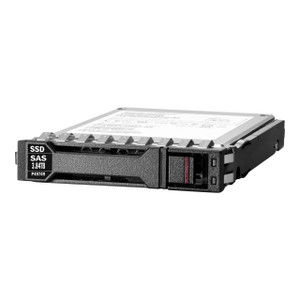
HPE P87717-B21 3.2TB NVMe Gen5 E3.S Self-Encrypting SSD
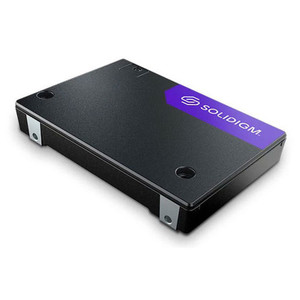
The HPE P87717-B21 is a 3.2TB NVMe Gen5 solid-state drive in the E3.S form factor, purpose-built for enterprise and surveillance storage deployments where capacity, speed, and security intersect. This is a mixed-use drive—neither pure sequential workload nor random-I/O specialist—which makes it a pragmatic fit for surveillance NVRs, hybrid edge compute, and data center storage that demand flexibility without compromise.
Why This Drive Matters for Surveillance and Enterprise Storage
- 3.2TB capacity in E3.S form factor: The E3.S standard (Enterprise, 3.5-inch equivalent, Short depth) delivers density in a smaller footprint than traditional 2.5-inch SSDs, enabling higher drive count per chassis in both NVR and server environments without thermal penalty. More cameras, more retention, same rack real estate.
- NVMe Gen5 interface: PCIe 5.0 bandwidth (128 GB/s theoretical) future-proofs multi-camera ingest pipelines. Even mixed-use workloads benefit from reduced latency on parallel read/write operations—critical when 24/7 recording from 8, 16, or 32 camera streams compete for I/O cycles.
- Mixed-use performance classification: Optimized for workloads that blend sequential video write (recording streams) with random-access reads (live playback, search, export). Not specialized for pure streaming (which would be surveillance-class) or pure database workloads (which would be datacenter-class), but strong in both—the right tradeoff for NVRs that must record and retrieve simultaneously.
- Self-encrypting drive (SED) capability: Built-in AES-256 encryption at the hardware level means surveillance footage is encrypted without CPU overhead. Meets FIPS 140-2 Level 2 compliance on many enterprise deployments—relevant for sensitive environments (healthcare, banking, government) where data-at-rest encryption is non-negotiable.
- Enterprise-class reliability: Built for 24/7 operation in climate-controlled data centers and surveillance appliance bays. Designed for high MTBF (mean time between failure) and consistent performance under sustained multi-stream load—no thermal throttling surprises mid-shift.
- Hot-swap E3.S mechanical: E3.S drives are field-replaceable in enterprise chassis without powering down the entire system (depending on enclosure design), reducing downtime during drive failure or capacity expansion.
Technical Foundation
The P87717-B21 uses the NVMe Gen5 protocol over PCIe 5.0, delivering approximately 10x the bandwidth of SATA and 2x the bandwidth of PCIe 4.0. For surveillance, this translates to lower latency on multi-stream ingest and concurrent playback operations. Mixed-use firmware tuning means the drive performs well on sequential camera recording (where large write blocks dominate) but remains responsive when the VMS pauses to serve a live-view client query or execute a forensic search across stored footage.
Self-encryption is handled in the drive's controller—no host CPU cycles wasted on crypto. If the NVR or storage appliance supports OPAL (Opal Disk Encryption) or TCG (Trusted Computing Group) protocols, you can manage encryption unlock and key rotation centrally without touching individual drives. For compliance audits, SED drives eliminate the need for post-hoc encryption layers that add latency.
The P87717-B21 (often searched as P87717 B21) fits the E3.S form factor used in HPE ProLiant Gen11 servers, HPE Alletra storage arrays, and third-party appliances certified for this footprint. Verify your chassis and controller support E3.S before ordering—legacy systems expecting 2.5-inch M.2 or traditional 3.5-inch spindle will require an adapter or architectural redesign.
When This Drive is the Right Choice
Select the P87717-B21 if your deployment is a surveillance NVR or edge storage appliance that must handle 24/7 multi-camera ingest at moderate-to-high frame rates (15–30 fps per stream, 8–32 cameras) and simultaneously serve playback and forensic queries. The 3.2TB capacity is ideal for 7–14 day retention on 16-camera systems at 4MP resolution, depending on compression codec and frame rate. If your retention window stretches beyond two weeks or you're recording 8MP+ cameras, stack multiple drives or escalate to larger capacity variants within the P87700 series.
When to Choose a Different Model
If your NVR or storage chassis requires SATA or legacy NVMe M.2 (2280 form factor) instead of E3.S, HPE offers SATA SSD alternatives in the P series. If you need larger single-drive capacity for long-term retention, investigate higher-capacity variants in the same family. If your appliance does not support NVMe Gen5 or has no OPAL/TCG encryption management, a standard Gen4 NVMe or SATA SSD may simplify integration at a modest performance cost.
Installation and Integration Notes
E3.S drives require a chassis or enclosure with E3.S drive bays and a compatible NVMe controller or switch. Confirm firmware on your storage appliance or server recognizes the P87717-B21 model—some legacy BIOS versions may not enumerate Gen5 drives correctly. If deploying multiple drives for RAID or striping, verify the appliance supports your chosen parity or mirroring topology. Self-encryption setup requires BIOS and OS support for OPAL or TCG Lite; consult your NVR's documentation for encryption enablement and key management procedures.
What's in the Box
The P87717-B21 ships as a drive-only module. No bracket, adapter, or cable included—E3.S drives connect directly to compatible chassis bays. If your system does not have native E3.S slots, third-party E3.S-to-M.2 or E3.S-to-NVMe adapters are available from specialized storage retailers.
Frequently Asked Questions
Q: Is the P87717-B21 compatible with my NVR or server?
A: The P87717-B21 requires a chassis or controller with E3.S drive bays and NVMe Gen5 support. Check your appliance's technical documentation or contact the OEM to confirm E3.S compatibility. Legacy systems with M.2 or SATA-only bays will not accept this drive without an adapter.
Q: How long will the P87717-B21 retain surveillance video?
A: Retention depends on camera count, resolution, frame rate, and codec. On a 16-camera system at 4MP and 15 fps with H.265 compression, expect roughly 7–10 days of full retention. Higher frame rates or resolution reduce retention proportionally; lower frame rates extend it. Calculate using your NVR's storage calculator tool.
Q: Does the P87717-B21 support encryption?
A: Yes. The P87717-B21 is a self-encrypting drive (SED) with AES-256 hardware encryption. If your NVR or server supports OPAL or TCG protocols, you can enable encryption and manage keys centrally. If not, the SED capability is available but requires firmware/OS support to activate.
Q: What is the warranty on the P87717-B21?
A: HPE provides manufacturer warranty terms with this drive. Contact your distributor or HPE support for the specific warranty period and coverage details associated with your purchase order.
Q: Can I use the P87717-B21 in a RAID array?
A: Yes, if your storage appliance or RAID controller supports E3.S NVMe drives and the firmware recognizes the P87717-B21 model. Verify RAID mode (0, 1, 5, 6, 10) support in your controller documentation before deployment.
Q: What is the performance difference between Gen5 and Gen4 NVMe for surveillance?
A: For most 24/7 surveillance workloads (sequential write-heavy recording), the practical throughput difference between Gen4 and Gen5 is modest—both easily saturate at 500+ MB/s write. Gen5's advantage appears in multi-stream concurrent playback or when the NVR services forensic queries while still recording. If your system has modest load (8 cameras, low frame rate), Gen4 is sufficient; if you're scaling to 32+ streams or expect heavy playback during record, Gen5 is the safer bet for future-proofing.
The P87717-B21 lands at a sweet spot for surveillance infrastructure scaling: 3.2TB of Gen5 NVMe in a form factor (E3.S) that lets you stack drives in dense appliances without thermal compromise. I see this drive chosen most often when teams are moving from spinner-based (SATA HDD) NVRs to all-flash, mixed-use workloads, and they need the encryption story locked in from day one.
Technical Highlights:
- NVMe Gen5 bandwidth (128 GB/s theoretical): Handles multi-stream ingest (8–32 cameras) plus concurrent playback and forensic queries without latency spikes. Even if you max out at 600 MB/s sustained throughput in your NVR, the headroom keeps micro-stalls out of your recording pipeline—critical during heavy VMS search operations.
- 3.2TB mixed-use capacity: Strikes the right balance between sequential video write (where the drive shines) and random reads (playback, metadata queries). Not over-optimized for one workload, which means predictable performance across surveillance and edge-compute scenarios.
- Self-encrypting AES-256 at the hardware controller: Zero host CPU overhead for encryption. If your NVR or appliance speaks OPAL/TCG, you manage key rotation and unlock centrally—no per-drive administration. FIPS 140-2 Level 2 eligible, which matters for healthcare, banking, and government facilities that audit data-at-rest protection.
Deployment Considerations:
- E3.S form factor is not universal—confirm your chassis supports it before purchase. M.2 NVMe adapters exist but add latency and thermal complexity; native E3.S slots are the right path.
- Gen5 support requires relatively recent BIOS and controller firmware. If your NVR or server ships with older firmware, it may fall back to Gen4 negotiation or fail enumeration entirely. Budget time for a firmware update before deployment.
Positioning: the P87717-B21 is the drive to select when you're building or expanding a 24/7 surveillance or edge-compute storage tier that must remain responsive under load and encrypt footage without burning CPU cycles. Small surveillance shops may not need Gen5 (Gen4 is fine), but any multi-site operation or appliance handling 16+ cameras simultaneously should prioritize this.