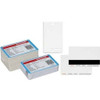
Honeywell PVC42625 OmniProx ISO Proximity Card
Overview
The Honeywell PVC42625 is an OmniProx ISO proximity credential card operating at 125 KHz with 34-bit format encoding. This is a standard-issue credential for access control deployments, warehouse entry systems, and facility badging programs. The card works with OmniProx reader infrastructure, meaning it integrates directly into existing proximity-based door access, checkpoint verification, and multi-building credential schemes.
Key Features
- 125 KHz Operating Frequency: Widely supported across commercial proximity readers. This frequency is the industry standard for non-encrypted badge systems, so compatibility with installed reader networks is predictable and well-documented. No compatibility guesswork needed when deploying across multiple facilities or integrating with legacy infrastructure.
- 34-bit ISO Format Encoding: The 34-bit format provides a standardized encoding structure recognized by most commercial proximity reader platforms. This specification matters because it ensures the PVC42625 will communicate reliably with OmniProx systems and reduces the risk of encoding mismatches during credential provisioning.
- OmniProx Reader Compatibility: Purpose-built for OmniProx reader systems, the card integrates seamlessly into access control platforms using OmniProx infrastructure. If you operate badge readers and credential systems already using OmniProx, the PVC42625 is a plug-in credential—no reader firmware updates or translator modules required.
- ISO Standard Format: The ISO standard ensures basic interoperability with most commercial proximity systems beyond OmniProx. This is a risk-reduction feature: if you ever need to migrate readers or integrate third-party systems, an ISO card is more portable than a proprietary format.
- Commercial-Grade Physical Construction: Proximity cards are subject to daily handling, pocket wear, and reader friction. The PVC42625 is engineered for durability in commercial environments—warehouses, distribution centers, multi-tenant facilities—where credentials see frequent use and occasional environmental stress.
- Credential Lifecycle Support: The card format allows for standard issuance workflows: encoding at the provisioning point, personalization (printing name/photo/ID number), and integration into badging management databases. This supports phased rollout and revocation management without special reader reconfiguration.
Integration & Compatibility
The PVC42625 integrates with access control platforms that provision OmniProx credentials. Typical deployments include door readers wired to access control panels, badge management systems that encode and assign the PVC42625 to individuals, and facility badging workflows where credentials are issued, tracked, and revoked. The card operates passively—it requires no battery or power source—so it has no maintenance overhead and no electronic components that can fail.
Installation integrators and security professionals deploy these cards across warehouse check-in points, employee badging stations, and perimeter access gates. The card's lack of encryption means it is not suitable for high-security environments requiring cryptographic verification—use encrypted proximity formats or smart cards where authentication strength is critical.
When to Choose a Different Model
If your facility requires encrypted credentials or multi-factor authentication, consider smart card or contactless smart card alternatives within the Honeywell security product line. If you operate a mix of OmniProx and non-OmniProx readers, an ISO standard card may have compatibility trade-offs; consult your reader vendor's supported formats. For environments demanding tamper-evident credentials or custom encoding, discuss options with your access control system provider.
Frequently Asked Questions
Q: Can the PVC42625 be used with non-OmniProx proximity readers?
A: The PVC42625 is designed for OmniProx systems. While the 34-bit ISO format is a standard, compatibility with other proximity reader brands depends on whether those readers support the 34-bit ISO specification. Verify reader compatibility before deploying across mixed systems.
Q: Does the PVC42625 require any power supply or battery?
A: No. The card is passive—it contains no electronics or battery. It operates entirely through inductive coupling with the proximity reader. This eliminates maintenance and replacement costs associated with battery-powered credentials.
Q: Is the PVC42625 encrypted or secure against cloning?
A: The PVC42625 uses unencrypted 125 KHz proximity technology. It is not cryptographically secured and can be read by any 125 KHz reader tuned to the OmniProx standard. For high-security applications requiring authentication protection, smart cards or encrypted proximity formats are more appropriate.
Q: Can the PVC42625 be personalized with employee photos or names?
A: Yes. The card can be printed with employee names, ID numbers, photos, and facility branding as part of your badging issuance workflow. Printing capability depends on your credential printer—consult your badging system vendor for compatible card personalization options.
Q: What is the lifespan of the PVC42625?
A: The card has no active electronics, so it does not degrade electronically. Physical durability depends on handling and storage conditions. Normal commercial use (warehouse, office, multi-building badging) typically results in several years of reliable service. Replace if the card becomes physically damaged or delaminated.
Q: How is the PVC42625 encoded or provisioned?
A: Encoding is performed by your credential management system using an OmniProx card encoder. Your access control administrator assigns the card a unique ID and links it to an employee or facility entry in the badging database. This happens during the issuance workflow before the card is handed to the user.
Ted PerryPerspective based on aggregated IP Security Depot and affiliated engineering team experience.
The Honeywell PVC42625 is a straightforward proximity credential—no electronics, no complexity, just reliable passive RF coupling at 125 KHz. If you're managing badging across a warehouse or multi-building campus with OmniProx readers already deployed, the PVC42625 is a no-brainer drop-in. The 34-bit ISO format is the workhorse of commercial access control, so you won't encounter encoding surprises or reader compatibility headaches.
Technical Highlights:
- 125 KHz Passive Induction: No battery, no active circuitry. The card is powered entirely by the magnetic field from the reader. This eliminates credential replacement due to battery failure and cuts lifecycle management overhead significantly in high-turnover environments.
- 34-bit ISO Encoding: Industry-standard format recognized across OmniProx and most commercial proximity platforms. Encoding density is moderate, but that's the design trade-off with unencrypted proximity—simplicity wins, security takes a backseat. Deploy the PVC42625 where convenience and integration matter more than cryptographic rigor.
- OmniProx Native Compatibility: If you already have OmniProx readers on doors, gates, or checkpoints, the PVC42625 integrates without reader firmware tweaks or protocol translation. Encoding, revocation, and multi-site roaming all work within your existing badging management infrastructure.
Deployment Considerations:
- Proximity cards are not encrypted. In environments where credential cloning or skimming is a concern (secure facilities, defense contractors, high-security data centers), this card is inappropriate. Use a smart card or cryptographic proximity system instead.
- Passive RF range is typically 3–6 inches, depending on reader tuning and antenna design. If your deployment requires read distances beyond this range, verify your OmniProx reader specifications beforehand. Some readers are optimized for longer range; others are not.
- The PVC42625 can be physically damaged by moisture, extreme heat, or delamination over time. In outdoor or harsh warehouse environments, protective overlays or card sleeves extend card lifespan cost-effectively.
Deploy the PVC42625 as a cost-effective, low-maintenance credential for warehouse badging systems, multi-facility employee access, and any OmniProx-based infrastructure where speed of issuance and ease of revocation outweigh the security trade-offs of unencrypted proximity technology.