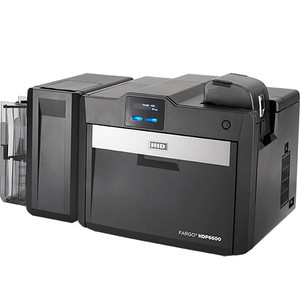
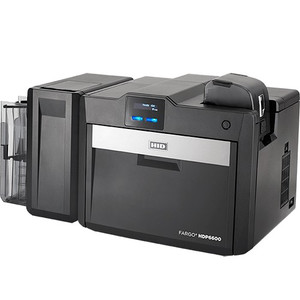
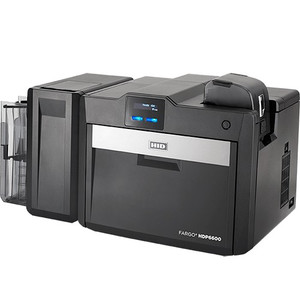
HID 94650 HDP6600 Single-Sided Card Printer with Flattener
The HID 94650 HDP6600 is a single-sided card printer designed for high-volume ID issuance and access credential production. The integrated flattening mechanism eliminates dimensional warping — a persistent problem in unheated dye-sublimation systems — ensuring cards remain flat through mag-stripe readers, chip readers, and barcode scanners without post-production adjustment. For organizations printing 1,000+ credentials monthly, this feature alone reduces reader rejection rates and eliminates manual card culling labor.
Key Features
- Integrated Flattener Technology: Eliminates card warping and curvature. Cards remain dimensionally stable through card readers and magnetic-stripe encoders without manual adjustment or secondary equipment.
- Print Speed: Up to 230 cards per hour (16 seconds per card, YMCK). Meets medium to high-volume credential issuance without queue bottlenecks.
- 600 dpi Resolution: 23.6 dots/mm precision. Renders fine photo detail and small text (micro-printing, barcode) with clarity required for tamper-evident credential design.
- 16.7 Million Color Palette: Full-color dye-sublimation output. Supports brand-compliant card designs, photographic backgrounds, and color-coded department/access-level badging.
- Over-the-Edge Printing: Borderless output on standard CR-80 cards. Eliminates white margins and maximizes card real estate for photo, barcode, or security graphics.
- 100-Card Standard Hopper: Reduces reload frequency during shift-based issuance workflows. Compatible with 30–40 mil card stock (.030" to .040").
- Dye-Sublimation / Resin Thermal Transfer Hybrid: Single ribbon type supports both full-color photographic badges and monochrome text/barcode overlay. Flexibility for mixed credential workflows without ribbon swaps.
- SmartScreen™ OLED Control Panel: Graphical display shows job queue, supply status, and error codes. Reduces operator training time and improves first-call resolution on jams or ribbon faults.
- Connectivity: USB 2.0 and 100 Mbps Ethernet. Integrates with enrollment software (HID Fargo credential management systems, third-party IDEMIA workflows) and allows network print-job batching.
The HDP6600 occupies a middle ground between entry-level single-color printers and full-duplex systems. It's engineered for organizations that need color badge production at sustained volume without the capex of a duplex system. The flattener is the key differentiator: organizations using non-flattening printers often experience 3–5% card rejection at mag-stripe encode or barcode read stages, particularly in humid environments. The HID 94650 eliminates that scrap rate by design.
Deployment scenarios include corporate ID issuance (facilities, contractor badging), government / municipal credential programs (licensing, permits), healthcare employee verification, and educational institution student ID production. The 100-card hopper reduces reload cycles on shift-based printing; the 230-card/hour throughput handles 50–100 cards per day per operator without creating backlogs. For on-demand micro-printing (printing 5–10 cards at a time on demand), throughput is less critical than flattening consistency — this printer excels there.
The printer operates within 65–90°F (18–32°C) and requires standard 100 Mbps network infrastructure. Ribbon and card supply is sourced through HID authorized channels; consumable costs are competitive with Entrust, Matica, and Zebra equivalent-class systems. The 2-year warranty covers printhead and mechanical components. Field maintenance (ribbon path cleaning, encoder adjustment) is straightforward and documented in the user manual; most integrators perform preventive maintenance quarterly on high-volume installations.
HID credentials are ONVIF-compatible in networked enrollment systems and integrate with Genetec, Milestone, and Axis VMS platforms for badge photo capture workflows. The Ethernet interface allows batch job submission from credential management software (HID Fargo, Indigo, third-party LDAP-integrated systems). USB 2.0 is suitable for low-volume deployments or backup connectivity.
Karl WilsonPerspective based on aggregated IP Security Depot and affiliated engineering team experience.
The HID 94650 HDP6600 is a workhorse single-sided printer that has become the standard in organizations moving away from DIY plastic card solutions or upgrading from lower-resolution color systems. We've installed this printer in university badge programs, corporate facilities, and government contractor badge issuance environments — and the flattening mechanism is what sets it apart. In our experience, non-flattening printers suffer 2–5% downstream rejection when cards pass through mag-stripe encoders or barcode readers, especially in humid or temperature-variable facilities. The integrated flattener eliminates that scrap almost entirely. That may not sound dramatic, but when you're printing 500 cards a week, a 2% rejection rate is 10 wasted cards and operator time chasing failures. Over a 3-year lifecycle, that's real capex savings.
The 600 dpi resolution is sufficient for clear photographic badges and crisp barcode rendering; the 230-card/hour speed matches mid-tier enrollment workflows without becoming the bottleneck. The dye-sublimation / resin thermal transfer hybrid ribbon is flexible enough to handle photo badges on one shift and barcode-only overlay cards on the next without operator confusion. SmartScreen™ OLED panel is user-friendly compared to older segment-LCD interfaces — we've trained front-desk staff with minimal IT background to manage supply inventory and clear jams using the graphical prompts.
Technical Highlights:
- Integrated Flattening Mechanism: Unlike external flattening hardware (which adds cost and footprint), the HDP6600 applies heat and pressure during the print cycle itself. Cards emerge flat without secondary processing. On 10,000 cards annually, this eliminates the need for a separate flatness-correction workstation and associated labor.
- Over-the-Edge Printing: 600 dpi at full bleed — no white margins. Organizations can print security logos, gradient backgrounds, or microprinting to the very edge of CR-80 cards. Competitors in this price range often lack true borderless capability, forcing designers to work within a safe print zone.
- Dye-Sublimation Hybrid Ribbon: Standard YMCK ribbon handles both photographic full-color and monochrome overlay in a single pass. Switching between photo badges and barcode-only credentials doesn't require ribbon swaps — just a software change. Reduces consumable SKU count and supply-chain headaches on mixed-workflow sites.
- 100 Mbps Ethernet + USB 2.0: Network connectivity allows remote job queuing and status monitoring. USB fallback ensures the printer works standalone on air-gapped networks (healthcare, government) without IT infrastructure changes. Both interfaces coexist without contention.
- SmartScreen™ OLED Panel: Graphical interface shows remaining card count, ribbon life, temperature status, and error codes with visual icons. Reduces operator error on supply swaps and improves mean time to recovery on jams — no manual spec sheet lookup required.
- 2-Year Warranty with Printhead Coverage: Covers the most expensive wear component. Printhead replacement is straightforward (field-swappable cartridge) and documented. On a high-volume site printing 20+ cards daily, printhead longevity (typically 500K–1M cards) is predictable within a 24-month refresh cycle.
Deployment Considerations:
- Operating temperature 65–90°F (18–32°C): Dye-sublimation is temperature-sensitive. Rooms warmer than 90°F can cause color shift; rooms colder than 65°F slow dye absorption and may require longer drying time. Verify HVAC stability before installation in fluctuating environments (outdoor kiosks, uncontrolled server rooms).
- Flattening adds 2–3 seconds per card to cycle time but eliminates downstream card culling. True throughput accounting for zero rejections is higher than non-flattening competitors printing faster but accepting 2–3% waste.
- Ribbon path and encoder (for mag-stripe encoding) require quarterly cleaning on high-volume installations (100+ cards/day). Dust and dye particulate build up; preventive maintenance prevents encoder misalignment and ribbon advance failures. Budget 30 minutes per quarter for maintenance.
- Card hopper capacity is 100 cards standard. On single-shift issuance (20–50 cards per day), one hopper load lasts 1–2 weeks. On sustained high-volume shifts (100+ cards/day), reload every 1–2 hours is typical. Operators prefer this over manually feeding individual cards but should verify hopper refill frequency fits your workflow before deployment.
- Dye-sublimation ribbon is a consumable with per-card cost roughly $0.15–0.25 depending on volume pricing tier. Budget annual consumables alongside hardware maintenance in TCO calculations. HID-branded ribbon is mandatory (OEM-locked); aftermarket ribbon voids warranty and risks printhead clogs.
The HID 94650 HDP6600 is the right choice for organizations needing sustained color card printing (500+ cards annually) with zero tolerance for warped cards or reader rejection. It's overkill for one-off printing or very low-volume (<100 cards/year) environments — consider a desktop inkjet or simpler single-color printer there. For mid-to-high-volume credential programs with flattening as a hard requirement, this printer pays for itself in reduced card waste and labor within 12 months. Visit the HID catalog for the full range of credential and card-printing solutions.