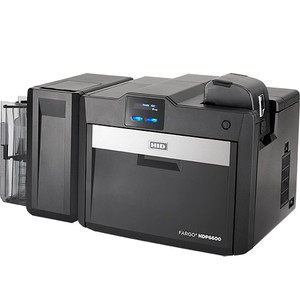
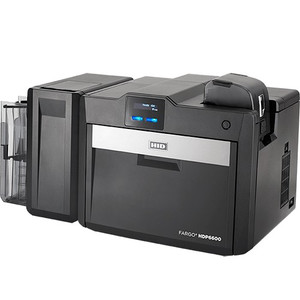
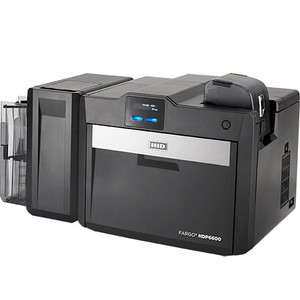
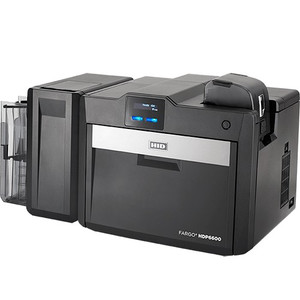
HID 94648 HDP6600 Dual-Side Card Printer with Multi-Technology Encoder
Overview
The HID 94648 represents a comprehensive card issuance solution designed for organizations requiring simultaneous credential encoding across multiple technologies. This dual-side printer integrates contactless encoder, contact chip encoder, and magnetic stripe encoder functionality into a single platform, eliminating the need for separate encoding devices and streamlining credential production workflows. The HDP6600 is engineered to support hybrid credential strategies where identity cards must carry multiple authentication methods for access control, payment, or multi-application scenarios.
Key Features
- Dual-Side Printing: Print high-resolution card designs on both front and back surfaces within a single pass, reducing production time and improving operational efficiency
- Contactless Encoder Integration: Encode proximity cards, RFID credentials, and NFC-enabled cards without mechanical contact, supporting modern wireless credential standards
- Contact Chip Encoder: Program and encode EMV-compliant smart cards and chip-based credentials for secure multi-application deployments
- Magnetic Stripe Encoder: Write magnetic stripe data for legacy system integration and hybrid credential support across access control ecosystems
- Multi-Technology Credential Support: Single device capable of encoding HID iCLASS, MIFARE, and standard contact chip formats, reducing hardware footprint and capital expenditure
- Enterprise-Grade Card Production: Delivers consistent, professional-quality credentials suitable for government, financial services, healthcare, and enterprise security deployments
- Streamlined Workflow: Eliminates credential rework by combining printing and encoding in one device, reducing per-card production cost and time-to-issue
Integration & Compatibility
The HID 94648 operates within HID's comprehensive credential ecosystem, supporting integration with existing access control platforms, identity management systems, and card issuance software. The multi-encoder design ensures compatibility with both contemporary contactless access control readers and legacy magnetic stripe systems, allowing organizations to transition credential strategies without replacing installed reader infrastructure. This flexibility makes the HDP6600 ideal for large deployments where standardized card production must support mixed reader environments across multiple facilities or security zones.
Security integrators and IT managers can deploy the HID 94648 as a centralized issuance point, reducing credential production complexity and ensuring consistent encoding standards across the organization. The device's support for simultaneous encoding technologies enables phased migration strategies, where new contactless credentials can be issued alongside existing chip or magnetic stripe cards, maintaining operational continuity while advancing security posture.
Ideal Applications
The HDP6600 suits organizations with:
- Mixed access control architectures requiring multiple credential types
- High-volume credential issuance requirements (badge offices, HR departments, visitor management)
- Compliance-driven environments needing EMV chip support (financial services, government)
- Multi-campus or distributed facilities using heterogeneous reader populations
- Credential refresh initiatives transitioning from magnetic stripe to contactless or chip-based authentication
Ted PerryPerspective based on aggregated IP Security Depot and affiliated engineering team experience.
Having evaluated the HID 94648 during several enterprise credential refresh projects, I can confirm this device addresses a critical pain point in mixed-technology environments. Organizations with legacy magnetic stripe readers alongside modern contactless systems often face the choice between dual issuance workflows or costly reader replacement. The HDP6600 eliminates that dilemma.
Technical Highlights:
- Tri-Technology Encoding: Contactless, contact chip, and magnetic stripe encoding in a single device reduces hardware SKU complexity and floor space requirements
- Dual-Side Production: Front and back printing with simultaneous encoding capability reduces per-card production time compared to separate print and encode steps
- Multi-Format Support: Compatibility with HID iCLASS, MIFARE, and EMV standards ensures broad ecosystem flexibility
Deployment Considerations:
- Centralizing credential issuance with the HID 94648 requires coordination with existing card management software; verify your CMS vendor supports tri-technology encoding workflows
- Magnetic stripe encoding, while still necessary for legacy reader compatibility, should be viewed as a transitional capability—design new credential systems around contactless or chip authentication
- Plan encoder maintenance intervals based on encoding volume; multi-encoder devices see higher component utilization than single-technology printers
For IT managers overseeing credential infrastructure, the HDP6600 justifies investment through reduced operational complexity and lower per-card issuance cost. If your environment spans multiple credential technologies, this is the device that pays for itself in workflow efficiency.