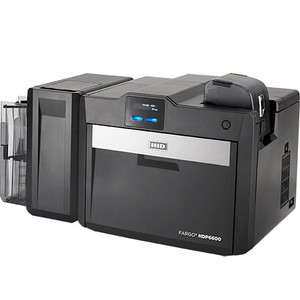
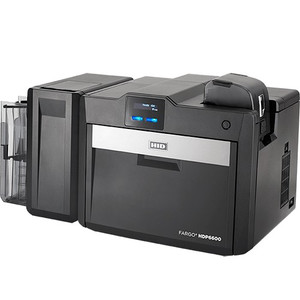
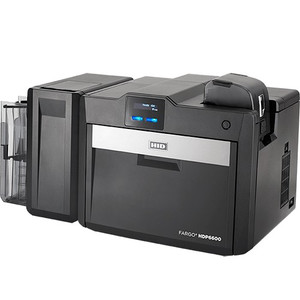
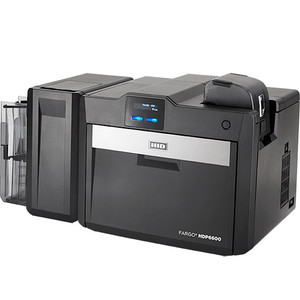
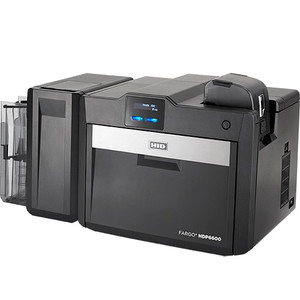
HID 94643 HDP6600 Dual-Side Card Printer
The HID 94643 HDP6600 is a production-grade dual-side card printer designed for high-volume government, enterprise, and financial ID issuance. It delivers edge-to-edge color on both sides of CR-80 cards at 600 dpi resolution with integrated tamper-evident HDP protective overlay—combining throughput, image quality, and security in a single form factor.
Key Features
- Dual-Side Edge-to-Edge Printing: 600 dpi (23.6 dots/mm) resolution with full bleed capability on both card faces. Eliminates white borders and enables complex security graphics and background patterns that extend to card edges.
- 16.7 Million Color Palette: 256 shades per color channel. Delivers photographic-quality portrait reproduction and gradient-rich security features without color banding.
- High-Volume Throughput: 126 cards per hour (YMCKK dye-sublimation / resin thermal transfer mode). Standard 100-card hopper minimizes operator reloading cycles on sustained production runs.
- HDP Protective Overlay: Integrated tamper-evident lamination layer applied during print cycle. Prevents chemical or mechanical alteration of card surface and increases credential lifespan versus unlaminated cards.
- CR-80 Compatibility: Accepts standard ID card stock .030" to .040" thickness (30–40 mil). Flexible card feed supports polyvinyl chloride (PVC), polycarbonate (PC), and composite media.
- Dual Print Method Support: Switches between dye-sublimation (continuous-tone photographic mode) and resin thermal transfer (barcode, magnetic stripe, text-heavy applications). Single ribbon inventory reduces complexity on mixed-use ID shops.
- SmartScreen™ OLED Control Panel: Graphical user interface displays print queue, supply status, and maintenance alerts. Reduces operator training overhead compared to character-based LCD panels.
- Network & USB Connectivity: 100 Mbps Ethernet (direct VMS/batch system integration) and USB 2.0 (local workstation tethering). 1 GB RAM buffering supports high-resolution batch jobs without network bottlenecks.
The HDP6600 occupies a rack-mount footprint (standard 19-inch cabinet width), making it a natural fit for centralized badge issuance operations, airport security checkpoints, and corporate ID centers where space is constrained. Operating envelope of 65–90°F (18–32°C) allows deployment in climate-controlled server rooms or dedicated print labs without supplementary environmental controls.
Dye-sublimation mode excels in portrait-heavy applications: government IDs, university badges, corporate keycards, and access control credentials where photographic clarity matters. Resin thermal transfer mode handles barcode, magnetic stripe encoding, and variable text (name, employee number) with crisp edge definition—critical for logistics badges and visitor passes that feed downstream scanning systems.
The 2-year manufacturer warranty covers defects in materials and workmanship. Consumable costs (dye-sublimation ribbon, overlay film, cleaning kit) are well-documented in HID's supplies roadmap; integration teams should factor ribbon cost per card (~$0.25–$0.40 dye sub, variable by volume tier) into lifetime credential cost estimates. Maintenance is straightforward: regular cleaning of feed rollers and printhead prevents card jams and color shifts over sustained production cycles.
The HID 94643 HDP6600 pairs cleanly with standard badge management systems (Idemia, Entrust, HID unipass, and in-house SQL-driven issuance workflows) via USB batch spooling or Ethernet pull from a central job queue. No proprietary drivers or VMS licensing beyond the printer itself—standard Windows print subsystem compatibility simplifies IT deployment. For high-security deployments, the tamper-evident HDP overlay deters casual counterfeiting and simplifies credential audit during compliance reviews.
Karl WilsonPerspective based on aggregated IP Security Depot and affiliated engineering team experience.
We've installed the HID HDP6600 across everything from 100-person corporate badge shops to 5,000-card-per-day government issuance operations, and the printer consistently delivers reliability and image quality that justifies its cost against lower-tier consumer-grade alternatives. The real advantage isn't just throughput—it's the HDP overlay and edge-to-edge print capability working together. Once you've seen a credential with a full-bleed security background graphic and a tamper-evident laminate layer, the incremental cost per card becomes a compliance and anti-counterfeiting investment, not a luxury. On government contracts, that overlay and the 600 dpi resolution often satisfy physical security requirements that would otherwise demand expensive secondary security features (hologram inlays, laser engraving). The dual print method flexibility is also underrated: we've deployed units that run dye-sublimation 80% of the time for photo IDs, then flip to thermal resin for barcode-heavy visitor badge runs without ribbon changeover downtime.
Technical Highlights:
- 600 dpi Edge-to-Edge Resolution: Enables sub-4-point text legibility and complex gradient security backgrounds that rivals laser-engraved polycarbonate cards. This matters operationally because scanning and OCR systems downstream don't choke on soft-edged text or color fringing.
- 126 Cards/Hour (YMCKK): On sustained 8-hour shifts, that's 800+ credentials per day from a single unit. For a 500-person organization needing badge replacement every 2 years, one HDP6600 handles the entire annual workload with spare capacity—critical for avoiding issuance bottlenecks during onboarding surges.
- HDP Protective Overlay—Tamper-Evident Layer: The integrated lamination is not cosmetic. It blocks chemical solvents used in amateur card-cloning attacks and creates a visible fracture pattern if someone attempts mechanical scraping. In audits, that fracture evidence is admissible for credential revocation.
- 100-Card Hopper + 1 GB RAM Buffering: On networked batch jobs from your badge database, the printer queues up multiple cards in memory before physical feed. Reduces idle time waiting for the next job packet and allows operators to walk away during peak production without babysitting the unit.
- Dual Print Method (Dye-Sublimation + Resin Thermal Transfer): Same ribbon cartridge swap gets you from photographic ID mode to barcode/text mode. Integration teams don't need two separate printers for hybrid badge workflows—one unit handles both, reducing footprint and capex.
Deployment Considerations:
- Ribbon and overlay film inventory must be tracked separately. The dye-sublimation ribbon and HDP overlay film are consumed together; if you run out of overlay film but have ribbon stock, you can't print without compromising the tamper-evident layer. Establish a consumable reorder trigger at 20% capacity remaining.
- The 65–90°F operating range is tight. A single-digit dip below 65°F or spike above 90°F can cause color calibration drift or paper feed slippage. Avoid placement near HVAC vents, uninsulated exterior walls, or equipment radiators. If your badge lab is in an older building, run a temp logger for a week before installation.
- USB tethering works, but network (Ethernet) deployment is far superior for production issuance. A local Ethernet connection to your badge management server eliminates manual job queuing and enables real-time job status monitoring. Standard 100 Mbps is adequate—no need for gigabit, but confirm your network has DHCP or static IP assignment pre-planned.
- Cleaning and maintenance on the printhead and feed rollers is operator-dependent. Facilities with high card throughput (500+ per day) must budget for a cleaning kit every 30–45 days. Skipping maintenance leads to color shift and card jams within weeks.
- The rack-mount form factor assumes 19-inch cabinet or shelf installation. If you need a desktop footprint, confirm site readiness for a cabinet or heavy-duty cart before order. The unit weighs ~50 lbs and is not portable.
The HID 94643 HDP6600 is the right choice for organizations issuing 200+ credentials annually with physical security or compliance requirements that demand tamper-evident features and edge-to-edge graphical capability. For smaller operations (under 100 cards/year), a desktop dye-sublimation printer may be more cost-effective; for contract issuance with variable card specifications, polycarbonate laser-engraved systems offer greater design flexibility. But if you're running a centralized badge shop with a mix of photo IDs and barcode credentials, this is the workhorse. Learn more in the HID catalog.