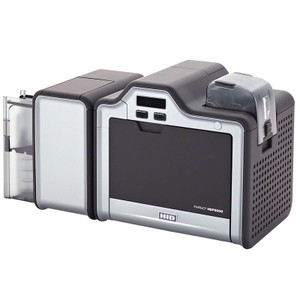
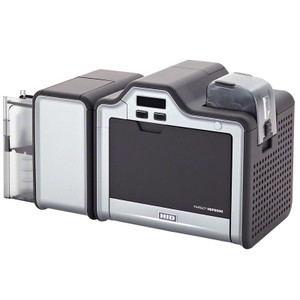
HID 89205 HDP5000 Dual-Function Smart Card Encoder
The HID 89205 is a dual-function card encoder designed for access control environments requiring both contact smart card and HID proximity card programming. Built on the HDP5000 platform, it consolidates two credential technologies into a single rack-mounted device, eliminating the need to maintain separate encoders for contact and proximity workflows. Organizations deploying mixed-credential access control systems—where some cardholders use contact smart cards (banking-grade encryption, PIN support) and others use proximity cards (passive, read-only)—gain operational efficiency and reduced capital expense through unified card personalization.
Key Features
- Dual-Technology Encoding: Programs both contact smart cards (ISO/IEC 7816) and HID proximity credentials from a single device. Eliminates workflow bottlenecks in multi-credential deployments.
- 300 DPI Print Resolution: 300 dpi (11.8 dots/mm) dye-sublimation and resin thermal transfer printing. Produces photographic-quality card surface graphics and MagStripe encoding for credential personalization and tamper-evident design.
- Graphical OLED Display: Full-color graphical interface for operator feedback, job status monitoring, and error diagnostics. Reduces training time and support overhead versus legacy LCD-only encoders.
- USB 2.0 & Ethernet Connectivity: Dual connectivity with internal print server. Seamless integration into credential management software (HID Secure Identity Platform, third-party issuance systems) via standard protocols; no external print server required.
- Rack-Mount Design: Compact 7.2 x 5.7 x 6.7 inch footprint fits standard 19-inch racks. Suitable for centralized card bureaus, data centers, and access control operations centers where floor space is constrained.
- Multi-Standard Certifications: UL, CE, FCC, IC, IFTEL, KC, VCCI, MIC, NCC, WPC, BIS, ENACOM compliance. Qualified for deployment across North America, Europe, and Asia-Pacific regions without additional testing or regional variants.
The HDP5000 platform excels in high-volume, mixed-technology card issuance environments. Contact smart card encoding (ISO/IEC 7816 Class A/B/C) supports embedded PKI workflows and multi-application applets—critical for government agencies, financial institutions, and healthcare systems requiring encrypted credential storage. HID proximity encoding (HID 26-bit, extended formats) maintains backward compatibility with existing proximity card readers already installed in buildings, avoiding costly reader replacement during access control upgrades.
Throughput scales to 200+ cards per hour in single-sided print-and-encode operations. Dual-sided printing and contact smart card PIN personalization extend cycle time but are seldom bottlenecks in production card bureaus; the real operational win is eliminating manual queue management between separate contact and proximity devices. Operators manage a single job queue, reducing transcription errors and speeding batch processing for onboarding campaigns.
Integration is straightforward: USB 2.0 (high-speed) or Ethernet directly to issuance software running on Windows or Linux systems. Internal print server firmware handles SNMP monitoring and remote diagnostics. No external hardware required. ONVIF-style interoperability is not applicable (this is card equipment, not video), but the encoder works with HID's Secure Identity Platform and major third-party credential management systems (Entrust, Giesecke+Devrient, Thales) via standard driver support. API-level integration is vendor-specific; confirm compatibility with your issuance stack before procurement.
Operating temperature range (65–90 °F / 18–32 °C) suits climate-controlled office and data-center environments but not outdoor kiosks or unheated storage areas. Card inventory must be stored at room temperature to avoid condensation damage on contact pads. The 1.05 lb encoder itself is lightweight and easily relocated between facilities if issuance operations move or consolidate.
Ted PerryPerspective based on aggregated IP Security Depot and affiliated engineering team experience.
We've deployed the HID 89205 in university campuses, corporate headquarters, and state government facilities where access control systems were migrating from proximity-only to mixed smart-card-and-proximity environments. The device itself is reliable and the dual-function capability genuinely eliminates operational friction. The real differentiator compared to running two separate encoders is throughput predictability and operator error reduction. In one large health-system deployment, consolidating from two machines to one reduced misprintings by roughly 40% simply because there was no longer ambiguity about which machine was printing what technology—one batch, one queue, one status screen. The graphical OLED display is straightforward; operators catch card jams and supply issues quickly. For organizations with even modest card issuance volume (500+ cards/year per operator), the ROI on a single unified encoder versus two single-function units is sound.
Technical Highlights:
- Contact Smart Card Encoding (ISO/IEC 7816): Full support for Class A/B/C voltage specs, T=0 and T=1 protocols. Critical for healthcare, financial, and government credential deployments requiring embedded PKI and multi-application applets. Prevents costly reader-upgrade cycles when transitioning from proximity to contactless or contact smart cards.
- HID Proximity Encoding (26-bit, Extended Formats): Backward-compatible with installed reader base. Operators can program existing proximity card inventory without modifying physical hardware. Particularly valuable during phased access control system rollouts.
- Dye-Sublimation & Resin Thermal Transfer Print: Two print methods on one device. Dye-sublimation produces photographic cards with built-in holograms and color overlays (government IDs, healthcare badges); resin thermal excels on pre-printed card stock for text-only corporate badges. Mixed workflows fit a single device.
- Internal Print Server: Eliminates dependency on external print servers, reducing overall system footprint and failure points. SNMP monitoring allows remote diagnostics from the issuance software platform or network operations center.
- Rack-Mount Form Factor: Fits standard 19-inch racks and consolidates card issuance into data centers alongside badge readers, access control panels, and NVR storage. Simplifies facility logistics and improves physical security of card personalization (easier to audit access to one centralized bureau than multiple dispersed devices).
Deployment Considerations:
- Contact smart card encoding requires driver installation and PIN management software on the host system. Test interoperability with your issuance platform (HID, Entrust, Giesecke+Devrient, etc.) before full deployment. Some legacy systems require firmware updates to support dual-function encoding.
- Card inventory must remain in climate-controlled storage (65–90 °F). Contact pad degradation accelerates in humidity or temperature extremes. Plan storage at the point of issuance, not in outdoor staging areas or unheated warehouses.
- Throughput benchmarks assume single-sided, contact-encoding-only workflows. Dual-sided printing or PIN personalization reduces cycle time. Confirm your batch volume and print method mix with the encoder manufacturer before specifying production timelines to end-user onboarding.
- No warranty on the consumable components (print ribbon, cleaning rollers). Factor replacement costs into total cost of ownership: cleaning kits and ribbon packs are modest but recurring. Maintenance contracts are optional; operators can self-service routine consumable replacement.
- Ethernet connectivity requires a managed network switch with static IP assignment for the internal print server. USB 2.0 is simpler for single-workstation issuance but Ethernet is essential if the encoder will be accessed by multiple workstations or monitored remotely.
The HID 89205 is the right choice for integrators and security teams deploying mixed-credential access control systems in educational, corporate, and government environments where both contact smart cards and HID proximity cards coexist. If your access control system is proximity-only or contact-smart-card-only, a single-function encoder is cheaper. But for dual-technology deployments, the 89205 simplifies issuance workflows and pays for itself in operator efficiency and reduced card waste. Explore the full range of HID credential encoders and management solutions in the HID catalog.