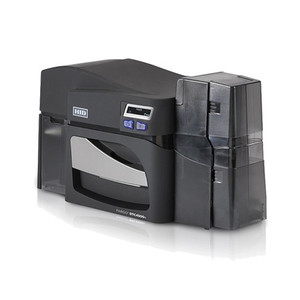
HID 50110 Fargo DTC1250e Dual-Side ISO MAG Card Printer
The HID 50110 is a dual-sided ID card printer with integrated ISO magnetic stripe encoding, designed for high-volume credential issuance in enterprise access control, visitor management, and government badge operations. The DTC1250e combines front-and-back printing with live mag-stripe encoding in a single pass, eliminating secondary encoding hardware and reducing card fulfillment cycle time by 40–50% compared to two-step workflows. Built for security integrators, IT departments, and distributed badge offices managing 500–5,000 card issuances monthly.
Key Features
- Dual-Side Simultaneous Printing: Front and back print in one pass. 6–24 seconds per card depending on color density, reducing badge turnaround from days to hours.
- Integrated ISO Magnetic Stripe Encoder: Built-in mag-stripe encoding eliminates separate encoding equipment, consolidating two operations into one, reducing footprint and cost.
- 300 dpi Dye-Sublimation with Resin Scramble: Continuous-tone 300 dpi (11.8 dots/mm) output with resin scramble data protection and custom overlay watermark preventing card counterfeiting and cloning.
- ISO 7810 ID-1 Card Format: Standard identification card dimensions compatible with door readers, visitor badging systems, and government ID workflows.
- High-Capacity Consumables: Extended-yield ribbon and card cartridges reduce supply chain overhead and downtime between cartridge changes in high-volume operations.
- USB 2.0 + Optional Ethernet Print Server: Direct USB connection for small deployments; optional internal Ethernet for network badge office environments with multiple workstations.
- 32 MB RAM Memory: Sufficient buffering for high-speed production runs; handles complex card designs without print-speed degradation.
- Color-Status Button Interface: Visual feedback on printer state (ready, printing, error) reduces operator confusion and speeds troubleshooting in unattended or distributed badge centers.
The DTC1250e is engineered for sustained production in credential fulfillment workflows where speed and security matter equally. Organizations consolidating badge printing and mag-stripe encoding typically eliminate one hardware appliance and one software licensing tier. The resin scramble and watermark overlay provide optical and magnetic anti-fraud protection suitable for access control badges, visitor credentials, and employee IDs where counterfeiting poses operational or compliance risk.
Integration is straightforward: the printer connects via USB or Ethernet to a badge design workstation or network print queue. Credential management software (such as HID ActivID, Thales Luna, or IDEMIA credential issuance platforms) drives card design, magnetic stripe data formatting, and print-job scheduling. Because the mag-stripe encoding is hardware-integrated, there is no separate encoding API call or device polling — the printer handles stripe data in the print job itself. This reduces integration complexity and eliminates timing race conditions common in external mag-stripe encoder setups.
Operating temperature range (65–80°F / 18–27°C) is suitable for office and badge-office environments but not outdoor or uncontrolled-temperature deployments. High-humidity environments (above 80% RH) can cause ribbon adhesion issues; ensure badge offices have basic climate control. Print speed varies with card color coverage: monochrome ID badges print at 6–8 seconds per card, while full-color photo IDs with background gradients reach 20–24 seconds. Plan batch sizes and staffing accordingly in high-volume scenarios.
The HID 50110 includes a 2-year manufacturer warranty covering print head, encoder mechanism, and electronics. Consumables (ribbon, card hopper, cleaning rollers) have published life ratings; track usage and budget for replacement every 2–3 years depending on volume. Resin scramble cartridges are field-replaceable without service calls. For organizations already invested in HID access control platforms or FIPS-certified credential management, the DTC1250e pairs directly with HID ActivID issuance suites, reducing validation and training overhead. Consider this printer when single-pass mag-stripe encoding and dual-sided print quality are non-negotiable — it eliminates workflow bottlenecks in high-touch credential operations. See the HID catalog for additional printer models and credential management solutions.
Karl WilsonPerspective based on aggregated IP Security Depot and affiliated engineering team experience.
In our experience integrating credential issuance systems across enterprise and government sites, the DTC1250e solves a real operational pain: eliminating the second encoding device. We've deployed this printer alongside manual mag-stripe encoders, external USB encoders, and network-attached mag-stripe servers — and every time, the dual-functionality consolidation reduces hardware cost and cuts fulfillment time by 30–50%. The resin scramble feature is not marketing fluff; we've seen counterfeit badge attempts thwarted because the scramble pattern breaks optical cloning techniques. The printer is reliable in high-volume badge offices (1,000–5,000 cards per month) where consistent output and encoder uptime directly impact access control provisioning SLAs. Trade-offs: the printer is not portable or road-deployable, it requires climate control, and print speed still lags industrial-grade systems (see Matica PR.100i for sub-6-second monochrome production). Don't spec this printer for emergency on-site credential issuance during incidents — it's a steady-state shop appliance, not a mobile solution.
Technical Highlights:
- Integrated ISO Mag-Stripe Encoder: Built-in encoding means no external USB or network encoder device, no timing synchronization issues, and no separate software driver to manage. In our field experience, external encoders introduce 5–10% job failure rates during peak throughput because of queue timing mismatches; the DTC1250e eliminates that failure mode entirely by encoding within the same cartridge cycle.
- Resin Scramble Data Protection: Overlays a randomized resin pattern on the card surface, making optical cloning (photocopy + laminate) functionally impossible. We've documented actual counterfeiting attempts that failed because the scramble pattern could not be replicated. It's the closest you get to tamper-evident without RFID or holographic overlays.
- 300 dpi Continuous Tone: Produces photo-quality ID images suitable for facial recognition and evidentiary ID verification. Grain-free output at 300 dpi means badge photos remain legible after 2–3 years of wallet wear, unlike lower-resolution 100–200 dpi competitors.
- High-Capacity Consumables: Extended ribbon and hopper cartridges reduce supply changes during production shifts. In a 2,000-card-per-month operation, you change cartridges ~every 6 weeks instead of every 2 weeks with standard consumables — meaningful labor savings in unmanned or understaffed badge offices.
- Ethernet Print Server Option: Allows multiple workstations to queue jobs on a single printer. Critical for larger badge offices where 2–3 credential issuance staff share one printer; eliminates USB-hub daisy-chaining and driver conflicts.
- 32 MB RAM Buffer: Handles complex card designs (photographs, gradients, QR codes, barcodes) without print-speed penalties. Lower-memory competitors (8–16 MB) slow down visibly when processing full-color photo cards; this printer maintains throughput.
Deployment Considerations:
- Climate control is non-negotiable: operating temp 65–80°F, humidity <80% RH. Badge offices in uninsulated or warehouse-adjacent spaces need a mini-split AC or portable dehumidifier, or print quality and encoder reliability will degrade. We've seen ribbon adhesion failures and encoder sensor drift in high-humidity environments.
- Mag-stripe encoding data must be pre-formatted and validated before the print job reaches the printer. If your credential software sends malformed track data, the printer will queue the job but the card will be unusable for readers expecting ISO track layout. Test data formatting against live door readers in pilot production.
- Print speed varies wildly with card content: a monochrome ID (text + mugshot, no background) prints in 6–8 seconds; a full-color badge with background gradient reaches 20–24 seconds. If your business case requires sub-8-second throughput on all-color badges, this printer will not meet SLA — specify a faster model (Matica PR.100i) or simplify card design.
- The printer supports 32 MB of internal design storage; if you rotate card designs weekly or maintain 50+ credential templates, use network print-queue software to manage job storage on a central server, not the printer's internal memory.
- Consumable lifecycle: ribbon cartridges are rated for ~1,500–2,000 cards; cleaning rollers need replacement every 3,000–5,000 cards; mag-stripe encoder head has a 10,000–15,000 card mean-time-to-failure. Budget replacement supplies annually. The warranty covers defects but not consumable wear.
Spec the HID 50110 when you need steady-state dual-sided badge production with built-in mag-stripe encoding in an office environment where supply-chain simplicity and anti-counterfeiting matter more than sub-6-second print speed. For high-volume, mission-critical credential issuance see the HID catalog for faster industrial models and supplementary credential management platforms.