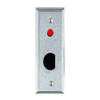
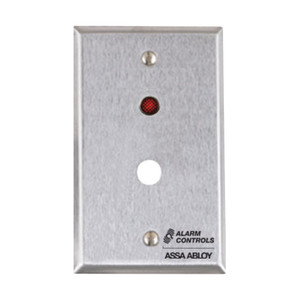
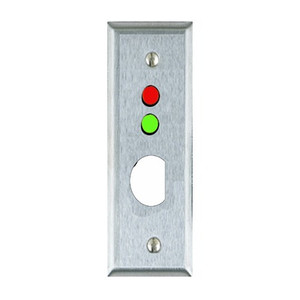
HES RP-01A Remote Narrow Red LED N/O Tamper Switch
The HES RP-01A is a remote-mount tamper switch designed for distributed access control architectures where localized tamper detection and visual feedback must exist at the door or enclosure rather than at a central control unit. This component pairs a normally open (N/O) contact with a narrow red LED indicator, allowing field technicians to verify tamper status during installation, commissioning, and maintenance without requiring a separate monitoring connection back to the control panel. The RP-01A integrates directly with HES door strikes and third-party access control platforms that accept standard switch inputs, making it a straightforward drop-in for multi-door installations requiring per-door tamper monitoring.
Key Features
- N/O Contact Configuration: Normally open switch contacts close on tamper event, compatible with any access control input card or networked alarm sensor that monitors switch closure.
- Narrow Red LED Indicator: Compact status light (red wavelength) provides immediate visual confirmation of tamper state — no remote polling or networked query needed.
- 12VDC Input Voltage: Low-voltage DC supply eliminates special wiring requirements; powered from standard access control 12V auxiliaries or dedicated supply.
- D Hole Mounting Design: Standardized mounting footprint secures the switch body in strike plates, enclosures, and mounting brackets without modification or custom fastening.
- HES Strike System Compatibility: Direct integration with HES 5000 Series and 7000 Series electric strikes; OEM-tested pairing eliminates integration risk.
- Third-Party Platform Support: N/O contact works with any access control system (Salto, Genetec, Milestone, Honeywell, etc.) that monitors discrete switch inputs or networked sensor nodes.
- Indoor Rated: Suitable for controlled-environment installations (offices, institutional buildings, data centers) where humidity and temperature are regulated.
- US Manufactured: Sourced direct from the manufacturer — genuine HES product, no grey-market stock.
The RP-01A addresses a critical gap in distributed access control: the need for real-time tamper feedback at the door without requiring a dedicated networked sensor or running alarm-hardwire back to the panel. On a multi-door site, this reduces installation labor and simplifies troubleshooting — a technician can visually confirm a strike is reporting tamper by simply looking at the LED during a site walk, without needing to pull up a VMS or access control dashboard.
The narrow red LED wavelength is chosen for visibility under typical ambient lighting (indoor fluorescent, LED, or natural daylight) without being so bright as to create false status reports or require dimming resistors. The N/O contact is electronically non-latching — the switch returns to open state once the tamper condition clears, allowing the access control system to log the event and reset the alert without manual intervention.
Integration is straightforward: the RP-01A mounts directly to the strike body or enclosure via D hole fastening, the 12VDC power feeds from the same auxiliary supply that powers the strike, and the switch output connects to any monitored input on the access control panel or a networked relay module. No firmware updates, no commissioning apps, no cloud dependencies — the RP-01A is a passive, hardwired component that functions identically whether it's monitored by a 10-year-old legacy system or a modern cloud-connected platform.
This switch is most applicable to commercial and institutional deployments where door-level tamper monitoring is a security requirement (bank vaults, secure offices, data centers, controlled laboratories) and where on-site visual feedback improves maintenance response time. For single-door or low-security installations, a networked door sensor may be more cost-effective; for sites requiring extensive hardwired tamper monitoring across dozens of doors, the RP-01A's per-door cost advantage over networked solutions becomes substantial, especially when combined with HES strike systems already specified for the project.
Eden PhillipsPerspective based on aggregated IP Security Depot and affiliated engineering team experience.
We've deployed the RP-01A across institutional and commercial access control projects where distributed tamper detection is non-negotiable — hospitals, financial institutions, and research facilities. What differentiates this switch is its refusal to add complexity to the system. There's no network overhead, no sensor node firmware to patch, no cloud dependency. The N/O contact closes on tamper, the red LED glows, and the access control system sees a switch closure on its input. It works the same way in 2024 as it did in 2014, and it will work the same way in 2034. That sounds trivial until you're on a 48-door site with a mix of legacy and modern access control platforms — the RP-01A just works everywhere. The narrow red LED is also a practical choice: it's visible from across a room in normal indoor lighting without being so bright that it creates false alarm reports or requires shielding. We've seen integrators pair this with HES 5000 and 7000 Series strikes and nest the whole assembly into metal enclosures without any optical interference.
Technical Highlights:
- N/O Contact Logic: Switch closure on tamper event integrates with standard discrete input cards on any access control panel. No relay inversion, no inverted logic — straightforward wiring and commissioning. Hardwired tamper monitoring is more reliable than networked sensors for critical doors because there's no network latency or topology dependency.
- 12VDC Auxiliary Supply: Most access control systems already provide 12VDC for solenoid strikes and power supplies. The RP-01A draws minimal current from that bus — no overload risk, no separate supply runs required. One power lead covers both the strike and the switch.
- D Hole Mounting Footprint: Standardized across the access control hardware ecosystem. If you're installing an HES strike, you already have the mounting plate with D holes. The switch installs into the same footprint in seconds, eliminating field fabrication or custom brackets.
- LED as Commissioning Tool: During installation and annual maintenance audits, technicians can confirm tamper circuit continuity by physically observing the LED state — no need to walk back to the control room or pull up software. This cuts troubleshooting time dramatically on multi-door sites.
- Hardwired Reliability: No wireless, no mesh networking, no battery. If the 12VDC supply is present and the switch contact is wired, the system is working. Removes an entire class of failure modes (dead batteries, interference, range loss) that plague wireless tamper sensors.
Deployment Considerations:
- The RP-01A is indoor-rated only — do not specify for exterior doors, outdoor vestibules, or exposed loading docks without weatherproof enclosure. If you need tamper monitoring on an outdoor strike, use a sealed networked sensor or route the RP-01A into a weather-rated junction box.
- Power and signal wiring must comply with local electrical code for low-voltage control circuits. In some jurisdictions, 12VDC access control wiring and alarm wiring cannot share the same conduit — verify before pulling cable. If the site has separate access control and alarm systems, you may need two independent RP-01A installations.
- The narrow red LED is visible from the front of the strike assembly. If the strike is mounted in a recessed frame or behind a secured faceplate, the LED may not be visible during routine maintenance. Plan LED placement during the site survey — sometimes the switch must be mounted slightly offset to ensure the technician can see the status light without removing covers.
- Tamper contact closure is non-latching — the switch returns to open state once the door is closed and tamper ceases. This is ideal for access control systems that log events, but if you're using a latching relay downstream for annunciation, ensure the relay is energized during the tamper window. Check the access control panel's input configuration (latch vs. momentary capture).
- The D hole mounting is a friction fit — over time, vibration or thermal cycling can loosen the switch body in the strike plate, potentially degrading electrical contact. During commissioning and annual maintenance, verify the switch body is seated fully and the fastener is snug. Some integrators add a drop of thread-lock (removable strength) to prevent creep on high-traffic doors.
The RP-01A is the right choice for integrators building hardwired, on-premises access control systems where per-door tamper detection is mandatory and network-free operation is preferred. If your project requires cloud-connected analytics, wireless sensor mesh, or predictive maintenance telemetry, a networked door/tamper sensor is a better fit. For traditional access control — HES strikes on a Genetec or Honeywell panel with discrete input cards — the RP-01A is the proven, low-cost, zero-maintenance solution. Explore the full HES catalog for compatible strikes and control hardware.