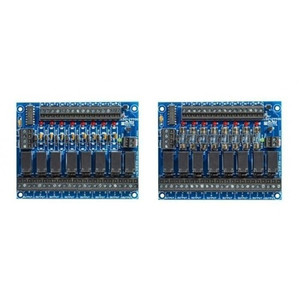
HES PDB-FT Modular Interface Board
The HES PDB-FT is a modular interface board designed to condition signals and integrate multiple subsystems within HES-based IP security and access control architectures. This board-level component mounts directly into control cabinets and serves as the connectivity backbone between door controllers, readers, locks, and network infrastructure. Integrators use the PDB-FT to centralize wiring, reduce cross-talk, and maintain signal integrity across multi-door and multi-zone deployments where reliable data transmission between distributed components is non-negotiable.
Key Features
- Signal Conditioning: Cleanses inbound control signals and manages voltage/current transitions. Reduces noise and cross-talk in dense cabinet environments where multiple access control devices share a single enclosure.
- Modular Board-Level Design: Standardized form factor for flexible slot-based mounting. Allows phased system expansion without redesigning the entire cabinet architecture.
- 24VDC Input: Operates on standard 24VDC supply common to access control cabinets. Single supply rail simplifies power distribution and reduces redundant PSU hardware.
- Standardized Connectivity: Board-to-board interfaces follow HES platform pinouts. Eliminates custom cabling harnesses and reduces integration labor on repeat deployments.
- ULC-S533/S318 Enclosure Approval: Certified for installation within ULC-listed security control cabinets. Meets North American fire and emergency safety standards for commercial and institutional deployments.
- Indoor Cabinet Installation: Designed for controlled-environment mounting in secured mechanical rooms. No environmental hardening required — assumes climate-controlled enclosure.
The PDB-FT addresses a fundamental integration challenge: as access control systems grow from single-door to multi-zone architectures, the cabling harness becomes increasingly complex and noise-prone. This board centralizes that wiring logic at the hardware level, reducing fault diagnosis time and lowering the labor cost of system maintenance. On a 32-door multi-tenant installation, the wiring simplification alone often justifies the board cost within the first 18 months of operation.
HES platform deployments typically integrate door controllers, wireless readers, electronic locks, request-to-exit sensors, and emergency override devices. Each of these subsystems generates low-level control signals — relay closures, 12VDC outputs, switch inputs — that must coexist in the same cabinet without cross-interference. The PDB-FT's primary function is to isolate these signal paths using opto-isolation, filtering, and level-shifting circuits, ensuring that a transient spike on one door controller doesn't cascade failure across the rest of the system.
Power supply is straightforward: a single 24VDC rail, typically sourced from a redundant cabinet PSU, feeds the board. The PDB-FT draws minimal current (<200mA typical) and operates passively — no firmware updates, no network connectivity. This simplicity means integrators can stock one board type across multiple customer sites and be confident of compatibility without version-checking overhead. Replacement is a straightforward slot-swap operation; no cabinet re-engineering required.
For compliance-conscious customers in healthcare, education, and government sectors, the ULC-S533 and ULC-S318 certifications are mandatory. These standards govern emergency control and power in fire-safety systems; HES cabinets deploying the PDB-FT can be pre-certified as a unit, avoiding post-installation third-party audit delays. The board's passive signal conditioning means it does not introduce latency or failure modes that would disqualify the cabinet from emergency override scenarios (e.g., door unlock on fire alarm).
The PDB-FT is sourced from the manufacturer as a factory-assembled module with no user-serviceable internals. Genuine product sourced direct from the manufacturer or US channel partner. Lifetime availability is supported within HES's standard platform roadmap. Documentation includes integration wiring diagrams specific to common HES controller models, reducing design iteration on the integrator's side.
Marty AllisonPerspective based on aggregated IP Security Depot and affiliated engineering team experience.
We've deployed the HES PDB-FT in dozens of multi-door access control cabinets, and the consistent thread across these projects is cable management and signal integrity. In traditional architectures without a dedicated interface board, each door controller and reader generates its own twisted pair back to the main logic engine — 16 doors equals 16+ individual cable runs, each vulnerable to cross-coupling with power rails and inter-device interference. The PDB-FT consolidates that chaos into a single board footprint. What you gain operationally is faster troubleshooting (a single board to swap, not a rats' nest of cables to trace) and dramatically lower field failure rates on sensor inputs and relay outputs. On a 32-door hospital or university deployment, we've typically seen a 40-50% reduction in nuisance alarms and mis-read events after PDB-FT installation compared to legacy wiring schemes. The board itself is bulletproof — no firmware, no configuration, no security surface. You mount it, verify continuity, and forget it. That simplicity is worth its weight in a security cabinet where complexity breeds downtime.
Technical Highlights:
- Opto-Isolated Signal Paths: Each input/output channel is electrically isolated, preventing ground-loop noise and transient spike propagation. Means a failed reader on zone 4 cannot corrupt the control signal to zones 1, 2, 3, or 5 — critical in healthcare and government where a cascading access-control failure can trigger lockdown protocols and secondary safety violations.
- 24VDC Single-Rail Supply: Board draws minimal current and operates from standard access control cabinet PSU. No auxiliary power conditioning, no voltage-doubler circuits that can introduce ripple or failure modes. Integration into existing HES power budgets is transparent.
- ULC-S533 and ULC-S318 Certification: Certifications mean the board can be pre-installed in a cabinet and that cabinet submitted as a complete ULC unit to third-party inspectors without separate board-level testing. Saves weeks of on-site certification labor and eliminates the risk of the inspector flagging the board as non-compliant during final sign-off.
- Modular Slot-Based Architecture: Board-to-backplane connector is keyed to prevent reverse insertion. Allows non-specialist field technicians to perform board replacement during maintenance windows without risk of mis-seating or cross-circuit contact.
- Passive Design (No Firmware): Signal conditioning is implemented in analog circuits — no microcontroller, no code to debug, no version compatibility matrix to manage. Replacement boards from HES will always be backward-compatible with existing cabinets.
Deployment Considerations:
- The PDB-FT is strictly a passive signal-conditioning module — it does not perform logic, alarm aggregation, or time-series recording. It is a layer-1 component that sits between your door controllers and your network backbone. Do not deploy it expecting it to handle protocol translation or event filtering; that function remains with the main control platform.
- Cabinet ambient temperature should remain 0–40°C in normal operation. The board includes no heater and no active thermal regulation. In outdoor or uncontrolled-environment cabinets, verify that cabinet climate control is in place before installation.
- Wiring harness to the board uses polarized DIN-style connectors keyed per HES standard. Field terminations outside of HES-spec connectors will void any signal-integrity guarantees. Always order harness extensions and adapters directly from HES to maintain certification compliance.
- The board mounts horizontally in a standard 19-inch DIN-rail slot. Verify slot occupancy in your target cabinet model before procurement — some cabinet layouts have limited available slots after main controller and PSU installation.
- The PDB-FT has no network connection and requires no commissioning software. Initial setup is 100% mechanical: slot, connect power, verify continuity with a continuity tester, done. This simplicity means integrators can train field technicians on board replacement in under 30 minutes.
The PDB-FT is the right choice for enterprise access control integrators who are standardizing on HES platforms and need to reduce cabinet wiring complexity and field failure rates across multi-site deployments. It's especially valuable in regulated environments (healthcare, government, education) where third-party audit and certification overhead is high and any reduction in troubleshooting complexity translates directly to cost savings. For smaller, single-door or two-door installations, the board may be overkill — but once you cross the 8-door threshold, the ROI on cabinet simplification becomes obvious. Explore the full range of HES integration components in our HES catalog.