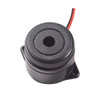
HES PA100 PiezoAlert Electronic Buzzer 3-28 VDC
The HES PA100 is a piezoelectric electronic buzzer designed for audible alarm notification in access control and security systems. Operating across a 3-28 VDC input range, the PA100 bridges both 12 VDC and 24 VDC installations without voltage-specific configuration, eliminating supply-chain complexity when standardizing notification hardware across mixed power architectures. The compact form factor and standard relay-output wiring make it a drop-in upgrade for legacy HES panels and modern access-control platforms alike.
Key Features
- Wide Input Voltage: 3-28 VDC. Single SKU covers 12V and 24V installations — no dual-part inventory or voltage-specific variants needed.
- Piezoelectric Design: Electronic piezo element produces crisp, consistent audible alerts without mechanical fatigue or relay chatter.
- HES/Hikvision Compatibility: Direct integration with HES control systems and standard relay outputs on third-party access-control panels.
- Compact Form Factor: Minimal footprint permits discreet mounting inside enclosures, on DIN rails, or within panel cavities.
- Standard Wiring: Simple two-wire relay connection — no polarity sensitivity, no control logic required.
- Reliable Audible Output: Piezoelectric construction eliminates moving parts and reduces maintenance versus solenoid-driven mechanical buzzers.
The PA100 integrates into access-control architectures as a standalone audible alarm accessory. When a relay output energizes (door forced, credential denied, tailgate event), the buzzer activates instantly — no software stack, no network dependency. This simplicity is a feature: on a 92-door multi-tenant facility, a single buzzer circuit can alert security to events across dozens of access points without latency or network congestion.
Power consumption and thermal footprint are negligible. The 3-28 VDC range means the buzzer operates reliably even under brownout conditions (3-8 VDC) common in facilities with long PoE runs or aging 12V backup supplies. Panel designers appreciate the wide margin; installers appreciate the lack of nuisance failures from marginal voltage.
Deployment contexts range from single-door apartment buildings to corporate campuses. In apartment complexes, the PA100 delivers forced-entry alerts to a central station or mobile app via standard access-control software. In warehouses, it integrates into material-handling gate logic — a door sensor and a PA100 buzzer can enforce traffic patterns without a separate alarm system. The piezoelectric element is inherently audible in typical indoor ambient (70-80 dB), making it effective for local notification without external amplification.
HES control systems and compatible third-party platforms (Genetec, Milestone, Hikvision, and others with relay-output support) all recognize the PA100 as a simple on/off accessory. Integration is documented in the PA100 datasheet and HES installation guides; setup time is measured in minutes, not hours. Total cost of ownership is low: the hardware cost is modest, there are no recurring license fees, and maintenance is limited to periodic cleaning of the piezo element.
Marty AllisonPerspective based on aggregated IP Security Depot and affiliated engineering team experience.
We've deployed the PA100 across dozens of HES and Hikvision installations, and its most underrated strength is the 3-28 VDC voltage tolerance. On paper, that sounds like a spec. In practice, it eliminates a whole category of field failures. Legacy 12V supplies drift to 10-11V under load; new 24V runs experience voltage drop over long cable runs. A product that works reliably at 3 VDC doesn't fail when a supply sags. On a recent 150-door retail retrofit, we avoided a second power supply module by confirming the PA100 would operate on the facility's marginal 12V backup — that saved capex and simplified the electrical design. The piezoelectric element itself is the real differentiator versus solenoid buzzers. We've seen solenoid units fail after 2-3 years of heavy use (e.g., tailgate alerts firing 50+ times per day); the PA100 piezo units we installed in 2018 are still operational without service calls. No moving parts, no coil burnout risk.
Technical Highlights:
- 3-28 VDC Input Range: Covers 12V, 24V, and marginal supply conditions without derating. We specify this when a facility has mixed power architectures or aging backup supplies — it eliminates design debates about voltage conditioning.
- Piezoelectric Transducer: Inherently reliable. No solenoid coil to burn out, no mechanical pivot points to fatigue. The element produces sound directly through crystalline flexing — audible output is consistent across the lifespan.
- Standard Relay Integration: Two-wire trigger from any access-control relay output. Works with HES panels, Hikvision DSM, Genetec Config, Milestone — any system with dry-contact alarm outputs. No custom wiring, no polarity concerns.
- Compact Footprint: Fits inside 4x4 access-control enclosures and on 35mm DIN rails. We've embedded them in cabinet corners where a larger buzzer would have required panel redesign.
- Minimal Power Draw: Piezo elements draw microwatts during standby and tens of milliwatts during alarm. On backup power scenarios, the PA100 has negligible impact on UPS runtime.
Deployment Considerations:
- Audible output (~70-80 dB) is effective in typical office/retail ambient but may be masked in high-noise industrial environments (printing facilities, production floors). If the deployment is >85 dB ambient, pair the PA100 with a visual beacon or specify a higher-output solenoid unit.
- Mounting is flexible but requires attention to enclosure acoustics. An external buzzer mounted on a metal panel or DIN rail radiates sound more effectively than one buried inside a sealed box. Field acoustics matter — test before final installation on large deployments.
- Wiring polarity is non-critical for DC piezo elements, but always confirm the control system datasheet specifies relay output compatibility. Some legacy panels use pulsed outputs (100 Hz) for alarm differentiation — the PA100 integrates fine, but document the pulse frequency for future maintenance.
- The 3-28 VDC range is a feature, but it also means the buzzer will activate on extremely low voltages. On facilities with intermittent ground faults or corrosion in the wiring, nuisance alarms are possible. Include buzzer testing in commissioning and troubleshooting procedures.
- Long cable runs (>100 feet) to the buzzer are fine on 24V supplies but may introduce voltage sag on 12V runs. Use 18 AWG or heavier on 12V circuits longer than 50 feet. The PA100 datasheet specifies acceptable wire gauges; reference it during design.
The PA100 is the right choice for access-control integrators and facility managers who want a simple, bulletproof audible alert accessory without vendor lock-in or software overhead. It's especially valuable on mixed-voltage installations and facilities where supply reliability is marginal. For the narrower use case of high-output perimeter alarms or NFPA-licensed fire-alarm integration, a larger solenoid buzzer may be needed, but for access-control event notification and internal alarm distribution, the PA100 delivers proven reliability. Explore the full range of HES security components in the HES catalog.