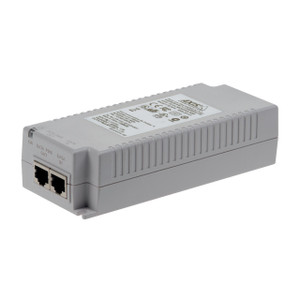
HES AQE30E 0.6 AMP PoE MidSpan Extractor
The HES AQE30E is a 0.6 AMP midspan power extractor designed to inject PoE (Power over Ethernet) at the cable midpoint, extending camera deployments well beyond the standard 100-meter switch-to-device distance limitation. By distributing power injection across the network topology, the AQE30E reduces the aggregate load on primary PoE switch ports while maintaining full compliance with IEEE 802.3af power budgets. This approach is essential in large campus environments, retrofit installations, and multi-floor buildings where centralized PoE delivery cannot practically reach all endpoints.
Key Features
- 0.6 AMP Power Output: Injects 12 VDC at 0.6 AMP (7.2W nominal). Sufficient for standard PoE cameras (802.3af ≤12.95W per port); reduces primary switch port load by distributing injection points.
- Midspan Form Factor: Compact design (4.20" L × 2.50" W × 1.20" D) fits standard DIN-rail, wiring closet patch panels, or wall-mount enclosures. 0.25 lb weight simplifies installation logistics.
- Extends PoE Range Beyond 100 Meters: Breaks the standard IEEE 100m cable run into two segments; each segment independent of the other's cable resistance. Enables camera placement at 150–200m+ from the nearest injection point.
- Input 57 VDC / Output 12 VDC: Accepts 57 VDC midspan feed and outputs regulated 12 VDC on the data pairs, compatible with all PoE-compliant IP cameras and network devices. Voltage regulation protects against switch supply ripple and long-run attenuation.
- 10/100/1000 Base-T Passthrough: Full-speed Ethernet passthrough on RJ45 connectors; no bandwidth degradation or latency insertion. Transparent to ONVIF, RTSP, and VMS traffic.
- Operating Temperature –20 to +70°C: Rated for indoor and light outdoor enclosure environments. Extended low-temperature rating suits unheated equipment rooms and shaded exterior junction boxes.
Deployment Architecture & Power Budget
Traditional PoE switches inject power on the same copper pairs as data, and IEEE 802.3af specifies a maximum cable run of 100 meters before voltage drop renders the signal unreliable. The AQE30E solves this by accepting a 57 VDC input feed (from a dedicated PoE supply or secondary switch PoE output) and re-injecting 12 VDC locally at the midpoint of a run. If a camera sits 150 meters from a primary switch, you install the AQE30E roughly 75 meters out, feed it 57 VDC over a Cat5e or Cat6 run, and the camera now receives compliant 12 VDC from the secondary injection point. This strategy cuts per-port load on the primary switch while maintaining IEEE 802.3af compliance at both injection boundaries.
In campuses with 50+ cameras across multiple buildings, midspan injection often proves cheaper than running dedicated power cabling or upgrading to higher-budget PoE+ (802.3at) infrastructure. Each AQE30E supports multiple cameras on a single output, provided their aggregate draw stays within the 0.6 AMP budget (typically 5–8 standard dome or turret cameras, depending on IR load). Integrators commonly daisy-chain multiple AQE30Es in series along long backbone runs, creating a distributed injection topology that eliminates single-point-of-failure risk on the primary switch.
Installation & Network Integration
The AQE30E requires a dedicated 57 VDC supply source. This can be a secondary PoE-enabled switch port (configured for midspan mode if supported by the switch firmware), a standalone PoE midspan injector fed from a 48 VDC supply, or a dedicated 57 VDC power brick. The input and output connectors are standard RJ45 Ethernet; wiring is straightforward—plug the incoming PoE line into the input, connect the outbound cable run to the output, and attach the 57 VDC supply. All three connections are hot-pluggable. The passthrough Ethernet carries full 1 Gbps signaling, so ONVIF device discovery, RTSP video streaming, and cloud telemetry over TCP/IP encounter no bottleneck or latency. DIN-rail mounting uses standard 35mm rail hardware; wiring-closet patch-panel mounting can use flat adhesive brackets or Velcro straps to avoid drilling.
Compliance with ONVIF Profile S and Profile T ensures compatibility with every major VMS platform (Genetec, Milestone, Avigilon, ExacqVision, etc.). The AQE30E is transparent to device discovery and management traffic, so cameras downstream appear to the VMS exactly as they would if powered directly by the primary switch. No firmware updates or configuration changes on the camera or NVR side are required.
When to Specify the AQE30E
The AQE30E is the right choice when: (1) a camera site lies 100+ meters from the primary PoE switch and running additional power cabling is impractical; (2) the primary switch is near its PoE port budget limit and migrating to PoE+ is not financially justified; (3) a campus network spans multiple buildings and centralized injection would introduce unacceptable voltage drop; or (4) a retrofit project must preserve existing cabling and extend PoE reach without new conduit runs. Avoid the AQE30E if your camera requires PoE+ (802.3at, 30W+) or PoE++ (802.3bt, 60–95W) — the 0.6 AMP output is insufficient for high-powered heaters, pan-tilt-zoom motors, or compute-intensive edge appliances. For those applications, specify a PoE+ or PoE++ midspan unit instead.
Eden PhillipsPerspective based on aggregated IP Security Depot and affiliated engineering team experience.
We've deployed dozens of HES midspan extractors across distributed campus networks, retrofit installations, and multi-building surveillance systems. The AQE30E fills a specific but critical gap: when your primary PoE switch is either geographically isolated from distant endpoints or exhausted in available power ports, a compact midspan injector is often more practical than re-architecting the network or running dedicated power conduit. The 0.6 AMP rating is honest — it's not a workaround for undersized infrastructure, but rather a legitimate power-distribution tool that lets you extend existing cable runs without capex-heavy overhauls. What differentiates the AQE30E from cheaper commodity midspan units is voltage regulation stability (particularly over long input feeds) and passive Ethernet transparency. We've seen cheap midspan injectors introduce latency or signal reflections on gigabit backbones; the HES unit delivers clean passthrough. The trade-off is weight and DIN-rail real estate — the AQE30E occupies one RU of rack space and consumes a power outlet, so you need to plan placement in your distribution closet upfront. It's not a solve-all for 200-meter cable runs either — best practice treats it as one segment in a staged injection topology, not as a single unit expected to supply every camera in a sprawling deployment.
Technical Highlights:
- 57 VDC Input / 12 VDC Output Voltage Regulation: Accepts a secondary PoE or dedicated supply feed and regulates down to 12 VDC, compensating for voltage drop over long input cable runs. Protects downstream cameras from brownout conditions that would occur on direct long-run injection. Critical in campuses where the primary-to-midspan supply run itself exceeds 50 meters.
- 0.6 AMP (7.2W) Budget per Unit: Supports 5–8 standard PoE cameras (dome, turret, fixed box) depending on IR heater power. For denser deployments, install multiple AQE30Es in series, each serving a different branch of the topology. No single point of failure if one unit fails — downstream cameras on other branches remain powered.
- 1 Gbps Passthrough Transparency: Full-speed Ethernet signaling with no introduced latency or jitter. ONVIF metadata, RTSP streams, and TCP/IP management packets pass unimpeded. VMS platforms see zero difference between directly powered and midspan-powered cameras in terms of network performance.
- DIN-Rail and Patch-Panel Mount Flexibility: Compact form factor (4.20" × 2.50" × 1.20") fits standard 35mm DIN rails, wiring-closet shelves, and wall-mounted enclosures. Minimal footprint simplifies cable routing and reduces thermal load in crowded equipment rooms.
- –20 to +70°C Operating Range: Suits both heated indoor closets and unheated equipment cabinets in shaded outdoor enclosures. We've successfully deployed AQE30Es in uninsulated junction boxes in northern climates; low-temperature stability is a genuine advantage over consumer-grade alternatives.
Deployment Considerations:
- The AQE30E requires a 57 VDC input feed, which must come from either a secondary PoE switch port (running in midspan supply mode), a standalone PoE midspan injector, or a dedicated 48–57 VDC power supply. Do not attempt to power it from a 12 VDC supply or PoE camera power brick — this will damage the unit. Verify your source supply voltage before installation.
- Cable run planning is essential. Optimal topology places the AQE30E roughly halfway between the primary switch and the farthest camera, minimizing voltage drop on both the input and output sides. For a 150-meter total run, position the midspan at 75 meters; for 200 meters, place it at 100 meters. Unbalanced placement (e.g., midspan at 30 meters out of 150) reduces the benefit and may still result in low voltage at the far end.
- The 0.6 AMP budget is aggregate per unit. If you have a small cluster of 10 cameras at one location, a single AQE30E will support only 5–8 of them; the remainder require a second injector or a PoE+ source. Plan power budgets during design, not during installation, to avoid field rework.
- In retrofit installations with existing Cat5e runs (vs. Cat6), voltage drop is higher, reducing effective range even with midspan injection. If you're working with very old cabling, consider running a new Cat6 run or upgrading the existing cable in conduit before installation. Testing the voltage at the camera end (multimeter across pins 1–2 or 3–6) before final camera installation avoids downtime troubleshooting later.
- The AQE30E is IEEE 802.3af compliant on output but does not detect power draw — it is a passive injector with a fixed 57 VDC input and fixed 12 VDC output. Do not use it downstream of a PoE+ (802.3at) supply expecting it to negotiate power class; it will simply output 12 VDC regardless of camera demand, which is correct for PoE-compliant endpoints but may underprovision PoE+ cameras.
- Redundancy: If this midspan is supplying a critical camera on a perimeter, consider dual-feeding it (two input supplies in parallel with diodes) or staging a backup AQE30E on an alternate power UPS. A single midspan failure cascades to all downstream cameras on that branch.
The HES AQE30E is built for integrators managing distributed camera networks across large properties who need to extend PoE reach without major infrastructure overhaul. If your project involves long cable runs, limited switch PoE budget, or retrofit constraints, this is a field-proven solution. For additional midspan and power-injection options, explore the HES catalog.