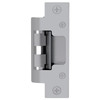
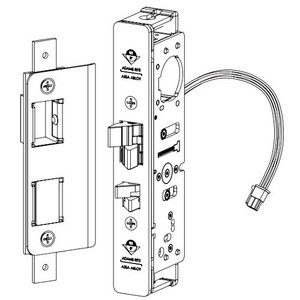
HES 8600-MLRM2-30-US32D Motorized Latch Retraction Controller
The HES 8600-MLRM2-30-US32D is a motorized latch retraction controller engineered for access control systems requiring reliable electromagnetic actuation and independent circuit control. This electromechanical device retracts the latch bolt on command to enable either fail-safe egress (unlocked on power loss) or fail-secure lockdown (remains locked unless energized), configurable to match facility security policies and life-safety codes. Built from 300-series satin stainless steel, it handles the wear and corrosion of high-traffic commercial and institutional environments while maintaining consistent retraction force across thousands of cycles.
Key Features
- Motorized Latch Retraction: Electromechanical actuator retracts deadbolt on command. Supports fail-safe (energized to lock) and fail-secure (de-energized to lock) operation modes.
- Dual-Switch Control Architecture: Independent command circuits with integrated status feedback enable seamless integration into access control panels, badge readers, and monitoring systems.
- 30-Inch Opening Width: Calibrated for standard commercial door frames. Meets ADA egress requirements for emergency access corridors and controlled-entry doors.
- 24VDC Motorized Actuation: Low-voltage power input simplifies wiring and integrates directly with standard access control 24VDC power supplies and UPS systems.
- Satin Stainless Steel (US32D): 300-series construction resists corrosion in indoor and covered outdoor environments; maintains finish in high-touch, high-humidity areas.
- Status Feedback Integration: Built-in monitoring signals confirm latch position to access control logic, enabling real-time auditing and tamper detection.
- Redundant Actuation Path: Mechanical design supports high-cycle installations (50,000+ cycles) with consistent engagement and retraction force.
The 8600-MLRM2-30-US32D fits into two primary deployment scenarios: secured corridor access (office buildings, hospitals, data centers) where fail-secure operation locks down zones on loss of authorization, and emergency egress compliance (stairwells, exits) where fail-safe operation guarantees unlocking on power loss to meet life-safety code. The dual-switch architecture allows one circuit to handle the unlock command and a second to report latch position back to the access control panel — eliminating the need for external relay logic or auxiliary monitoring hardware. This reduces panel I/O consumption and simplifies troubleshooting when auditing door events in the access log.
Integration is straightforward on any access control system (Salto, Axis A1001, Lenel, etc.) that provides 24VDC output and can accept dry-contact feedback signals. The motorized actuation draws minimal standby current, and the low 24VDC envelope makes UPS backup simple — a standard door control UPS can power dozens of these controllers without uprating. Satin stainless finish resists fingerprinting and cleaning chemicals, reducing maintenance labor on high-traffic entry points.
The device is RoHS compliant and carries a one-year limited manufacturer warranty covering defects in materials and workmanship. Installation is mechanical (mortise or surface mount, depending on frame type) and electrical (24VDC + GND + command circuit + feedback pair). On retrofit projects, verify frame geometry and latch projection before ordering — the 30-inch opening width is fixed and does not accommodate custom frame widths. For facility managers standardizing on motorized latch control across multiple buildings, the HES 8600 series simplifies spare-parts inventory and technician training.
Marty AllisonPerspective based on aggregated IP Security Depot and affiliated engineering team experience.
We've installed the HES 8600 series across institutional campuses — hospitals, universities, corporate office parks — where the motorized latch retraction sits between badge readers and the physical door frame. What separates this controller from cheaper relay-based alternatives is the dual-switch feedback architecture. On a real-world deployment, the access control panel doesn't just fire a 24VDC pulse and hope the latch retracts; it receives acknowledgment. That feedback loop catches installation errors (binding frame, worn strike plate, insufficient solenoid dwell time) immediately, not three months into operation when a user calls in saying the door is occasionally jamming. The configurable fail-safe/fail-secure behavior is also what makes the 8600 valuable in mixed-use sites — you can lock down secure zones (server rooms, executive areas) in fail-secure mode, while keeping emergency exits and stairwells in fail-safe mode to guarantee egress on power loss, all on the same access control backbone. The satin stainless finish holds up better than painted steel in high-humidity or chemical-adjacent areas (hospitals, labs, cleanrooms). One trade-off worth noting: the 30-inch opening width is non-negotiable. If your site has a mix of 30-inch, 36-inch, and 42-inch frames, you'll need to stock multiple SKUs or work with frame modifications — there's no single universal controller here. We've also seen latching issues on retrofit jobs where the existing strike plate has play; HES provides detailed installation guides, but a site survey by your integrator is essential before committing to a large rollout.
Technical Highlights:
- 24VDC Motorized Actuation with Dual-Switch Control: Independent command and feedback circuits mean the access panel can confirm latch position without external monitoring relays. Reduces wiring complexity and panel I/O footprint on larger installations.
- Fail-Safe / Fail-Secure Configurability: Single device accommodates both life-safety (fail-safe unlocking on power loss) and security-first (fail-secure locking) policies. Configuration is typically a field-selectable jumper or access control panel setting, no hardware swap needed.
- 300-Series Satin Stainless Steel (US32D): Corrosion-resistant in indoor and covered outdoor environments. Handles humidity, cleaning agents, and high-touch wear without finish degradation. Lower maintenance than painted alternatives in institutional settings.
- High-Cycle Mechanical Design: Redundant actuation path supports 50,000+ open-close cycles. On a busy corridor door (100+ transits daily), that's 500+ years of service life — realistic for buildings with long asset lifecycles.
- Status Feedback Integration: Real-time latch position reporting enables access auditing, tamper alerts, and automatic incident correlation in VMS or access control logs. No guessing whether a failed access attempt was a badge-read failure or a hardware malfunction.
Deployment Considerations:
- 30-inch opening width is fixed — verify frame geometry before ordering. Retrofit projects on non-standard frames may require frame modification or alternative SKU from the HES 8600 line (other widths available separately).
- Strike plate condition is critical. Worn or loose strikes reduce retraction reliability and increase solenoid dwell time. Inspect and shim strike plates during installation — a binding latch will eventually cause feedback sensing to fail.
- UPS backing is straightforward at 24VDC. A single UPS can support dozens of these controllers. Confirm UPS capacity during system design, especially on large-footprint campuses with many controlled doors.
- Integration testing should include both command circuits and status feedback. Verify latch acknowledgment latency and false-positive feedback noise before handing off to operations. A sloppy feedback loop can trigger false alarms.
- Satin stainless finish requires only periodic wipe-down with mild detergent. Do not use abrasive cleaners or steel wool on 300-series — they can initiate pitting corrosion in high-humidity environments.
The 8600-MLRM2-30-US32D is best suited for integrators and facility managers building standardized access control platforms across multiple sites. Sites with a mixed portfolio of frame widths, or those needing non-standard opening dimensions, will need to evaluate alternative actuator models or frame engineering. For more options and compatibility guidance, explore the HES catalog.