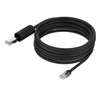
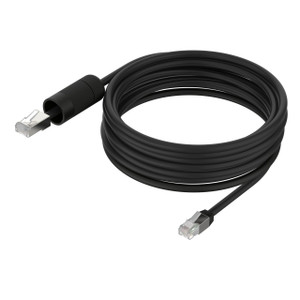
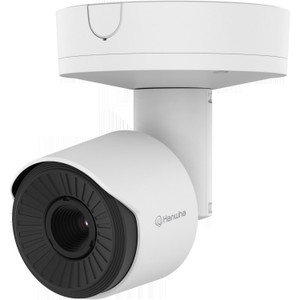
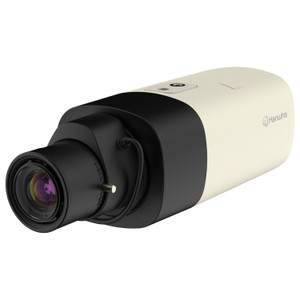
Hanwha SCL-150 Extension Cable for Remote Head Lens
The SCL-150 is a 15-meter extension cable purpose-built to connect remote head lens assemblies to compatible Hanwha camera bodies across longer installation distances. In surveillance deployments where the lens and camera body must be separated — to hide the body in a junction box or mount the lens discretely on a building façade — signal degradation over standard runs becomes a real problem. This cable solves that by maintaining signal fidelity across its full 15-meter (49.2-foot) span without requiring amplification or repeaters, which keeps the installation simpler and reduces latency.
Key Features
- 15-meter reach (49.2 feet): Grants you true flexibility in component placement. You can separate the lens from the camera body far enough to hide infrastructure or optimize sight lines — critical in retail or corporate environments where visible equipment is undesirable.
- Compatible with Hanwha Hanwha IP cameras remote head lens assemblies: Works with PNM-9000QB and SLA-T series lenses. Verify your specific lens model against the Hanwha catalog before ordering to avoid integration surprises.
- High-quality signal transmission: The cable is engineered specifically for extended runs, meaning you won't see the signal degradation, dropouts, or intermittent connection loss that undersized or generic cables introduce over 15 meters. This matters on 24/7 surveillance — a disconnection in the middle of an incident is worse than no camera at all.
- Plug-and-play design with secure connections: No soldering, no crimping, no field-assembly headaches. Connection is immediate and reliable across thermal cycles and vibration — relevant if this is mounted on or near HVAC ducts, machinery, or exterior walls subject to temperature swings.
- Professional-grade construction: Built to withstand demanding surveillance environments — whether that's direct sunlight, humidity, temperature extremes, or occasional physical stress. This is not consumer-grade cable; it's rated for continuous outdoor or industrial deployment.
- Supports remote head lens deployments at scale: In multi-camera retail, warehouse, or perimeter installations, the ability to run a single extended cable from a hidden body to a remote lens head means fewer visible junction boxes, cleaner aesthetics, and easier future moves/changes.
Integration & Compatibility
The SCL-150 is purpose-designed for extension cables and connectivity solutions within the Hanwha PNM-9000QB and SLA-T remote head lens family. Do not assume compatibility with other Hanwha camera lines or third-party lenses — remote head connectors are proprietary, and using an incompatible cable will either fail to seat or, worse, seat partially and introduce intermittent faults that are difficult to diagnose in the field. Confirm your lens model against the Hanwha documentation before deployment.
This cable is a passive component — it carries power and control signals to the remote head and returns video to the camera body. It does not perform any signal conversion, encoding, or amplification. If you require longer distances than 15 meters, consult Hanwha application engineering; running additional cables in series or using repeaters is not a supported configuration.
Deployment Scenarios
The SCL-150 excels in retail surveillance where the camera body fits in a ceiling cavity or equipment room and the remote lens mounts on a discrete pendant or wall fixture — achieving full coverage without visible infrastructure. Likewise, in perimeter security or facility surveillance, you can position the lens at the optimal vantage point (eaves, pole, building corner) while the powered camera body and network connection sit in a protected enclosure 15 meters away. Warehouse automation integrators benefit from this flexibility when coordinating camera placement with dock doors, conveyor layouts, or high-bay storage where moving the body 15+ meters from the lens avoids cable clutter and structural interference.
Frequently Asked Questions
Q: Is the SCL-150 compatible with all Hanwha cameras?
A: No. The SCL-150 is designed specifically for Hanwha PNM-9000QB and SLA-T series remote head lenses. It will not work with fixed-lens or standard motorized lens cameras. Verify your lens model in the Hanwha documentation before ordering.
Q: Can I use multiple SCL-150 cables daisy-chained to extend beyond 15 meters?
A: Not as a supported configuration. Hanwha does not document or warranty daisy-chaining. If you require longer distances, contact Hanwha application engineering for guidance; alternative solutions or extended cable variants may be available.
Q: What happens if the cable is run alongside power lines or in electrically noisy environments?
A: The cable is engineered for professional surveillance installations, but like all low-voltage control and video cables, it benefits from separation from high-voltage AC runs. If physical separation is impossible, conduit or shielded routing is recommended to minimize EMI-induced artifacts.
Q: Is the SCL-150 rated for outdoor use?
A: The cable itself is professional-grade and rated for demanding environments. However, if it will be exposed to direct sunlight, rain, or UV, route it through conduit or UV-rated cable protection to extend service life. The connectors are designed for secure seating but are not sealed against direct water immersion — protect connection points from pooling water.
Q: What is the warranty on the SCL-150?
A: Consult Hanwha's standard accessory warranty documentation or your specialty distributor for warranty terms specific to this cable.
Q: Does the cable carry power to the remote head, or is separate power required?
A: The SCL-150 carries both control signals and power to the remote head lens assembly from the camera body. No additional power connection is required at the lens end, simplifying the installation.
Marty AllisonPerspective based on aggregated IP Security Depot and affiliated engineering team experience.
The Hanwha SCL-150 solves a specific installation constraint: separating the lens from the camera body by up to 15 meters without introducing signal loss or control lag. In practice, this means you can hide a powered camera body in a junction box or equipment closet while running the remote head lens out to your optimal vantage point — eaves, poles, façade corners — without visible cable runs or bulk. That 15-meter reach is exactly what retail and warehouse deployments need to clear structural obstacles and maintain clean sight lines.
Technical Highlights:
- 15-meter extended run (49.2 feet): Spans typical installation distances — floor to ceiling, building edge to interior junction — without requiring amplification or repeaters, which keeps latency flat and integration simple.
- Integrated power and control: The cable carries both supply voltage and signaling to the remote head, eliminating the need for a separate power connection at the lens end. One connection point is one fewer failure point in a 24/7 deployment.
- Proprietary connector design: Engineered specifically for Hanwha PNM-9000QB and SLA-T lenses, so compatibility is binary — works or doesn't. No guessing or field improvisation.
Deployment Considerations:
- Compatibility is non-negotiable: The SCL-150 will not work with other Hanwha camera lines or third-party lenses. Confirm your remote head lens model before ordering — wrong connector type wastes time and creates field stress.
- 15 meters is the design limit: Daisy-chaining cables or running longer distances is not a supported configuration. If your installation geometry requires more than 15 meters of separation, escalate to Hanwha application engineering before committing to a design.
- Environmental protection is your responsibility: The cable itself is professional-grade, but connectors are not sealed against water pooling. In outdoor or high-humidity installations, route connectors through conduit or weatherproof enclosures.
The SCL-150 is best positioned for retail surveillance, warehouse facility monitoring, and perimeter security where the installation geometry naturally separates the lens location from the powered camera body. If your layout doesn't require that separation, a fixed-position standard lens camera eliminates one connection point and one source of field troubleshooting. For integrators, this cable is a deployment accelerator — it simplifies the mechanical and electrical layout when remote head placement is already specified.