
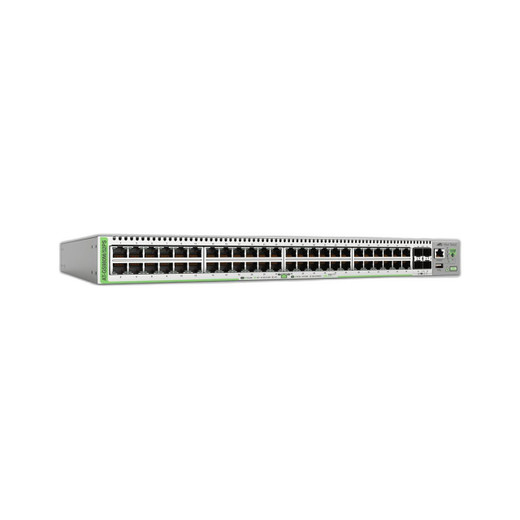


Product images are provided for reference and may not represent the exact model, configuration, or included
components.
Overview
SKU:
AT-GS980M/52PS-10
UPC:
90849688022132
Condition:
New
Availability:
Backorder Available — Contact for ETA

Hanwha AT-GS980M/52PS-10 48-Port Gigabit PoE+ Switch
Hanwha AT-GS980M/52PS-10 48-Port Gigabit PoE+ Switch The Hanwha AT-GS980M/52PS-10 is a high-performance managed Gigabit Ethernet switch purpose-built…
Hanwha AT-GS980M/52PS-10 48-Port Gigabit PoE+ Switch
$99,999.99
Your recommended setup
Review items below — quantities update pricing automatically.
Item
Qty
Status
Price
Optional Add-Ons recommended
Services optional
Bundle Summary
Bundle Subtotal:
$0.00
Optional Add-Ons:
$0.00
Services:
$0.00
Total:
$0.00
Overview
SKU:
AT-GS980M/52PS-10
UPC:
90849688022132
Condition:
New
Availability:
Backorder Available — Contact for ETA
Description

Hanwha AT-GS980M/52PS-10 48-Port Gigabit PoE+ Switch
The Hanwha AT-GS980M/52PS-10 is a high-performance managed Gigabit Ethernet switch purpose-built for enterprise security and networked device deployments. With 48 Gigabit Ethernet ports and 4 SFP uplink ports, this 1RU rack-mount switch combines exceptional port density with robust Power over Ethernet (PoE+) delivery—capable of powering up to 48 IP cameras, wireless access points, and networked security devices simultaneously.
Key Features
- 48 x 10/100/1000T Gigabit Ethernet PoE+ ports
- 4 x 100/1000X SFP ports for uplink redundancy and extended reach
- 740W maximum PoE power delivery (48 ports @ 15W or 24 ports @ 30W PoE+)
- 104Gbps switching fabric with 77.4Mpps forwarding rate
- 1RU compact rack-mount form factor (441 x 359 x 44 mm)
- Low operational noise at 42 dBA
- Managed switch with enterprise-grade VLAN, QoS, and security features
- Maximum power consumption: 909W
Technical Highlights
This switch is engineered for medium to large enterprise network deployments requiring centralized power distribution and high throughput. The 104Gbps switching fabric and 77.4Mpps forwarding rate minimize latency and packet loss, ensuring reliable performance for bandwidth-intensive surveillance, access control, and IoT applications.
Power delivery is intelligently distributed across all 52 PoE-enabled ports with a total budget of 740W. This flexibility allows operators to choose between standard PoE (15W per port across all 48 ports) or PoE+ (30W per port across 24 ports), optimizing deployment scenarios for IP cameras, 802.11ac wireless access points, and powered security devices.
Four SFP uplink ports provide critical redundancy and extended connectivity options, enabling seamless integration with core switch infrastructure or multi-switch deployments across geographically distributed facilities. This architecture reduces single points of failure and supports network scalability.
Applications
- Large-scale IP video surveillance systems (40+ cameras)
- Enterprise access control and door lock installations
- Wireless network backbone for distributed AP deployments
- Campus and multi-building network consolidation
- Data center and server room switching
James Everett
The AT-GS980M/52PS-10 addresses a critical gap in enterprise security infrastructure: the need for high-port-count PoE delivery without sacrificing switching performance. Its 740W PoE budget is substantial but realistic—a typical 4MP IP camera consumes 10–15W, making this switch suitable for 48–70 mixed devices depending on power profiles. The dual PoE mode (15W standard or 30W+) provides genuine flexibility for mixed environments combining fixed cameras, PTZ units, and powered accessories.
The 1RU profile and modest 5.8kg weight make it ideal for existing rack deployments, while 42 dBA noise levels keep it suitable for equipment rooms with passive cooling. Four SFP uplinks are often underestimated in value—they enable non-blocking uplink capacity and redundancy that prevent the switch from becoming a bottleneck as camera count scales. For IT teams managing 50+ networked devices, this switch reduces complexity by consolidating power and switching, lowering total cost of ownership compared to separate PoE injectors or smaller switches chained together.
Specifications
10/100/1000T (RJ-45) COPPER PORTS:
48
100/1000X SFP PORTS:
4
TOTAL PORTS:
48
POE ENABLED PORTS:
52
SWITCHING FABRIC:
104Gbps
FORWARDING RATE:
77.4Mpps
WIDTH X DEPTH X HEIGHT:
441 x 359 x 44 mm (17.36 x 14.13 x 1.73 in)
Mount Type:
1RU Rack-mount
Weight:
5.8 kg (12.79 lbs)
PACKAGED DIMENSIONS:
575 x 520 x 150 mm (22.64 x 20.47 x 5.90 in)
NOISE:
42 dBA
MAX POWER CONSUMPTION:
909W
MAX HEAT DISSIPATION:
3102 BTU/h
MAX POE POWER:
740W
MAX POE PORTS AT 15W PER PORT:
48
MAX POE+ PORTS AT 30W PER PORT:
24
Have Questions?
Ask an Expert.
RELATED PRODUCTS




System Design, Deployment & Technical Support
Support services and planning resources for commercial surveillance, access control, and infrastructure deployments.
Fixed scope • Fixed price
System Design Assistance
- Get help validating product compatibility
- Coverage requirements
- Storage planning and deployment architecture before you buy.
Deployment & Configuration Support
- Access fixed-scope support for rollout planning
- User setup guidance
- Migration and system standardization across single-site or multi-site deployments
Guides, Tools & Calculators
- PoE requirements
- Storage retention
- Camera selection and deployment methodology