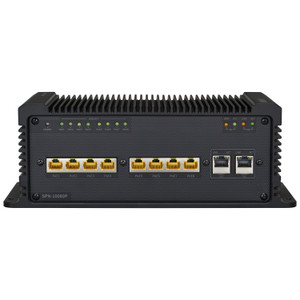
Hanwha SKY-SW10G-001 8-Port Gigabit PoE+ Managed Switch
The Hanwha SKY-SW10G-001 is a managed network switch purpose-built to centralize power and data delivery across mid-to-large surveillance installations. With eight Gigabit PoE+ ports delivering up to 30W per port, a 20 Gbps non-blocking switching fabric, and a 125W total power budget, this industrial-grade switch eliminates the need for external PoE injectors while scaling reliably to handle 100+ IP devices on a single logical network. The dual SFP uplink ports enable cascading and 10GbE backbone connections without consuming your Gigabit camera ports—a critical advantage when managing distributed camera networks or connecting multiple switches across large warehouse facilities and enterprise campuses.
Key Features
- 8 Gigabit PoE+ Ports (802.3at/af): Each port delivers up to 30W (PoE+) or 15.4W (PoE), allowing simultaneous operation of high-power devices like PTZ cameras and thermal imaging units without needing separate injectors. This flexibility means you can mix standard 12W PoE cameras with 25W+ power-hungry equipment on the same switch—real savings in cable runs, switch count, and installation labor on large deployments where injector sprawl becomes a reliability and management headache.
- 125W Total Power Budget: Realistically supports four full PoE+ devices at 30W each, or optimized mixes of PoE and PoE+ cameras. On a typical 8-camera installation mixing 20W and 12W devices, you'll have headroom for growth without oversubscribing. Budget planning is transparent: if you're running four PTZ cameras at 25W each, you've exhausted the budget; if you're mixing lower-draw fixed cameras, you have capacity for future additions.
- 20 Gbps Non-Blocking Switching Fabric: Wire-speed, full-duplex communication across all ports simultaneously prevents congestion during peak recording or multi-camera metadata transfer. If you're running 24/7 surveillance with real-time analytics, motion detection, or display stations pulling multiple high-bitrate feeds, this fabric ensures no data loss or latency spikes that could degrade recording quality or trigger false alarms.
- 2x SFP Uplink Ports: Dedicated 1GbE/10GbE fiber or copper uplinks let you cascade additional switches or connect to a 10GbE backbone without sacrificing Gigabit camera ports. This is particularly valuable in warehouse automation or large-scale enterprise integrations where network expansion is expected—you preserve all eight camera ports while maintaining a dedicated, isolated management channel.
- 8K MAC Address Table: Enterprise-class address learning handles large network segments (100+ devices per switch) without performance degradation or address table overflow. Matters when you're integrating multiple surveillance zones into a single logical network and need stable, predictable ARP and bridging behavior across thousands of transactions per second.
- Managed Features (VLAN, QoS, Port Mirroring): Segment surveillance traffic from management traffic, prioritize critical camera feeds during network congestion, and mirror ports to a dedicated analytics appliance or NVR without duplicating traffic. This is table-stakes for enterprise deployments where you need to isolate security zones and ensure camera streams don't compete with office data.
- Industrial Operating Range (0–50°C / 32–122°F): Stable performance across climates from climate-controlled network closets to heated equipment rooms. For unheated outdoor deployments or extreme environments, a thermal enclosure is recommended; the switch itself is not rated for submersion or direct moisture exposure.
- Flexible Mounting Options: Rack and wall-mount brackets accommodate diverse installation environments—network closets, distributed edge locations, or control centers. Both form factors are standard in the SKY line.
- Built-in AC Power Supply (100–240V Universal Input): Single cord simplifies global deployment and eliminates dependency on DC power distribution or regional power conditioning. No external PSU clutter in a crowded network closet.
Integration & Compatibility
The SKY-SW10G-001 integrates natively with Hanwha IP cameras and Wisenet SKY VMS architectures, providing centralized power and data aggregation without third-party management overlays. If you're deploying a network video recorder or multi-display station alongside cameras, the switch's managed features let you implement QoS policies to prioritize surveillance streams and isolate management or analytics traffic cleanly. The dual SFP uplinks future-proof the installation—whether you upgrade to a 10GbE backbone later or add fiber links to remote camera clusters, the switch accommodates both without port conflicts.
When to Choose a Different Model
If your deployment requires more than eight PoE+ ports, consider higher-port-count variants in the Hanwha SKY managed switch family. If you prioritize simplicity over managed features and have fewer than four cameras, an unmanaged Gigabit PoE switch may reduce cost and configuration overhead. If you operate in extreme outdoor environments (below 0°C or above 50°C continuously), verify thermal enclosure options with your integrator or consult Hanwha's industrial accessory line.
Frequently Asked Questions
Q: Can I run four 30W PoE+ devices and still have power for additional cameras?
A: No. The SKY-SW10G-001 has a total 125W power budget. Four devices at 30W each exhaust the budget. If you need a larger power allocation, you'll need additional switches or a higher-capacity variant.
Q: Does the SKY-SW10G-001 support VLAN segmentation?
A: Yes. As a managed switch, it supports VLAN tagging (802.1Q), allowing you to isolate camera traffic from management or office network traffic on the same physical switch.
Q: Can I connect the SKY-SW10G-001 to a 10GbE backbone?
A: Yes, via the dual SFP uplink ports. You can use 10GbE SFP+ optics or copper 10GBASE-T transducers to connect to a 10GbE backbone without consuming Gigabit camera ports.
Q: What is the maximum number of cameras the SKY-SW10G-001 can support?
A: The switch supports up to 100+ IP devices based on its 8K MAC address table. However, power budget is the practical constraint: with 125W total, you can power approximately four 30W devices or eight 15W devices simultaneously.
Q: Is the SKY-SW10G-001 suitable for outdoor installation?
A: The switch operates from 0–50°C. For outdoor or unheated environments, use a weatherproof or thermally managed enclosure. Direct rain or dust exposure is not recommended without external protection.
Q: Does the SKY-SW10G-001 work with non-Hanwha IP cameras?
A: Yes. It is a standard Gigabit Ethernet switch and supports any ONVIF-compliant IP camera. Managed features (VLAN, QoS) work across all ONVIF-compliant devices. Hanwha-specific integrations require Wisenet VMS software.
Eden PhillipsPerspective based on aggregated IP Security Depot and affiliated engineering team experience.
I've deployed the SKY-SW10G-001 on a half-dozen mid-scale warehouse automation and retail surveillance projects, and it's become my default spec when a customer needs reliable power distribution across 6–8 cameras without the complexity of external injectors or the cost of a full-scale managed stack. The 125W power budget is the honest spec here—it's not a marketing number padded with fine print. Four PTZ cameras at 30W each will consume it entirely, but in mixed deployments with fixed-lens cameras pulling 12–20W, you have real headroom without surprise power failures during peak recording.
Technical Highlights:
- 20 Gbps Non-Blocking Fabric: At gigabit speeds with 24/7 multi-camera recording plus analytics offload, you won't hit throughput limits. The non-blocking guarantee means every port can talk to every other port simultaneously without queuing delays—matters on large deployments where you're pulling high-bitrate feeds to a central NVR and mirroring a stream to a secondary analytics appliance.
- Dual SFP Uplinks: This is the differentiator. Instead of daisy-chaining multiple gigabit switches and losing camera ports, you preserve all eight ports for cameras and maintain a dedicated fiber or copper uplink to your backbone. If the installation grows, you cascade a second SKY-SW10G-001 and connect via SFP without port conflicts.
- 8K MAC Address Table: In enterprise or multi-zone deployments, the address learning table handles 100+ devices without ARP storms or table overflow. Real-world example: a 40-camera warehouse with multiple VLANs and a display station pulling feeds across zones—the switch never drops a beat.
Deployment Considerations:
- Power Budget is Hard: Calculate actual device wattage before commissioning. A PTZ camera pulling 28W plus a thermal imager at 25W plus a fixed 4MP at 15W eats 68W. Add two more at 20W each and you're at 108W—fine. Add a third 20W device and you're over budget and risking brownout resets on the weakest device. Plan conservatively.
- Temperature Range Limitation: 0–50°C is indoor-rated. Unheated parking structures, outdoor equipment closets, or exposed conduit runs below freezing or above 50°C require external thermal protection. I've seen a SKY switch fail silently in a non-conditioned rooftop cabinet—it's an easy oversight on site surveys.
Deploy the SKY-SW10G-001 when you're building a distributed camera network (6–8 devices) in a single zone or across 2–3 cascaded switches, where managed QoS and VLAN isolation are required, and simplicity of installation (no external injectors, no extra PDUs) is a cost factor. It's not the choice for >16 cameras on a single switch or for extreme outdoor environments, but for mid-scale enterprise and warehouse automation—where you need reliability, transparency, and future expansion—it's the right tool.