
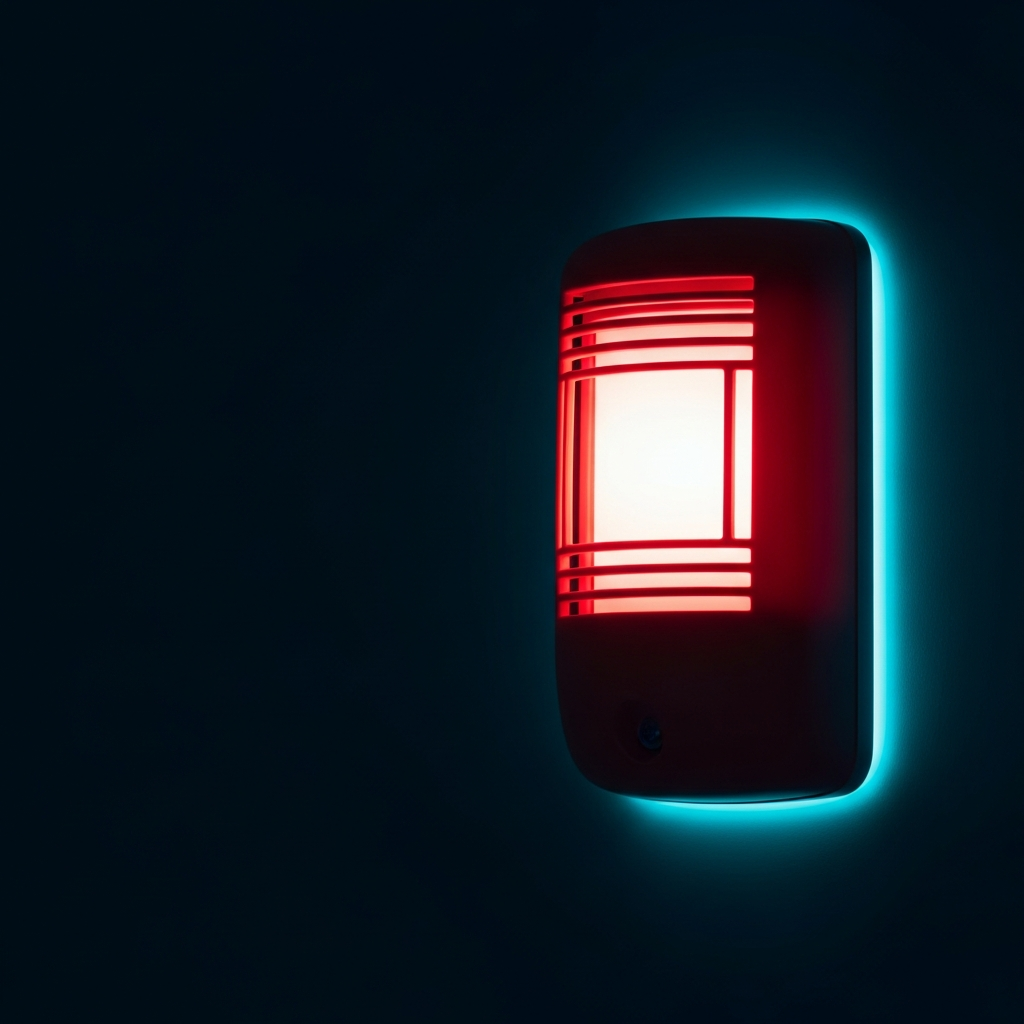
Notification Appliance Selection Guide
Horn vs strobe vs speaker vs combo. UL 1971 / 1480 / 2572, candela math, and ADA placement.
Key takeaways
- Strobe candela is the load-bearing spec - too low and the strobe doesn't cover the room.
- UL 1971 covers visual signaling; UL 1480 covers speakers; UL 2572 covers mass notification appliances.
- Pillow audibility (75 dBA at the pillow with door closed) drives sleeping-area design.
- Synchronize all strobes within view within 0.1 sec to meet anti-seizure requirements (NFPA 72 18.5.4.4).
- Voice speakers are sized for intelligibility (0.70 STI target), not just loudness.
In this guide
Appliance types
| Type | Provides | Typical use | UL listing |
|---|---|---|---|
| Horn | Audible tone (Temporal-3, T-3) | Audible-only zones | UL 464 |
| Strobe | Visual flash (xenon) | Visual-only or supplement to audible | UL 1971 |
| Horn-strobe combo | Both, single backbox | Most common in commercial | UL 464 + UL 1971 |
| Chime-strobe | Voice-tone chime + strobe | Schools, hospitals - less startling | UL 464 + UL 1971 |
| Speaker | Voice announcement | Voice evac, mass notification | UL 1480 |
| Speaker-strobe combo | Voice + visual | Voice evac systems | UL 1480 + UL 1971 |
| Low-frequency horn | 520 Hz tone (better arousal) | Sleeping areas - hotels, dorms | UL 464 |
| Mass notification appliance | Multi-message voice + visual | ECS deployments | UL 2572 |
2-wire vs 4-wire
- 2-wire combo shares wiring for horn and strobe - simpler install, less capability (must activate both together).
- 4-wire combo has separate horn and strobe circuits - allows visual-only or audible-only operation, common in voice evac retrofits.
UL listings reference
| Listing | Scope | Why it matters |
|---|---|---|
| UL 464 | Audible Signaling Devices | Horns and bells. Establishes dBA at 10 ft rating. |
| UL 1480 | Speakers for Fire Alarm, Emergency, and Commercial Signaling Systems | Voice evac and ECS speakers. Power ratings (tap), frequency response, intelligibility. |
| UL 1638 | Visual Signaling Appliances - Private Mode | Strobes for non-fire / private mode (older listing). |
| UL 1971 | Signaling Devices for the Hearing Impaired | Strobes for fire alarm. Candela ratings, flash rate, synchronization. |
| UL 2572 | Mass Notification Systems | ECS appliances. Multi-message, prioritization, integration with fire. |
| UL 268 | Smoke Detectors for Fire Alarm Systems | Initiating device listing - paired context. |
Candela coverage math
NFPA 72 Table 18.5.5.5.1 specifies minimum candela for a single wall-mounted strobe based on room dimensions. The strobe must be sized so that everyone in the room can see the flash regardless of body position.
| Room dim (ft) | Wall-mount cd (1 device) | Wall-mount cd (2 devices, opp walls) | Ceiling-mount cd |
|---|---|---|---|
| 20 x 20 | 15 | 15 | 30 |
| 30 x 30 | 30 | 15 | 60 |
| 40 x 40 | 60 | 30 | 115 |
| 50 x 50 | 95 | 30 | 177 |
| 60 x 60 | 135 | 60 | 234 |
| 70 x 70 | 185 | 95 | Use multiple ceiling devices |
| 80 x 80 | 240+ | 135 | Multiple devices |
| 90 x 90 | Use multiple devices | 185 | Multiple devices |
Standard candela ratings
- Single-setting strobes: 15, 30, 75, 110, 135, 185 cd (multi-cd field-selectable common: 15/30/75/110/135/185)
- Higher candela for outdoor / dim ambient: 75 cd is the common minimum outdoors
- Hallway / corridor: strobes spaced max 100 ft on-center; first device within 50 ft of either end
Synchronization
Strobes within view must flash within 0.1 sec of each other to prevent inducing seizures (NFPA 72 18.5.4.4). Synchronization is achieved by:
- Same-circuit appliances with built-in sync (System Sensor SpectrAlert Advance, Wheelock E-series)
- Sync module at the NAC output (Honeywell DNI, Potter sync) - all strobes synced from upstream
- Addressable strobes synchronized through the panel SLC (Bosch FNI, Honeywell Notifier IDC)
Audibility math
Horn / speaker output decreases 6 dBA per doubling of distance (free field). In rooms with absorptive surfaces, real-world drop is closer to 4-5 dBA per doubling.
Required dBA by occupancy
| Occupancy | Target dBA | Measurement |
|---|---|---|
| Office / retail / general public | 15 dBA above ambient (or 75 dBA total) | 5 ft above floor |
| Sleeping areas (hotel, dorm) | 75 dBA at the pillow | Pillow position with door closed |
| Industrial / mechanical | 10 dBA above 60-sec peak | At the listener position |
| Hospital (general) | 10 dBA above ambient minimum | 5 ft above floor |
| Hospital (patient sleeping) | 15 dBA above ambient, voice intelligibility 0.70 STI | Pillow / nurse station |
Low-frequency horns
UL 464-listed 520 Hz low-frequency horns are required for sleeping areas because the lower tone wakes adults 95%+ of the time (vs 60-70% for the standard high-frequency horn). System Sensor SpectrAlert Advance L-series, Wheelock LH-series are working products.
ADA placement rules
- Wall-mount strobe: top of lens 80-96 inches above floor (ADA + NFPA 72 18.5.5.6)
- Wall-mount horn/speaker: 80-96 inches above floor (consistent with strobe)
- Manual pull stations: 42-48 inches above floor
- Reach to operate: 5 lbf maximum force, single-hand operation
- Visual contrast: red color on light backgrounds, white text on red
Brand comparison
| Brand | Product family | Notable for |
|---|---|---|
| System Sensor | SpectrAlert Advance | Industry standard for notification - broad NAC panel compatibility, multi-candela, low-frequency option |
| Wheelock (Cooper) | E-series, ET-series, LH-series | Long-standing line, broad commercial install base, ECS-ready |
| Potter | SP-series, SH-series, ST-series | 2-wire and 4-wire commercial, value pricing |
| Edwards (UTC) | Genesis, EST3 ECS appliances | Networked ECS, large-campus deployments |
| Bosch | FRS-series speakers, FNI-series strobes | Voice evac and ECS, UL 2572 mass notification |
| Honeywell Notifier / Fire-Lite | NS-series, P-series | Addressable + conventional commercial |
FAQ
Can I use horns alone (no strobes) in commercial?
Only in areas with no expected hearing-impaired occupants and where ADA accommodations are documented. In practice, almost all commercial occupancies require strobes for ADA compliance. Plan for combos.
Why do strobes need synchronization?
Multiple strobes flashing at different rates can trigger photosensitive seizures. NFPA 72 18.5.4.4 requires strobes within view to flash within 0.1 sec of each other, with overall flash rate not exceeding 2 Hz.
Do I need low-frequency horns in all sleeping areas?
For new construction in hotels, dormitories, and similar - yes, per NFPA 72 18.4.5.3 (2010 edition and later). The 520 Hz tone wakes adults reliably; standard 3.1 kHz fire-alarm tones miss roughly 30-40% of sleeping adults.
How do I calculate candela for an L-shaped room?
Break the L into rectangles and treat each rectangle as a separate room. Strobe in each rectangle, sized for that rectangle's max dimension. NFPA 72 18.5.5.5 has specific guidance for non-rectangular shapes.
Why are speakers sometimes specified at 70.7V instead of 25V?
Higher voltage allows longer cable runs with less voltage drop. 70.7V is common for large-area voice evac; 25V for smaller systems. Speakers have transformer taps (1/4W, 1/2W, 1W, 2W) - tap selection sets the actual acoustic output.
What's voice intelligibility STI?
Speech Transmission Index - measures how clearly voice messages will be understood. 0.70 STI is the NFPA 72 target for voice evac; 0.50 absolute floor. Affected by speaker placement, room acoustics, ambient noise, and signal-to-noise ratio. Measured with a calibrated meter post-install.
Notification gear in stock
Channel-direct on System Sensor, Potter, Wheelock. Senior Specialist available.
Browse Fire & Life Safety Panel Guide NFPA 72 Reference