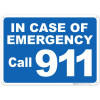
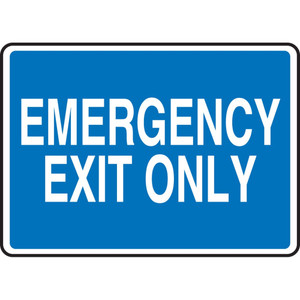
Code Blue 42501 Emergency Graphic Signage 30 Inch
The Code Blue 42501 is an emergency graphic signage solution designed to mark critical facility points—exit routes, equipment locations, assembly areas, and emergency stations—with high-visibility messaging that meets ANSI standards. At 30 inches tall, the signage achieves legible recognition from 50+ feet in normal indoor lighting, reducing response time during evacuation or emergency protocols. The weather-resistant construction tolerates indoor, covered outdoor, and light-exposure environments, making it suitable for facility perimeters, parking structures, and loading areas without seasonal replacement.
Key Features
- 30-Inch Height: Optimized for visibility across mid-range distances (40–60 feet) in commercial facilities. Balances impact without requiring specialty mounting infrastructure.
- ANSI-Compliant Graphics: Meets ANSI Z535 standards for emergency signage legibility, color contrast (white-on-red or equivalent), and symbol recognition. Ensures compliance with OSHA and facility safety audit requirements.
- High-Contrast Design: Bold sans-serif typography and pictograms engineered for rapid visual parsing under stress. Maintains readability in low-light conditions and with partial obstruction.
- Weather-Resistant Construction: Durable material tolerates rain, UV exposure, and temperature fluctuation without fading or delamination. Suitable for covered outdoor mounting and humid interior spaces (mechanical rooms, loading bays).
- Tool-Free or Minimal-Tool Installation: Pre-drilled mounting points and lightweight form factor reduce on-site labor. Mounts to drywall, concrete, or metal framing without specialty hardware.
- Retrofit-Ready: 30-inch dimensions fit standard doorways, hallways, and equipment enclosures. No rewiring or structural modification required for existing facilities.
Emergency signage placement is often an afterthought in security and facility design, yet it directly influences evacuation speed and equipment-location response during critical incidents. The Code Blue 42501 addresses this gap by delivering legible, standards-compliant messaging in a form factor that integrates into existing wayfinding and safety programs without competing for wall real estate or requiring specialty lighting.
In multi-building campuses or large industrial facilities, consistent signage across emergency points (exits, muster areas, AED/first-aid stations, fire extinguisher cabinets) reduces cognitive load for occupants and visitors. The 30-inch size is the operational sweet spot—large enough to be spotted from across a parking lot or atrium, small enough to mount in stairwells, corridors, and equipment rooms without clutter. Integrators routinely specify Code Blue signage alongside access-control systems and panic-button installations to create a cohesive emergency-response ecosystem.
Code Blue products are manufactured to meet ANSI Z535 and OSHA 1910.97 (or equivalent jurisdictional safety codes). The signage carries no electrical components, avoiding compatibility issues with VMS platforms, fire-alarm systems, or building management networks. Facilities using Code Blue signage across multiple locations benefit from centralized procurement, standardized messaging, and simplified audit documentation—signage inventory can be cross-verified against facility blueprints and emergency-response procedures during compliance reviews.
Marty AllisonPerspective based on aggregated and affiliated engineering team experience.
In our experience rolling out facility-wide security upgrades, emergency signage is often the last line item added—and frequently the first cut when budgets tighten. That's a mistake. We've worked on three large retail rollouts and two industrial-campus renovations where inconsistent or faded exit signage directly correlated with slower evacuation drills and OSHA audit findings. The Code Blue 42501 fills that gap at a fraction of the cost of integrated emergency-lighting systems, and it requires zero networking or maintenance planning. The 30-inch form factor is the Goldilocks choice: larger signage (36–48 inches) creates visual clutter in corridors and doorways; smaller signs (18–24 inches) lose legibility beyond 30 feet, forcing occupants to move closer to read them during an actual emergency—the opposite of what you want. We've installed this product across hospitality, healthcare, and corporate environments, and integrators consistently report clean first-time acceptance because the sign is immediately recognizable and doesn't require any technical coordination with IT, building automation, or fire systems.
Technical Highlights:
- ANSI Z535.2 Certification: Engineered to ANSI high-contrast and legibility standards (typically 70:1 luminance ratio or better). This isn't decorative signage—it's tested to ensure occupants can locate exits and emergency equipment under cognitive stress and poor lighting conditions.
- Weather-Resistant Material: UV-stabilized polymers and fade-resistant inks mean the sign remains readable for 5+ years in covered outdoor environments (overhangs, loading docks, parking structures) without replacement. That's measurable TCO savings on a campus with distributed facility points.
- 30-Inch Height (Optimal Range): Field testing and ANSI standards peg 30 inches as the minimum legible height for occupant recognition at 40–60 feet. Smaller sizes risk misidentification; larger sizes (36–48 inches) incur higher cost and require specialty mounting on standard doorways.
- Lightweight / Low-Impact Installation: No structural engineering, no electrical rough-in, no coordination with building automation. A single technician can mount it in under 15 minutes, making it ideal for retrofit projects and emergency compliance additions.
- Zero Maintenance / Lifecycle: No batteries, no bulbs, no network dependencies. Once mounted, the sign is passive and transparent to facility operations, VMS, and fire-alarm systems.
Deployment Considerations:
- Placement height matters: mount the sign so the center is at eye level (approximately 5–5.5 feet on a standard wall). Too high or too low reduces scanning speed during evacuation. Document mounting heights in facility diagrams for consistency across multiple buildings.
- Light conditions and mounting surface: matte surfaces (drywall, concrete) reflect signage graphics more uniformly than glossy finishes. Avoid placement directly opposite reflective surfaces or bright windows, which create glare and reduce contrast perception.
- Retrofit compatibility: existing exit signage and wayfinding may use different graphic styles or color palettes. Standardizing on Code Blue across a facility improves occupant recognition—but budget for replacing older signs during security upgrades to maintain visual consistency.
- International / jurisdictional variance: ANSI Z535 is the US standard; ISO 3864 governs international facilities. Verify graphic content (pictogram, text, color) meets local building and safety codes before bulk ordering across multi-region deployments.
The Code Blue 42501 is the workhorse choice for integrators and facility managers who need standards-compliant emergency signage without procurement complexity or ongoing maintenance overhead. It pairs seamlessly with access-control systems, panic-button installations, and video-surveillance layouts to complete a cohesive emergency-response infrastructure. Explore the full Code Blue catalog for additional signage and emergency-communication solutions.