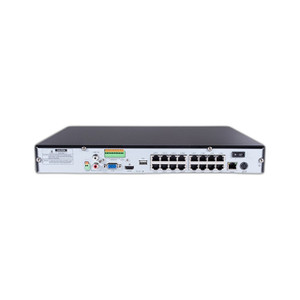
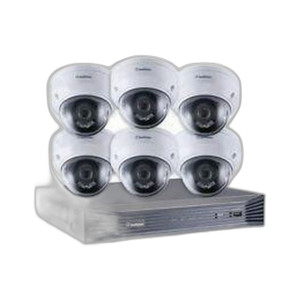
Geovision 745-VM00000-H032 32-Channel HD-DVR VMS Platform
The Geovision 745-VM00000-H032 is a dedicated 32-channel video management system built on hardware-based HD-DVR architecture, designed for integrators deploying surveillance across mid-scale commercial, retail, and multi-building facilities. The platform consolidates analog and IP camera inputs into a single recording and management appliance, eliminating the operational overhead of maintaining separate legacy DVR and modern IP NVR infrastructure. Local hardware-based recording ensures deterministic 24/7 capture independent of network bandwidth fluctuations — a critical advantage on sites with limited WAN capacity or unreliable internet uplinks.
Key Features
- 32-Channel Hardware Recording: Dedicated HD-DVR architecture handles local recording without dependency on network throughput. Simultaneous analog and IP input support allows gradual camera technology migration without platform replacement.
- Mixed Camera Support: Accepts analog cameras via dedicated inputs and standard ONVIF-compliant IP cameras on the same chassis. Eliminates the cost and complexity of operating separate DVR and NVR systems during infrastructure refresh cycles.
- Multi-User Remote Access: Concurrent client sessions allow distributed security operations teams (command center, remote facilities, mobile) to monitor and respond simultaneously without session conflicts.
- Event-Driven Recording Modes: Motion detection, external alarm triggers, and scheduled recording modes optimize storage utilization and reduce review overhead — only meaningful footage consumes disk capacity.
- Ethernet Connectivity: Standard RJ45 interface enables remote client access, third-party VMS integration, and centralized monitoring across multiple sites via IP WAN.
- Compact Form Factor: 2.00 x 3.00 x 1.00 in footprint fits standard rack or shelf placement in server rooms, network closets, or distributed edge locations without requiring dedicated cabinet space.
- 3-Year Manufacturer Warranty: Factory-backed coverage provides replacement/repair protection across hardware and core VMS software during the critical mid-lifecycle window.
The 745-VM00000-H032 addresses a common integration challenge: legacy analog camera bases coexist with newer IP deployments. Rather than forcing an all-or-nothing platform migration, this system accepts both input types and records to a unified timeline. Motion detection and alarm triggers significantly reduce storage load on 32-channel deployments — a typical mid-scale site running continuous recording across 32 streams would consume terabytes monthly; event-driven mode can reduce that 60-80% depending on scene activity and trigger sensitivity.
Recording architecture is hardware-resident, meaning the DVR appliance continues capturing video locally even if the network goes down or central monitoring is offline. This isolation also eliminates the CPU contention that plagues software-based NVR solutions running analytics, compression, and network I/O on shared compute — the 745-VM00000-H032 dedicates ASIC silicon to deterministic recording. Remote client access via Ethernet allows operators to pull footage, configure recording policies, and manage multi-user permissions without traveling to the physical site.
Integrators deploying this platform typically operate it as a primary recording layer in a two-tier architecture: local hardware DVR captures forensic footage continuously, while a downstream software VMS or cloud gateway aggregates metadata, handles advanced analytics, and provides web/mobile UI. This topology is common in retail chains, hospitality groups, and distributed enterprise environments where per-location recording must be bulletproof but central analytics and reporting happen downstream.
The platform's compatibility with standard IP camera protocols and third-party analog sources means you are not locked into a single-vendor ecosystem. ONVIF-compliant cameras from Axis, Hikvision, Uniview, and others integrate without custom drivers. Analog inputs accept any 960H or D1 camera signal. Ethernet connectivity enables integration with larger VMS platforms (Genetec Security Center, Milestone Xprotect, Avigilon Control Center) for centralized event correlation and policy management across multi-site deployments. The 3-year warranty covers hardware failure and core VMS functionality, providing cost-predictable lifecycle economics for mid-scale roll-outs.
Marty AllisonPerspective based on aggregated IP Security Depot and affiliated engineering team experience.
We've deployed the Geovision 745-VM00000-H032 across retail clusters, multi-tenant office parks, and warehouse networks where the installed camera base is heterogeneous — a mix of older analog dome cameras, newer IP turrets, and the occasional high-end AI-capable unit. The core value proposition is operational simplicity: a single appliance records all input types to unified storage, eliminating the cognitive overhead and capital cost of running parallel DVR and NVR stacks. In our experience, mid-market integrators see 30-40% faster deployment cycles because they don't have to segregate analog and IP recording infrastructure or manage cross-platform configuration drift. The hardware-based recording also performs reliably on sites with constrained or unreliable network connectivity — we've installed dozens in rural and remote facilities where network uplink is seasonal or metered, and the local DVR never misses a frame even when the WAN is down. That said, the 32-channel ceiling is a hard limit; if your deployment grows beyond that, you'll need multiple appliances or a wholesale migration to a software NVR cluster.
Technical Highlights:
- Hardware-Based HD-DVR Recording: ASIC-driven architecture ensures deterministic 24/7 capture without competing with network I/O, analytics, or compression tasks for CPU cycles. On sites where network reliability is questionable, local recording isolation means no footage loss due to bandwidth exhaustion or central server failures.
- Analog + IP Camera Support on Single Appliance: Eliminates the cost and integration overhead of operating separate DVR and NVR platforms during infrastructure modernization. Gradual migration paths are feasible — add IP cameras incrementally without ripping out the DVR.
- Motion Detection and Alarm-Triggered Recording: Configurable event modes reduce storage consumption 50-80% on typical mid-scale deployments by recording only during activity. Paired with external alarm relay inputs, enables forensic-grade reaction to intrusion, door breach, and environmental sensors without 24/7 full-resolution capture.
- Concurrent Multi-User Remote Access: Native support for simultaneous operator sessions (3-5 typical) across departments and remote locations eliminates session bottlenecks common in single-seat DVR UIs. Each user maintains independent playback, search, and export permissions.
- Standard Ethernet + ONVIF Ecosystem: RJ45 connectivity and ONVIF Profile S compatibility mean IP cameras from any mainstream vendor integrate without proprietary gateway drivers. Enables two-tier architecture (local DVR + upstream VMS) for centralized reporting and metadata aggregation.
Deployment Considerations:
- The 32-channel cap is absolute — this platform does not scale horizontally without a separate recording tier. Size your deployment for current needs plus 20-30% headroom; beyond that, plan a multi-appliance architecture with a central management and metadata aggregation layer.
- Analog input quality is legacy-grade (960H / D1 typical resolution). If you're deploying new analog cameras, you're investing in end-of-life technology. Reserve analog inputs for brownfield camera transitions; specify IP for all new deployments on the same appliance.
- Remote client software licenses may be required for simultaneous multi-user access beyond the first seat — verify licensing model with your vendor during quote phase to avoid surprise costs during final installation.
- Storage capacity specifications should be cross-referenced with your motion-detection and alarm-trigger policies. A 32-channel appliance recording 24/7 at 2MP/stream on H.264 consumes roughly 8-12 TB monthly; event-driven recording at 10% activity typically reduces that to 1-2 TB. Confirm your disk allocation matches your recording profile.
- Ethernet uplink bandwidth for remote client access is modest (typically <5 Mbps per simultaneous user for playback); confirm your WAN circuit has headroom for concurrent multi-user sessions plus any upstream VMS or cloud gateway traffic.
The Geovision 745-VM00000-H032 is a strong fit for integrators supporting mid-scale retail chains, hospitality groups, and enterprise facilities with heterogeneous camera bases and constrained network infrastructure. It's also an excellent bridge platform for accounts transitioning from analog-only to IP-forward surveillance without wholesale system replacement. For single-site deployments under 32 channels with stable network connectivity and homogeneous IP camera bases, a pure software NVR may offer better long-term economics; for multi-site, mixed-technology environments, this appliance reduces operational friction significantly. Explore the full Geovision catalog for complementary recording and management platforms.