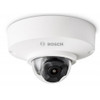
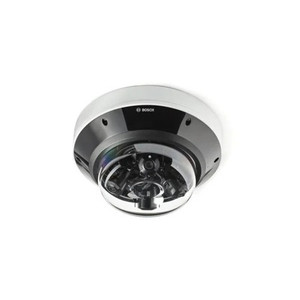
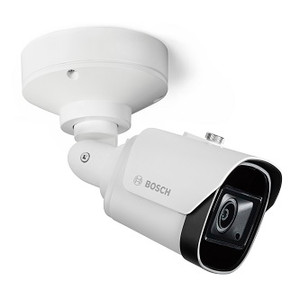
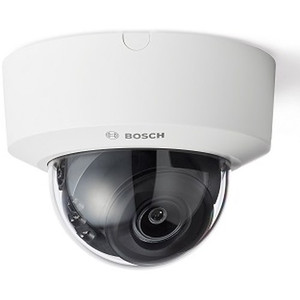
Bosch NDI-3702-A-GOV Fixed Dome 2MP Varifocal IP Camera
Overview
The Bosch NDI-3702-A-GOV is a 1080p fixed dome camera built around a 1/2.8-inch CMOS sensor and a motorized 3.3–10.2mm varifocal lens — the combination that makes it useful across a wide range of government and commercial facility deployments where scene coverage requirements change or aren't locked in at design time. With a horizontal field of view that spans 106° at the wide end down to 31.2° when zoomed in, a single camera can cover an open lobby or tighten up on a doorway without a hardware swap. The NDI-3702-A-GOV pulls under 3W on a standard 802.3af Class 3 PoE port, which means no budget pressure on your switch's power allocation and no supplemental power runs to the ceiling.
The 120dB dynamic range handles the mixed-lighting reality of government building entrances — a sun-lit exterior door next to a dim corridor interior — without the blown-out or crushed zones that compromise evidential value. Auto day/night switching with a 0.06 lx color threshold and 0.016 lx monochrome floor means this camera stays useful in low-ambient-light environments without IR illuminators, which keeps the form factor compact. For installations where local storage is a compliance or continuity requirement, onboard microSD/SDXC support goes up to 2TB — enough for extended retention at 1080p on a single card without relying on network availability.
Key Features
- 3.3–10.2mm Varifocal Lens (F1.6–F3.29): A 3.1x optical zoom range with a 106°–31.2° horizontal field of view gives installers real flexibility at commissioning time. Covering a wide lobby or narrowing to a badge reader at 15 feet is a lens adjustment, not a camera replacement. The F1.6 aperture at the wide end also helps in lower-light conditions where speed matters more than depth of field.
- 1920×1080 at up to 30fps, H.265/HEVC: Full 1080p at 30fps provides smooth motion capture for face and badge-detail use cases. H.265 compression roughly halves the storage and bandwidth footprint compared to H.264 at equivalent quality — meaningful when recording continuously across dozens of cameras in a facility with a fixed NVR or VMS storage budget. MJPEG is also supported for systems that require frame-accurate stills.
- 120dB Wide Dynamic Range: Building entrances, loading docks, and perimeter doors routinely combine direct sunlight and shadowed interiors in the same frame. 120dB WDR is wide enough to pull usable detail from both zones simultaneously — not just a software approximation, but the kind of dynamic range where forensic-quality imagery in a backlit entrance becomes achievable rather than aspirational.
- 0.06 lx Color / 0.016 lx Monochrome Sensitivity: The auto day/night mode transitions based on scene illumination, holding color until 0.06 lx before switching to the 0.016 lx monochrome floor. In practice, this is stairwell- or parking-structure-level ambient light — environments where many cameras have already gone to IR or full black-and-white. Color retention at low lux preserves clothing and vehicle color detail that matters in incident review.
- IEEE 802.3af/at Class 3, 2.1–3W Typical: Drawing between 2.1W typical and 3W maximum, this camera is well within the 15.4W Class 3 budget on any 802.3af switch port. That leaves substantial headroom per port on a 24- or 48-port PoE switch, which is relevant when designing high-density camera floors without upgrading switch infrastructure.
- MicroSD/SDXC Up to 2TB + 5-Second Pre-Alarm Buffer: Onboard storage up to 2TB provides local recording continuity if network connectivity drops — a useful edge-storage fallback in government facilities where network segmentation can isolate cameras from central recorders during incidents. The 5-second pre-alarm recording buffer ensures the moments before a triggered event are captured, not just the event itself.
- 355° Pan / 85° Tilt / 355° Roll Adjustment: Physical repositioning flexibility during installation — pan 0°–355°, tilt 0°–85°, roll 0°–355° — means the camera body can be oriented to match ceiling mount angle without the image being off-axis. This matters in angled ceiling installations or when repositioning for a changed security requirement after initial commissioning.
- 8 Configurable Privacy Masks: Up to 8 privacy masks allow blocking of sensitive or legally protected areas from the video stream — a standard requirement in government facilities, HR areas, medical spaces, or anywhere HIPAA, CIPA, or facility policy restricts continuous video capture of specific zones.
- ONVIF Profile S, G, M, T Conformance: Four ONVIF profiles (S for basic streaming, G for edge storage, M for metadata/analytics, T for advanced streaming) mean this camera integrates into virtually any ONVIF-capable VMS without proprietary drivers. Profile G specifically supports the onboard SD card recording workflow through ONVIF, so the edge storage feature is accessible from compliant VMS platforms without custom integration work.
Integration and Compatibility
The NDI-3702-A-GOV connects over a standard 10/100BASE-T Ethernet interface and draws power from any IEEE 802.3af or 802.3at Type 1 PoE source — no proprietary power requirements. ONVIF conformance across Profile S, G, M, and T covers the broadest range of VMS platforms: Milestone XProtect, Genetec Security Center, Avigilon Control Center, Bosch Video Management System, and any other ONVIF-capable platform can integrate this camera without manufacturer-specific plugins for basic streaming and recording workflows. For deployments using network video recorders with edge-storage failover, Profile G enables SD card recording management directly through the VMS interface. The camera's metadata output (Profile M) supports downstream analytics engines that consume ONVIF metadata streams, useful in larger deployments where centralized analytics processing is preferred over per-camera edge compute. Explore the full Bosch surveillance line for NVRs, encoders, and compatible accessories that extend this camera's capabilities in an integrated system. For structured planning around camera counts, storage retention, and PoE budgets, the camera selection guide covers the key tradeoffs. Pair with a PoE switch sized to your camera count — at 3W max draw per port, a 24-port 802.3af switch handles 24 of these cameras with substantial power budget remaining. For ceiling and wall mounting hardware, see compatible camera mounts and brackets.
Frequently Asked Questions
Q: What VMS platforms are compatible with the NDI-3702-A-GOV?
A: The NDI-3702-A-GOV supports ONVIF Profile S, G, M, and T, which covers the majority of enterprise VMS platforms including Milestone XProtect, Genetec Security Center, Avigilon, and Bosch Video Management System. Any ONVIF-compliant VMS can integrate this camera for basic streaming (Profile S), edge storage management (Profile G), metadata/analytics (Profile M), and advanced streaming (Profile T).
Q: Does the NDI-3702-A-GOV require PoE+ or will a standard PoE switch work?
A: Standard 802.3af PoE is sufficient. The camera draws a maximum of 3W and is classified as Class 3 (budget up to 15.4W on 802.3af), so it runs on any compliant 802.3af or 802.3at port. No PoE+ switch is required, which simplifies infrastructure planning and keeps per-port power costs down.
Q: How much onboard storage does the NDI-3702-A-GOV support?
A: The camera accepts Micro SD, Micro SDHC, and Micro SDXC cards up to 2TB. It also includes a 5-second pre-alarm recording buffer, which captures footage immediately before a triggered alarm event — ensuring the lead-up to an incident is preserved, not just the moment the trigger fires.
Q: What is the field of view range of the NDI-3702-A-GOV?
A: The 3.3–10.2mm varifocal lens provides a horizontal field of view of 106° at the wide end down to 31.2° at maximum zoom, with a vertical field of view of 55.2° to 17.5°. This range makes it suitable for covering wide open areas or focusing tightly on access points and badge readers from the same camera housing.
Q: Can the NDI-3702-A-GOV record locally if the network goes down?
A: Yes. The onboard microSD/SDXC slot (up to 2TB) combined with ONVIF Profile G conformance supports local edge recording independently of network availability. This is useful in deployments where network reliability cannot be guaranteed or where compliance requires local retention as a fallback.
Q: How many privacy masks does the NDI-3702-A-GOV support?
A: Up to 8 configurable privacy masks can be applied to block defined areas of the video stream. This is sufficient for most government and commercial facility requirements where specific zones — HR areas, medical spaces, or legally restricted zones — must be excluded from continuous video capture.
The spec that stands out to me on the NDI-3702-A-GOV isn't the resolution — 1080p is table stakes at this point. It's the 120dB dynamic range combined with a 0.06 lx color sensitivity floor. That pairing is what makes this camera genuinely useful on government building entrances where you're fighting direct sunlight through glass doors at the same time as a dim interior corridor. I've seen plenty of 2MP domes that can do one or the other well but fall apart in the transition zone. The NDI-3702-A-GOV (often searched as NDI 3702 A GOV) handles both without needing supplemental lighting or WDR workarounds in the VMS.
Technical Highlights:
- 120dB Dynamic Range: Wide enough to render usable, forensic-quality detail simultaneously in sunlit and shadowed zones within the same frame — the practical test for any entrance or perimeter door camera in a facility with floor-to-ceiling glass.
- 3W Max PoE Draw (Class 3, 802.3af): At 3W maximum, you're putting minimal load on each switch port. On a 24-port 802.3af switch with a 370W PoE budget, you can run 24 of these cameras and still have 298W of headroom for other devices — no budget pressure, no PoE switch upgrade triggered by this camera alone.
- ONVIF Profile S/G/M/T: Four conformance profiles mean this camera integrates cleanly with any serious VMS without custom drivers, and Profile G specifically enables VMS-managed edge recording to the onboard SD card (up to 2TB) — useful when you need network-independent local continuity as a compliance fallback, not just a nice-to-have.
Deployment Considerations:
- The 10/100BASE-T Ethernet interface is appropriate for 1080p streams but worth noting if your infrastructure is gigabit-only with managed QoS — 100Mbps is the ceiling here, which is fine for video but means the camera won't compete for bandwidth on a congested segment.
- No IR illuminator is specified in the evidence — the camera relies on ambient light and its 0.016 lx monochrome sensitivity rather than active illumination. In environments that go truly dark (below ~0.016 lx), plan for supplemental lighting or select a camera with integrated IR. This is not a dark-room camera.
This is the right fit for a government building interior deployment — lobbies, corridors, stairwells, card reader stations — where the combination of varifocal flexibility, entrance-grade WDR, and sub-3W PoE draw makes it a practical, infrastructure-friendly choice for facilities with dozens of camera positions and fixed PoE switch infrastructure.