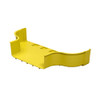
Panduit FRRF2412LYL FiberRunner 24x4 to 12x4 Fiber Routing Reducer
The Panduit FRRF2412LYL is a fiber routing reducer built for data centers and telecom central offices where a 24"x4" FiberRunner channel needs to step down cleanly to a 12"x4" channel or splice. Without a purpose-built fitting like this, field teams improvise transitions with cable ties and cut tray sections — a practice that stresses bend radii, complicates future moves, and fails structured cabling audits. The FRRF2412LYL eliminates that compromise with a factory-formed polycarbonate/ABS fitting that maintains proper fiber routing geometry through the transition.
Overview
The Panduit FiberRunner system is a raceway-based fiber management architecture designed for high-density cable environments where individual fiber strands need protection, bend-radius control, and long-term accessibility. The FRRF2412LYL connects a 24"x4" main trunk to a 12"x4" branch or splice — the kind of transition common at cabinet entries, zone distribution frames, or anywhere the trunk conduit narrows into a distribution run. Yellow coloring follows standard fiber infrastructure convention and makes the transition point immediately identifiable in a fully populated overhead tray system.
Key Features
- 24" to 12" Reducer Geometry: Spans a 25.47" overall width with exits sized for 24" and 12" FiberRunner channels — both measurements confirm a true half-step reduction, not an adapter collar. This means your 12" branch exits with the same full 4" depth as the trunk, preserving fill capacity on the downstream run rather than forcing fibers into a shallower path.
- Polycarbonate/ABS Construction: The combination of polycarbonate's impact resistance and ABS's dimensional stability makes this fitting durable enough for overhead installations where mechanical contact during cable pulls is unavoidable. Neither material corrodes, so it's appropriate in controlled data center environments without additional coating or treatment.
- 4.48" Overall Height: At 113.8 mm tall, the reducer fits within standard overhead cable management clearances. Confirm your ceiling plenum or raised-floor pathway has this vertical clearance before specifying — it's taller than a flat splice plate and needs to be accounted for in tight conduit runs.
- UL Listed per UL 2024: Listed under UL 2024 for fiber optic cable routing assembly — a requirement on many commercial and enterprise projects where the AHJ checks cable management listings during inspection. This listing covers the fitting itself, not just the channel system.
- NEBS Level 3 Compliant (Telcordia GR-63-CORE): NEBS Level 3 is the standard telecom carriers require for equipment deployed in central offices. If you're installing in a carrier-grade CO or a colocation facility with carrier tenants, this compliance is typically non-negotiable. The FRRF2412LYL meets it.
- RoHS Compliant: Meets the EU RoHS directive, relevant for projects with environmental compliance requirements or for systems integrators working across international sites where material declarations are required at handoff.
- Single-Unit Packaging: Ships as an individual fitting — useful for targeted replacements, small-scope additions, or when you need exactly one transition point without committing to a multi-pack. Order quantities to match your actual transition count.
- Yellow Color Coding: Consistent with single-mode fiber convention in many structured cabling standards. In mixed-media tray environments, the yellow immediately distinguishes fiber routing from copper management, reducing mis-termination risk during adds and moves.
Integration & Compatibility
The FRRF2412LYL is engineered specifically for the FiberRunner cable management system and connects FiberRunner 24"x4" channels or splices to FiberRunner 12"x4" channels or splices. It is not a universal tray reducer — it requires FiberRunner-compatible fittings on both the 24" and 12" exit sides. If your installation mixes FiberRunner with open-slot ladder rack or a different raceway brand, verify connector compatibility before ordering. This fitting is designed for telecommunications central offices and data center infrastructure applications where structured fiber management is required rather than ad hoc tray routing. The NEBS Level 3 rating makes it appropriate for carrier-class environments; the UL 2024 listing satisfies most commercial building inspection requirements.
Frequently Asked Questions
Q: What channel sizes does the FRRF2412LYL connect?
A: The FRRF2412LYL connects a FiberRunner 24"x4" channel or splice on one end to a FiberRunner 12"x4" channel or splice on the other end. Both exits maintain the full 4" depth, so fill capacity on the 12" branch is not reduced relative to the trunk depth.
Q: Is the FRRF2412LYL compatible with all FiberRunner raceway sizes?
A: No. This reducer is sized specifically for the 24"x4" to 12"x4" transition. If your installation uses different FiberRunner dimensions (e.g., 12"x4" to 6"x4"), you will need the corresponding reducer fitting for that step-down.
Q: Does the FRRF2412LYL meet NEBS requirements?
A: Yes. It is listed for Telcordia GR-63-CORE NEBS Level 3, which is the benchmark for equipment deployed in telecommunications central offices. It also meets the RoHS directive and is UL listed under UL 2024 for fiber optic cable routing assemblies.
Q: What material is the FRRF2412LYL made from?
A: The fitting is constructed from a polycarbonate/ABS blend. Polycarbonate contributes impact resistance; ABS provides dimensional stability. The combination is appropriate for overhead data center and telecom installations without additional treatment.
Q: How many units come in a package?
A: The FRRF2412LYL ships as a single unit (package quantity of 1). Order the quantity that matches your number of 24"x4" to 12"x4" transition points.
Q: What is the overall height clearance needed for this reducer?
A: The overall height is 4.48 inches (113.8 mm). Verify your overhead pathway or plenum has at least this vertical clearance at every point where the reducer will be installed — it stands taller than a flat splice plate and can be a constraint in low-ceiling environments.
The FRRF2412LYL is a fitting I specify whenever a FiberRunner trunk run needs to branch — the 25.47" overall width tells you this is a genuine geometry reducer, not a collar adapter, and the full 4" depth on both the 24" and 12" exits means you're not sacrificing fill capacity on the branch side. If you're running a high-count single-mode trunk overhead in a carrier CO or a large enterprise data center, this is how you handle the step-down without violating bend-radius requirements.
Technical Highlights:
- NEBS Level 3 (GR-63-CORE): Mandatory for carrier central office installs — this fitting passes the seismic, thermal, and airflow tests carriers require before they'll accept a facility build-out. Don't substitute a non-NEBS fitting and expect the carrier's sign-off.
- UL 2024 Listing: Covers this fitting as a fiber optic cable routing assembly — satisfies AHJ inspection requirements on commercial projects where unlisted cable management components are flagged as a deficiency.
- Polycarbonate/ABS at 4.48" height: The height is the spec most teams overlook. At 113.8 mm, this reducer sits noticeably taller than flat splice plates. In a 6" overhead plenum, that leaves under 40 mm of clearance above the fitting — enough for most installations, but measure before you commit to the routing plan.
Deployment Considerations:
- This fitting is FiberRunner-system-specific. It integrates with FiberRunner channels and splices only — if your upstream or downstream run switches to a different raceway brand or open-slot ladder rack, you need a system-level adapter, not this reducer.
- Yellow coloring aligns with single-mode fiber convention in many cabling standards, but confirm your site's color-coding scheme before ordering — if your project uses yellow for a different service, the color coding benefit inverts into a labeling problem.
For carrier-grade telecom central offices and enterprise data centers running structured FiberRunner trunk-to-branch transitions, the FRRF2412LYL is the correct specified fitting — not a workaround, not a field fabrication. The NEBS Level 3 compliance alone closes the door on carrier objections at final walkthrough.