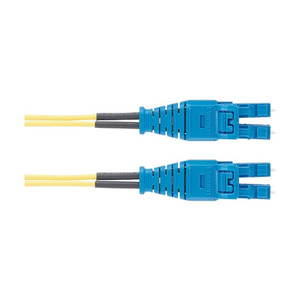
Hubbell HDFHPCLCPRPSM1 Single-Mode Duplex LC Plenum Fiber Patch Cord
Overview
The Hubbell HDFHPCLCPRPSM1 is a 1-meter single-mode duplex fiber optic patch cord designed for plenum-rated structured cabling environments. Terminated with LC push-rod connectors on both ends in a reverse-polarity configuration, it is built for data centers, enterprise backbone runs, and security system head-end closets where the cable pathway crosses air-handling spaces and NEC Article 800 requires OFNP-rated jacket material. The yellow jacket follows the TIA-598 color convention for single-mode fiber, making polarity and fiber-type identification fast during installation and troubleshooting.
Key Features
- Plenum (OFNP) Jacket Rating: The plenum-rated jacket meets the fire and smoke propagation requirements of NEC Article 800 for air-handling spaces. If your cable run passes through a dropped ceiling or raised floor used as an air return, this jacket eliminates the need for conduit — a real labor and materials savings in dense commercial buildouts.
- Single-Mode Fiber: Single-mode glass supports long-distance, high-bandwidth transmission without the modal dispersion limits that constrain multimode. For security and IT infrastructure linking MDF to IDF closets across a campus, single-mode ensures no signal degradation as distances grow — you are not capped at the 300–550m typical of OM3/OM4 multimode.
- Duplex Configuration: Two fibers in a single jacket handle bidirectional transmission in one pull. This is the standard for SFP-based switches, media converters, and fiber-connected NVRs — one cord handles both transmit and receive paths, reducing connector count and cable management clutter at the patch panel.
- LC Push-Rod Connectors: The LC form factor is the dominant choice for high-density fiber panels and SFP ports. Push-rod (also called push-pull or no-tool-release) connectors allow extraction from tight, high-density panels without a release tool — a meaningful advantage when you are working in a fully loaded 24- or 48-port fiber enclosure.
- Reverse Polarity: The HDFHPCLCPRPSM1 ships in a reverse-polarity (also called crossover) configuration, where the fiber positions are swapped end-to-end. This is specifically required when connecting two devices that both transmit on the same fiber position — common when patching between certain SFP transceivers or when correcting polarity without rewiring a permanent link. Confirm your polarity scheme before ordering; using a crossover cord where a straight-through is needed will result in a no-light condition.
- 1-Meter Length: The 1-meter length is optimized for patch panel to active equipment connections within the same rack or adjacent equipment — head-end security racks, distribution switches, and NVR enclosures where longer cords create slack-management problems. For cross-rack runs, evaluate 2- or 3-meter variants in the same family.
- Yellow Jacket — TIA-598 Compliant: Yellow is the TIA-598 standard color designation for single-mode fiber. In a mixed-fiber environment (where both single-mode and multimode cables are present), yellow versus aqua/orange immediately distinguishes fiber type at a glance, reducing mis-patching during moves, adds, and changes.
Integration and Compatibility
This cord terminates with standard LC duplex connectors compatible with LC-type SFP and SFP+ transceivers used in managed switches, media converters, fiber NVRs, and storage systems. The single-mode glass pairs with OS1 and OS2 single-mode transceivers — confirm your active equipment specifies single-mode (typically 1310nm or 1550nm) and not multimode (850nm) before deployment. The reverse-polarity configuration suits specific crossover patching scenarios; review your end-to-end fiber optic cable assembly polarity map before installation. This cord is suitable for use with Hubbell fiber enclosures and patch panels as well as third-party LC-compatible equipment. For switch-side planning, see the network switch category for compatible fiber-uplink models. If you are specifying a full structured cabling system, review the structured cabling category for complementary components including enclosures, adapters, and bulk cable.
Frequently Asked Questions
Q: What does reverse polarity mean on the HDFHPCLCPRPSM1, and when do I need it?
A: Reverse polarity means the two fibers are swapped end-to-end — fiber A at one connector becomes fiber B at the other. You need this when both connected devices transmit on the same fiber position (e.g., Tx on fiber A on both ends). If you are unsure, map your end-to-end polarity before ordering; a crossover cord used where a straight-through is required causes a no-light condition.
Q: Is the HDFHPCLCPRPSM1 compatible with multimode SFP transceivers?
A: No. This is a single-mode fiber cord intended for use with single-mode (OS1/OS2) transceivers operating at 1310nm or 1550nm. Multimode SFPs (typically 850nm VCSEL-based) require OM1/OM2/OM3/OM4 multimode fiber. Connecting single-mode fiber to a multimode transceiver will result in excessive insertion loss and a non-functional link.
Q: Why is the jacket rated plenum, and is it required for my installation?
A: Plenum (OFNP) jacket material meets the fire and low-smoke requirements of NEC Article 800 for cables routed through air-handling spaces such as dropped ceilings and raised floors used as air returns. If your run passes through a plenum air space, OFNP is required by code. For non-plenum pathways (conduit, riser), an OFNR or general-use jacket is acceptable and typically less expensive.
Q: What is the significance of the yellow jacket color?
A: Yellow is the TIA-598 standard color code for single-mode fiber. In facilities with both single-mode and multimode cabling, jacket color is the fastest way to distinguish fiber type at the patch panel, reducing mis-patching during moves, adds, and changes.
Q: Can I use this cord for inter-rack runs longer than 1 meter?
A: The 1-meter length is intended for within-rack or adjacent-rack patching. For cross-rack or cross-room runs, select a longer variant in the same family (2m, 3m, 5m, etc.). Avoid coiling excess length from a longer cord in a 1-meter space — coil-induced bend loss can degrade single-mode performance if bend radius falls below the cable's minimum specification.
The HDFHPCLCPRPSM1 is the cord I reach for when the MDF-to-IDF link has to cross a plenum ceiling and the panel is too dense for anything but LC push-rod connectors. The reverse-polarity configuration is the detail that trips up most installers — before you pull this out of the bag, confirm your polarity map. A crossover where you need straight-through means a dead link and a return trip.
Technical Highlights:
- Plenum (OFNP) Jacket: Code-compliant for air-handling spaces under NEC Article 800 — no conduit required in plenum ceilings, which is a real labor savings in commercial security head-end buildouts.
- LC Push-Rod Termination: No-tool extraction from high-density panels makes this the right connector for 24- and 48-port fiber enclosures where standard LC latches are inaccessible without a release tool.
- Single-Mode Glass, 1-Meter Length: Single-mode supports OS1/OS2 transceivers at 1310nm/1550nm with no distance ceiling imposed by modal dispersion. The 1-meter cut is sized for patch panel to active equipment within the same rack — prevents the slack loops that plague over-length cords in cable management.
Deployment Considerations:
- Verify polarity end-to-end before patching. Reverse-polarity (crossover) cords are needed only when both endpoints transmit on the same fiber position — using this cord in a straight-through polarity scheme will produce a no-light condition with no obvious visual indicator.
- Confirm active equipment is single-mode (OS1/OS2, 1310nm or 1550nm) before ordering. Inserting a single-mode cord into a multimode 850nm VCSEL transceiver results in excessive loss and an unreliable or non-functional link.
This cord is the correct specification for enterprise and commercial security MDF/IDF closets where plenum code compliance, LC panel density, and single-mode backbone infrastructure all converge — particularly in healthcare, education, and government facilities where plenum cable runs are the rule rather than the exception.