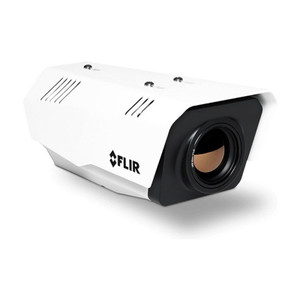
FLIR 427-0089-43-00 Fixed Thermal Security Camera
The FLIR 427-0089-43-00 is a fixed thermal security camera built around an uncooled VOx microbolometer detector, engineered for perimeter and critical-infrastructure sites where visible-light cameras fail once the sun goes down or fog rolls in. Thermal imaging reads heat signatures, not reflected light, so the 427-0089-43-00 detects intruders in total darkness, through smoke, and in glare conditions that blind conventional lenses. With an IP66 enclosure and an operating range of -50°C to 75°C, this is a camera specified for the edge cases other cameras can't handle — Arctic gate lines, desert substations, coastal fence perimeters.
Overview
Thermal detection is a different discipline than pixel-count marketing. The 427-0089-43-00 uses an uncooled VOx (vanadium oxide) microbolometer — the standard detector architecture for commercial thermal security cameras — paired with a thermal sensitivity (NETD) rating of less than 50 mK. That sensitivity figure matters more than most buyers realize: a lower NETD means the sensor resolves smaller temperature differences between a target and its background, which is what actually determines whether a human silhouette separates from a warm wall or a sun-baked fence line at range. Power comes via PoE+ or 24 VAC, giving installers flexibility on sites that already run PoE infrastructure and legacy sites wired for AC.
Key Features
- Uncooled VOx Microbolometer: No cryocooler, no scheduled maintenance cycle, and a lower unit cost than cooled thermal cores — the tradeoff commercial security integrators make deliberately versus military-grade cooled sensors.
- NETD <50 mK thermal sensitivity: Resolves fine temperature deltas, which is what separates a person from background clutter at distance rather than raw resolution alone.
- IP66 environmental rating: Sealed against dust ingress and powerful water jets — direct rain, wash-down, and wind-driven spray won't compromise the housing. Not rated for submersion; skip this unit if the mounting location floods.
- -50°C to 75°C operating range: Certified to run in environments that would shut down a standard IP camera — cold-storage yards, northern perimeter fencing, rooftop units under direct summer sun.
- PoE+ or 24 VAC power input: Run a single PoE+ cable for data and power on new installs, or tie into existing 24 VAC security wiring on retrofit jobs — no forced rewiring.
- ONVIF Profile S conformance: Standardized discovery and streaming means the 427-0089-43-00 integrates with ONVIF Profile S-compliant VMS platforms without a proprietary plugin.
- RTSP streaming: Pull the video stream directly into any RTSP-capable recorder or VMS for architectures that don't rely on ONVIF autodiscovery.
- H.264 compression: Keeps thermal video bitrate manageable on long-haul network links and reduces storage load on the NVR compared to uncompressed thermal feeds.
- NDAA-compliant: Clears Section 889 sourcing requirements for federal, municipal, and critical-infrastructure procurement where non-compliant camera hardware is disqualifying.
Integration & Compatibility
Because the 427-0089-43-00 speaks ONVIF Profile S and RTSP over H.264, it drops into most commercial VMS stacks without custom drivers — plan the integration the same way you would for a standard IP camera onboarding, verifying stream URI and ONVIF credentials during commissioning. For sites layering thermal detection with visible-light coverage, pair this unit with cameras from the broader FLIR camera catalog or browse outdoor IP cameras for a full perimeter build-out. If you're scoping a mixed thermal/visible deployment, the lens and coverage guide is worth reading before finalizing camera counts and placement. Route recorded footage to a compatible network video recorder, and confirm switch port budgets against the PoE+ draw using a PoE planning guide if you're running several thermal units off one closet switch. For search purposes, this model is also referenced as 427-0089-43-00 (often searched as 427 0089 43 00).
Frequently Asked Questions
Q: Is the FLIR 427-0089-43-00 NDAA compliant?
A: Yes, the 427-0089-43-00 is NDAA-compliant, meeting Section 889 sourcing requirements for federal and critical-infrastructure procurement.
Q: What detector type does the 427-0089-43-00 use?
A: It uses an uncooled VOx (vanadium oxide) microbolometer, the standard detector architecture for commercial thermal security cameras.
Q: What is the operating temperature range of the 427-0089-43-00?
A: The camera is rated from -50°C to 75°C, suitable for extreme cold and high-heat outdoor environments.
Q: How is the FLIR 427-0089-43-00 powered?
A: It accepts either PoE+ or 24 VAC power input, giving installers flexibility between PoE infrastructure and legacy AC-wired sites.
Q: What VMS platforms work with the 427-0089-43-00?
A: The camera supports ONVIF Profile S and RTSP streaming over H.264, allowing integration with any ONVIF Profile S-compliant VMS or RTSP-capable recorder.
Q: What is the IP rating on the 427-0089-43-00?
A: IP66, sealed against dust ingress and powerful water jets such as direct rain and wash-down spray.
The 427-0089-43-00 is one of the more straightforward thermal specs I run into: uncooled VOx microbolometer, NETD under 50 mK, IP66, and a -50°C to 75°C operating window. That temperature spread is the number that gets my attention first — it rules this camera in for sites where a standard IP camera's -40°C to 60°C spec sheet just doesn't cut it.
Technical Highlights:
- NETD <50 mK: Sub-50-milliKelvin sensitivity means the sensor separates a warm body from background clutter reliably, which is the actual driver of thermal detection range — not pixel count.
- -50°C to 75°C operating range: A 125-degree Celsius spread that covers Arctic perimeter fencing and desert rooftop mounts without a heater/cooler accessory.
- Dual power input (PoE+ / 24 VAC): Lets you standardize on PoE+ for new builds while dropping straight into existing 24 VAC runs on retrofit jobs — no rewiring budget line needed.
Deployment Considerations:
- ONVIF Profile S plus RTSP/H.264 means commissioning follows the same playbook as any standard ONVIF camera onboarding — verify stream URI and ONVIF credentials during setup.
- IP66 covers rain and wash-down spray but not submersion — confirm mounting height and drainage on flood-prone sites before spec'ing this unit.
I'd put the 427-0089-43-00 on a perimeter fence line for a cold-storage distribution yard or a northern-latitude substation — sites where a visible-light camera's night performance and a standard camera's temperature rating both fall short.